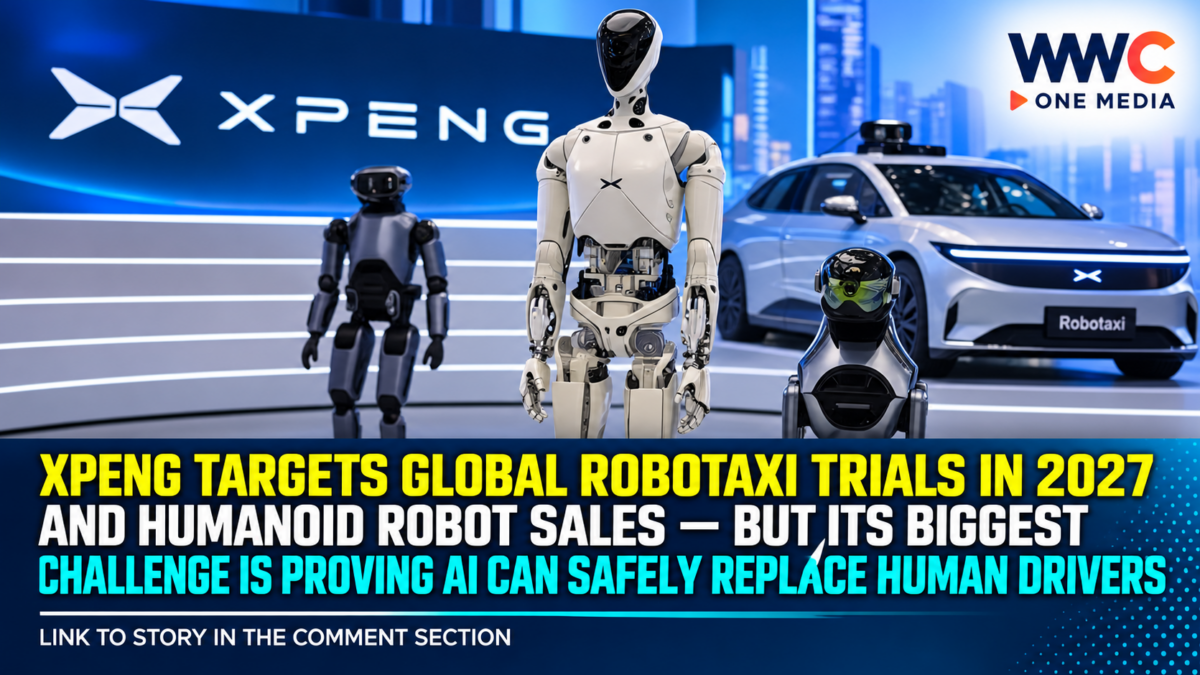
SINGAPORE — Chinese electric vehicle manufacturer XPeng is accelerating its transformation into an artificial intelligence company, with plans to test self-driving taxis in overseas cities in 2027 and begin offering its human-like IRON robots to external customers later that year. Vice-chairman and president Brian Gu believes robotaxis could become more common worldwide within two to three years. But behind the ambitious expansion lies a difficult challenge: proving that AI-powered vehicles can safely navigate unpredictable roads while humanoid robots move beyond demonstrations into commercially useful work.
Chinese technology company XPeng is preparing a major international push beyond traditional electric vehicles.
Speaking to Channel NewsAsia at the Milken Institute Asia Summit in Singapore, company president Brian Gu outlined plans to expand autonomous driving technology outside China, commercialize humanoid robots and develop a broader business built around artificial intelligence.
The strategy marks a significant shift for a company best known for producing electric sedans and sport utility vehicles.
XPeng now wants to compete in three emerging markets: autonomous transportation, humanoid robotics and advanced aerial mobility.
According to Gu, the company hopes to introduce overseas robotaxi pilot programmes in selected cities beginning in 2027.
A wider commercial expansion could follow over the next two to three years.
At the same time, XPeng is preparing to produce larger quantities of its IRON humanoid robot from early 2027, initially deploying the machines in company stores and offices.
External customer sales are targeted for the second half of the year.
Together, the plans underline the growing competition among technology and automotive companies to develop what the industry calls physical AI — artificial intelligence capable of interacting directly with the real world.
XPeng Plans Overseas Robotaxi Trials Starting in 2027
One of the most important announcements concerns XPeng’s international autonomous mobility plans.
Gu said the company intends to begin pilot testing in selected overseas cities next year.
The proposed expansion would move XPeng beyond its current domestic testing operations in Guangzhou.
The executive did not identify which countries or cities are being considered.
That distinction matters.
Although Gu discussed overseas expansion while speaking in Singapore, XPeng has not confirmed Singapore as a robotaxi trial location.
Nor has it announced that commercial driverless taxi services will begin carrying paying passengers across multiple international markets in 2027.
The confirmed plan is to pursue pilot testing in selected global cities.
Any wider deployment would depend on successful technical testing, regulatory approvals and local operating arrangements.
Gu believes larger-scale commercial adoption may become possible within two to three years, placing the potential expansion around 2028 to 2029.
However, this remains the company’s outlook rather than a guaranteed launch schedule.
XPeng’s YOYO Robotaxi Is Already Being Tested in Guangzhou
XPeng’s international ambitions build on its autonomous driving work in China.
The company is testing its robotaxi in Guangzhou, where nearly 100 vehicles are involved in a pilot programme, according to Gu’s interview with CNA.
On October 8, XPeng officially introduced YOYO as the brand name for its robotaxi business.
The company also opened an online registration channel in China for prospective participants using invitation codes.
The registration process represents a step toward broader user testing.
It should not be confused with the launch of unrestricted, citywide commercial robotaxi service.
In its official announcement, XPeng said its autonomous vehicle programme had already progressed through vehicle production, testing and demonstrations of the passenger booking process.
The company produced its first mass-production-designed robotaxi in May 2026.
In July, it demonstrated the process of requesting a vehicle and completing an automated passenger trip.
In August, XPeng secured qualifications for remote testing on approved roads in Guangzhou, including testing without a safety operator in the driver’s seat under specified conditions.
Those developments provide a technical foundation for future commercial trials.
More Than 2,000 Internal Robotaxi Rides Completed
Chinese electric vehicle publication CnEVPost reported that XPeng had completed more than 2,000 internal robotaxi test rides in Guangzhou by August.
The testing involved validating the passenger journey from booking a vehicle to completing a ride.
XPeng also tested payment systems and operational procedures.
The company previously offered internal paid trial rides at a symbolic price of one yuan.
These activities are designed to assess not only autonomous driving but also whether the entire passenger service can function effectively.
A successful robotaxi operation requires vehicles to locate passengers, recognize destinations, handle pickup and drop-off procedures and respond appropriately when unexpected situations arise.
However, 2,000 internal rides are not equivalent to millions of miles of independently validated driverless performance.
The reported figure establishes that XPeng has conducted operational testing.
It does not demonstrate that the company’s vehicles are already safe for unrestricted autonomous service in every city.
The YOYO Robotaxi Uses XPeng’s Own AI Chips
XPeng is placing considerable emphasis on developing technology internally.
The company says its robotaxi platform incorporates four proprietary Turing AI chips.
Together, the chips provide 3,000 trillion operations per second, or TOPS, of computing capacity, according to company specifications.
The platform also uses XPeng’s second-generation Vision-Language-Action system, known as VLA 2.0.
This technology is intended to help the vehicle interpret its surroundings and select driving actions.
XPeng says its system does not depend on high-definition maps or LiDAR sensors.
Instead, it uses a camera-centered approach supported by substantial onboard computing.
The company believes that reducing dependence on specialized maps and certain sensors could make deployment across different cities more flexible.
But computing power is only one part of autonomous driving performance.
The real test is whether the complete system can consistently identify hazards, understand road conditions and make safe decisions under real-world operating conditions.
XPeng’s specifications and architectural claims have not, by themselves, established superiority over competing robotaxi platforms.
Driver Assistance Is Not the Same as a Driverless Taxi
Gu highlighted the growing use of XPeng’s driver-assistance technology.
He said the company’s systems are engaged for nearly 60% of the distance travelled by its vehicles.
This suggests growing customer use of automated driving features.
But driver assistance and fully autonomous operation are fundamentally different.
A driver-assistance system may control acceleration, braking and steering under certain circumstances while requiring human supervision.
A Level 4 autonomous vehicle is designed to operate without a human driver within clearly defined conditions and locations.
The latter presents considerably more demanding safety challenges.
A robotaxi must respond to construction zones, unpredictable pedestrians, unusual road layouts and situations not encountered frequently during training.
Gu acknowledged that these unpredictable situations create a higher threshold for safe autonomous operations.
XPeng’s international expansion will therefore depend on demonstrating that its software can perform reliably beyond familiar test routes.
IRON Humanoid Robot Could Begin Working in XPeng Showrooms
XPeng’s second major initiative involves its humanoid robot, IRON.
The machine is approximately 1.73 metres tall and is designed with human-like proportions and movement.
The company wants to increase production from early 2027.
Initially, XPeng plans to use the robots within its own stores and offices.
Potential responsibilities include greeting visitors, answering questions, explaining products and assisting with simple customer service tasks.
Gu also described the possibility of robots handing bottled water to customers.
These activities provide controlled environments where XPeng can evaluate how humanoid robots perform around employees and visitors.
Retail showrooms are very different from unpredictable industrial or domestic environments.
The initial deployment is therefore better understood as a gradual commercial testing strategy than as proof that humanoid robots are ready to replace large numbers of human workers.
XPeng Targets External IRON Customers in the Second Half of 2027
After deploying IRON internally, XPeng intends to offer the robot to outside customers.
Gu identified the second half of 2027 as the target for this next phase.
The company has not disclosed a final retail price, confirmed external customer list or verified volume of orders associated with this announcement.
Those details will be important when evaluating whether humanoid robotics can become a meaningful business.
Companies developing robots face several commercial challenges.
Manufacturing costs must become manageable.
Robots must operate consistently over extended periods.
Maintenance and technical support must be reliable.
Customers must also determine whether the machines deliver economic benefits compared with existing equipment or human-operated services.
For XPeng, deploying IRON in its own facilities could provide valuable operational data.
The next challenge will be convincing external customers that the same technology is useful and financially viable.
XPeng Wants to Become a Physical AI Company
The robotaxi and humanoid programmes share an underlying strategy.
XPeng is seeking to reuse artificial intelligence capabilities developed for vehicles in other physical machines.
The company believes its AI models, computing architecture and manufacturing experience can support multiple product categories.
This is the basis of its physical AI strategy.
Unlike software systems that primarily generate text, images or digital content, physical AI operates through machines that interact with real environments.
A robotaxi must navigate traffic.
A humanoid robot must recognize objects and move safely around people.
A flying vehicle must satisfy demanding engineering and aviation safety requirements.
All three require integration between software, sensors, computing and mechanical systems.
XPeng believes developing those capabilities within a common technology ecosystem could create competitive advantages.
But the business case remains to be proven.
Success in manufacturing electric vehicles does not automatically guarantee profitable robotaxi or humanoid robot operations.
China’s Fierce Electric Vehicle Competition Is Driving Diversification
The strategic shift comes amid intense competition within China’s automotive industry.
Gu described the domestic market as extremely competitive because of the number of manufacturers competing for customers.
Companies face pressure to develop better technology, control costs and expand internationally.
Reuters reported in April that China’s global electric vehicle expansion has been influenced partly by domestic overcapacity and slowing sales.
Chinese manufacturers are increasingly seeking opportunities abroad while investing in advanced automotive and AI technologies.
For XPeng, the shift toward robotaxis and robotics could create additional sources of revenue beyond vehicle sales.
It could also help differentiate the company from competitors focused mainly on conventional electric cars.
However, diversification carries financial risks.
Advanced autonomous driving systems, humanoid robots and flying vehicles require substantial research and development spending.
Commercial returns may take years to materialize.
Investors will therefore be watching whether XPeng can convert its technological ambitions into sustainable revenue.
XPeng Faces Competition From Tesla and Other Robotaxi Operators
XPeng is entering an increasingly crowded market.
Tesla is pursuing autonomous transportation through its self-driving technology and Cybercab programme.
Other Chinese companies, including Baidu’s Apollo Go and Geely-backed Caocao Mobility, are also developing autonomous ride-hailing services.
Reuters reported that Caocao was preparing large-scale deployment of purpose-built robotaxis in 2027.
Competition is therefore moving beyond prototype demonstrations.
Companies are attempting to build real services that can operate economically and safely.
Different firms are pursuing different technical approaches.
Some rely heavily on LiDAR and detailed mapping.
Others emphasize computer vision and proprietary AI models.
There is no guarantee that one approach will dominate every market.
Success will depend on safety performance, regulatory acceptance, costs and the ability to operate reliably at scale.
XPeng’s Global Plans Depend on Local Regulations
One of the biggest barriers to international robotaxi deployment is regulation.
Autonomous vehicles must comply with the laws and testing requirements of the countries and cities where they operate.
Authorities may impose restrictions involving permitted roads, operating hours, remote supervision and emergency response procedures.
Regulatory frameworks also differ between markets.
Technology approved for one city cannot necessarily be introduced immediately in another.
Companies may need extensive local testing to demonstrate how their vehicles handle different traffic conditions.
For Southeast Asian cities, additional questions could involve motorcycles, mixed road users, congestion and varying road infrastructure.
These are practical issues rather than evidence that autonomous transportation is impossible.
They explain why overseas pilot programmes are a necessary step before full commercial operations.
As of October 11, XPeng has not publicly confirmed the specific overseas cities selected for its proposed 2027 tests.
Flying Cars Form a Third Part of the XPeng Strategy
XPeng is also pursuing flying vehicle technology through its affiliated aerial mobility business.
Reuters reported in April 2026 that the company expected to begin delivering its flying vehicles on a larger scale in 2027, subject to production and regulatory requirements.
The company has said it received more than 7,000 orders for its flying vehicle products.
These plans extend XPeng’s ambitions from roads and customer-service robots into aerial transportation.
However, so-called flying cars are not interchangeable with conventional automobiles.
Their deployment raises separate questions involving aviation certification, airspace rules, pilot requirements, infrastructure and public safety.
Announced orders and planned deliveries should not be treated as evidence of widespread commercial flying-car services.
The programme remains another ambitious component of the company’s longer-term technology strategy.
XPeng’s Expansion Could Reshape Its Global Business
XPeng has also set ambitious international business targets.
In an April Reuters interview, Gu said that overseas markets represented approximately 10% of XPeng’s vehicle sales volume and 15% of revenue in 2025.
He suggested that more than half of the company’s revenue could eventually come from outside China.
The potential timeframe was five to ten years.
That target is separate from the company’s 2027 robotaxi and humanoid robot schedules.
International expansion could create new customers and reduce reliance on China’s highly competitive domestic market.
But it also exposes XPeng to tariffs, regulation, local competition and changing consumer preferences.
The company must demonstrate that it can build effective international distribution and service networks.
For robotaxis, the challenge is more complex because deployment requires local operating partners and ongoing regulatory oversight.
What This Could Mean for Singapore and Southeast Asia
Gu’s comments at the Milken Institute Asia Summit in Singapore highlight the region’s importance to global discussions about advanced mobility.
Southeast Asian markets are experiencing growing interest in electric vehicles, digital services and artificial intelligence.
Robotaxis could eventually become part of urban transportation discussions, especially in cities seeking to improve mobility and address transport costs.
Humanoid robots may also attract interest from retailers, service businesses and industrial operators.
For Singapore, Malaysia, Thailand, Indonesia and the Philippines, the technology raises both opportunities and questions.
Autonomous vehicles could introduce new transport services.
But governments would need to consider passenger safety, insurance, cybersecurity, accessibility and the future of transport-related employment.
It is important not to confuse the location of Gu’s interview with a confirmed market launch.
XPeng has not announced that its YOYO robotaxis will begin operating commercially in Singapore or the Philippines in 2027.
The confirmed international plan is to explore pilot testing in selected cities whose identities remain undisclosed.
The Biggest Challenge: Moving From Demonstrations to Real Businesses
XPeng’s plans are ambitious, but the gap between a working demonstration and a profitable commercial service can be substantial.
A robotaxi must perform safely across millions of changing road situations.
A humanoid robot must operate reliably enough to justify its purchase and maintenance costs.
A flying vehicle must satisfy rigorous aviation requirements.
Each business also needs customers, distribution partners and regulatory clearance.
XPeng believes its in-house artificial intelligence systems can help support these different applications.
The company is already conducting robotaxi trials in Guangzhou, preparing its IRON robots for practical roles and developing its aerial mobility programme.
These steps show progress toward commercialization.
But they do not eliminate the technological, financial and regulatory risks.
The Bigger Picture: XPeng Is Betting Its Future on AI Beyond Electric Cars
XPeng is moving into a new phase of competition.
Rather than defining itself exclusively as an electric car manufacturer, it wants to become a global physical AI technology company.
Its near-term milestones are clear.
In 2027, the company hopes to begin overseas robotaxi trials and expand production of IRON humanoid robots.
During the second half of that year, it intends to offer IRON to external customers.
Over the following two to three years, XPeng believes autonomous taxis could become more widely deployed.
But those ambitions face a critical test.
The company must prove that its AI technology is safe enough for public roads, capable enough for practical robotic work and affordable enough to operate profitably.
XPeng is preparing to take robotaxis and humanoid robots beyond China — but its biggest challenge is turning ambitious technology into reliable, trusted and commercially successful services.
If it succeeds, XPeng could emerge as more than a major electric vehicle manufacturer.
It could become an influential participant in the global race to bring artificial intelligence into everyday transportation and physical work.