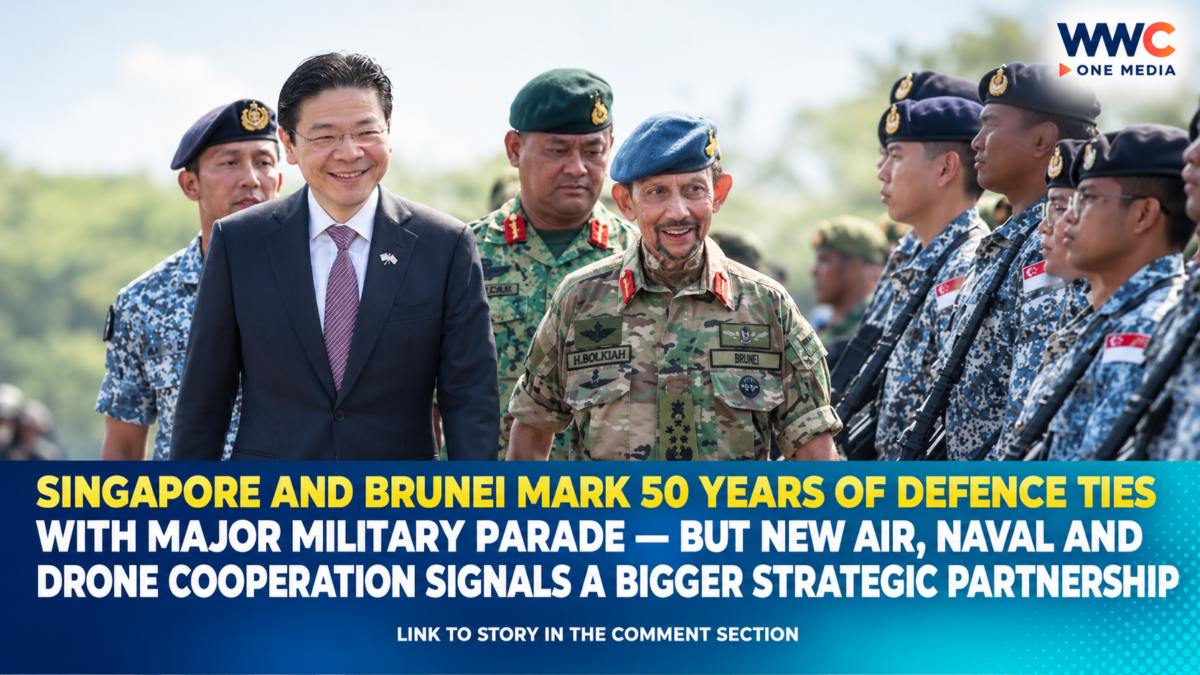
BANDAR SERI BEGAWAN, BRUNEI — Singapore Prime Minister Lawrence Wong and Sultan Hassanal Bolkiah have celebrated 50 years of bilateral defence relations with a joint military parade involving 256 personnel, naval vessels and military helicopters. But behind the historic ceremony is a growing strategic partnership that now includes expanded air force exercises, unmanned aerial vehicle training, new naval facilities and long-term military infrastructure — developments that could strengthen defence cooperation between the two ASEAN nations for decades to come.
Singapore and Brunei have reaffirmed one of Southeast Asia’s longstanding defence partnerships as their military forces celebrated five decades of cooperation during a major joint parade on Saturday, October 10.
The event, held at Muara Naval Base in Brunei, brought together members of the Singapore Armed Forces (SAF) and Royal Brunei Armed Forces (RBAF).
Prime Minister Lawrence Wong and Sultan Hassanal Bolkiah attended as guests of honour.
According to Channel NewsAsia and Singapore’s Ministry of Defence (MINDEF), the parade featured 256 military personnel alongside operational assets representing the army, navy and air force of both countries.
The anniversary commemorates formal bilateral defence relations established in 1976.
Over the past five decades, Singapore and Brunei have developed extensive military training arrangements, professional exchanges and joint exercises.
But the relationship is now expanding into new areas.
Initiatives announced during the golden jubilee year include a broader air force exercise framework, helicopter and drone training, a new underwater demolition facility and military training infrastructure in Brunei.
These developments show that the celebration is not simply about looking back.
It is also about preparing both armed forces for future defence requirements.
Lawrence Wong and Sultan Hassanal Bolkiah Lead Historic Military Ceremony
The October 10 event was a centerpiece of Prime Minister Wong’s official visit to Brunei from October 9 to 10.
Wong and Sultan Hassanal Bolkiah inspected the military parade, attended by senior defence officials and military commanders.
Singapore’s delegation included Defence Minister Chan Chun Sing and Chief of Defence Force Vice-Admiral Aaron Beng.
Brunei was represented by senior defence leaders, including Minister of Defence II Halbi Mohd Yussof and RBAF Commander Major-General Muhammad Haszaimi Bol Hassan.
Members of Brunei’s royal family, including Crown Prince Al-Muhtadee Billah and Prince Abdul Mateen, also attended.
The gathering reflected the institutional and personal relationships that have supported defence cooperation between the two countries.
In a public message following the ceremony, Wong emphasized Singapore’s longstanding friendship with Brunei and expressed his intention to continue strengthening the partnership.
His remarks reinforced the position that bilateral defence cooperation remains a priority for Singapore’s government.
256 Military Personnel Join Land, Sea and Air Display
The joint parade was designed to showcase cooperation across the three traditional branches of the armed forces.
Personnel from the SAF and RBAF participated alongside naval vessels and aircraft.
The maritime display involved three vessels.
Singapore contributed the Republic of Singapore Navy’s Maritime Security and Response Vessel Protector.
Brunei deployed the patrol vessel KDB AS-SIDDIQ and offshore patrol vessel KDB DARUSSALAM.
The ships conducted a coordinated sail-past, symbolizing longstanding navy-to-navy cooperation.
The aviation display featured five military helicopters.
Two Republic of Singapore Air Force H225M medium-lift helicopters flew alongside three Royal Brunei Air Force S-70i Black Hawk helicopters.
The fly-past highlighted practical cooperation between the two countries’ air forces.
MINDEF also confirmed that many personnel involved in the parade had participated in bilateral exercises earlier in the anniversary year.
The ceremony therefore brought together forces already accustomed to training alongside one another.
Defence Ties Began in 1976 and Have Grown for Five Decades
The roots of Singapore-Brunei defence cooperation go back to the early development of both countries’ armed forces.
Brunei’s military was established in 1961, while the Singapore Armed Forces was formed in 1965.
Formal bilateral defence relations began in 1976.
Since then, generations of Singaporean military personnel have trained in Brunei.
The relationship has expanded from training access and professional exchanges into structured cooperation involving land, naval and air operations.
Singapore’s official golden jubilee fact sheet also highlights personal ties among military leaders who trained together earlier in their careers.
Those relationships helped establish trust between the defence institutions.
Today, both armed forces maintain regular senior-level engagements, military exercises and opportunities for personnel to attend each other’s training courses.
The continuity of these arrangements is important because military cooperation depends on mutual familiarity, operational trust and long-term planning.
Why Brunei Is Important to Singapore’s Military Training
Brunei has played an important role in Singapore’s overseas military training arrangements.
Singapore has limited land area, which creates constraints for some types of military exercises.
Training environments in Brunei offer opportunities for SAF personnel to develop field skills that would be difficult to replicate at the same scale in Singapore.
In particular, the tropical terrain of Brunei’s Temburong district provides demanding conditions for military training.
During his official visit, Prime Minister Wong met SAF personnel training in Temburong and spoke with servicemen about their experiences.
Defence Minister Chan Chun Sing and senior SAF officers accompanied him.
The visit highlighted the importance of practical training access as a foundation of the bilateral relationship.
For Brunei, cooperation provides opportunities for professional exchanges, shared exercises and joint capability development.
The arrangement illustrates how countries with different military resources and geographical advantages can develop mutually beneficial training partnerships.
Singapore and Brunei Launch Exercise Vanguard
One of the most significant new initiatives is Exercise Vanguard.
On October 1, the Republic of Singapore Air Force and Royal Brunei Air Force launched the framework to deepen cooperation between their air forces.
MINDEF announced the initiative on October 2.
Exercise Vanguard brings together existing and new bilateral air force activities under a broader structure.
Its components include Exercise Airguard, an established exercise focused on ground-based air defence.
Two additional exercises — Exercise Wing Guard and Exercise Skyguard — expand cooperation into helicopter and unmanned aerial vehicle training.
The development is important because modern air operations increasingly involve coordination among different aircraft, sensors and support capabilities.
However, the announcement does not establish that Singapore and Brunei have created a combined air force or a new mutual-defence treaty.
Exercise Vanguard is a bilateral training and cooperation framework.
Its significance lies in improving familiarity, operational coordination and the development of professional capabilities.
Drone Training Becomes Part of the Next Phase
The inclusion of unmanned aerial vehicle training marks an evolution in the partnership.
Drones are increasingly relevant to military reconnaissance, surveillance and operational support.
Training personnel to operate and coordinate such systems requires technical knowledge and clear procedures.
The new Exercise Skyguard provides a framework for cooperation in this area.
But the official announcement does not disclose the deployment of new combat drones, specific weapons systems or confidential operational capabilities.
Claims about joint drone strike operations or major new weapons acquisitions would therefore go beyond the confirmed facts.
The development is best understood as an expansion of bilateral training into a growing field of military technology.
For both countries, such cooperation could support the development of personnel and operational practices as defence technology evolves.
Navies Open New Underwater Demolition Range
Maritime cooperation has also taken a significant step forward.
On October 8, the Republic of Singapore Navy and Royal Brunei Navy opened a jointly developed underwater demolition range.
The facility is intended to support the Royal Brunei Navy’s naval diving capabilities while creating additional opportunities for divers from both countries to train together.
Underwater demolition training can require specialized equipment, controlled environments and rigorous safety procedures.
By developing a shared facility, the two navies are expanding their practical cooperation.
The project builds on an established history of bilateral maritime exercises.
It also reflects a move toward longer-term capability development rather than temporary ceremonial activities.
However, the range should not be mischaracterized as a newly announced offensive military base or evidence of an imminent regional conflict.
Its officially stated purpose is training and professional cooperation.
Exercise Pelican Reaches Its 44th Edition
Another important element of the relationship is Exercise Pelican.
The Singapore and Brunei navies concluded its 44th edition on October 8, 2026.
The exercise has become a longstanding platform for the two navies to develop maritime coordination.
Such training helps naval personnel practice communication, maneuvering and operational procedures in a bilateral environment.
Repeated exercises can strengthen interoperability — the ability of different armed forces to operate effectively alongside one another.
The 44th edition illustrates that the relationship has been sustained over decades rather than emerging only during the anniversary celebrations.
It also provides a foundation for new cooperation, including the underwater demolition range opened during the same anniversary period.
Singapore and Brunei Begin Work on Binturan Bridge
Cooperation between the two armies is also expanding through new infrastructure.
On September 30, the Singapore Army and Royal Brunei Land Force held a groundbreaking ceremony for the Binturan Bridge in Brunei.
The bridge is being jointly developed to support military training requirements.
It is intended to provide lasting infrastructure for future exercises.
The project demonstrates a commitment to maintaining the physical facilities needed for long-term cooperation.
Unlike a temporary training exercise, a jointly developed bridge represents infrastructure that can support activities over many years.
However, officials did not describe the project as a civilian cross-border bridge linking Singapore and Brunei.
It is a military training infrastructure initiative located in Brunei.
Defence Leaders Build Relationships Through Professional Exchanges
Military cooperation involves more than equipment and exercises.
Singapore and Brunei also exchange personnel for professional education and training.
SAF officers attend the Command and Staff Course at Brunei’s Defence Academy.
RBAF officers participate in the corresponding programme at Singapore’s Goh Keng Swee Command and Staff College.
These courses allow officers to study leadership, strategy and military planning in another country’s professional environment.
They also create personal relationships that can be valuable during future cooperation.
MINDEF highlighted the continuing importance of high-level visits and institutional exchanges during the golden jubilee year.
In February 2026, the two countries held their 11th Defence Policy Dialogue in Singapore.
The discussion covered existing initiatives, the regional and international security environment, and opportunities for future cooperation.
Together, these activities help maintain continuity as new generations of military leaders assume command.
A New Commemorative Gallery Honors Five Decades of Cooperation
Following the October 10 parade, Wong and Sultan Hassanal Bolkiah jointly launched and toured a commemorative gallery.
The exhibition highlights important milestones and personal relationships developed over five decades of defence cooperation.
The project reflects the importance both governments attach to remembering the people and institutions that sustained the partnership.
Military relationships can be shaped by formal agreements, but they also depend on shared experiences among personnel.
The gallery is intended to preserve that history and introduce younger generations to the partnership’s development.
The initiative also forms part of a wider series of golden jubilee activities extending throughout 2026.
A commemorative closing dinner is scheduled to take place in Singapore on November 21, hosted by Brunei.
As of October 11, that event remains scheduled for the future.
Lawrence Wong Also Oversees Delivery of Singapore-Developed Emergency Vehicles
Wong’s Brunei visit included cooperation beyond traditional military activities.
According to Singapore’s Prime Minister’s Office, he was scheduled to witness the delivery of four Light Fire Attack Vehicles to Brunei’s Fire and Rescue Department.
The vehicles were developed by Singapore-based engineering company HOPE Technik and customized for Brunei’s operational requirements.
This initiative demonstrates an additional dimension of bilateral cooperation involving technology and emergency response.
However, the vehicles are intended for Brunei’s fire and rescue authorities, not its armed forces.
They should therefore be described as a separate public-safety and engineering cooperation initiative rather than a military weapons transfer.
The example highlights how the broader Singapore-Brunei relationship extends beyond defence into practical government and industry collaboration.
Why the Partnership Matters to Southeast Asian Security
Singapore and Brunei are both members of ASEAN and participate in regional defence cooperation frameworks.
Their bilateral relationship contributes to a broader network of military engagement across Southeast Asia.
Joint exercises can help armed forces build familiarity and improve their ability to cooperate during appropriate missions.
Singapore and Brunei have also worked together in regional and international security activities.
MINDEF noted that personnel from both armed forces served alongside one another during relief operations following Nepal’s 2015 earthquake.
The countries also co-hosted an ASEAN Defence Ministers’ Meeting-Plus maritime security and counter-terrorism exercise in 2016.
These examples show that the relationship extends beyond strictly bilateral training.
However, the October 10 parade does not represent the announcement of an ASEAN-wide military alliance or a new collective-defence obligation.
Its significance is the strengthening of an existing bilateral partnership that also supports broader regional cooperation.
What Comes Next for Singapore-Brunei Defence Relations?
The golden jubilee year has produced several practical developments.
Exercise Vanguard has introduced a broader air force cooperation framework.
The underwater demolition range has expanded naval training opportunities.
The Binturan Bridge project promises additional infrastructure for army training.
Senior-level visits and military education exchanges continue to reinforce institutional ties.
These initiatives indicate that both countries intend to maintain and develop their partnership.
Nevertheless, MINDEF has not announced a single quantified military spending package covering all the anniversary activities.
Nor has it disclosed a new defence treaty, permanent joint command or specific commitment to participate in future armed conflicts together.
Those details should not be inferred from the ceremony.
The next phase is more accurately described as deeper training, infrastructure and professional cooperation between longstanding partners.
The Bigger Picture: Five Decades of Trust Become a Platform for Future Defence Cooperation
The 50th anniversary of Singapore-Brunei defence relations marks an important milestone for two countries whose armed forces have worked together for generations.
The October 10 military parade showcased 256 personnel, naval vessels and aircraft in a demonstration of the partnership’s depth.
Prime Minister Lawrence Wong and Sultan Hassanal Bolkiah also inaugurated a commemorative gallery recognizing the people and achievements behind the relationship.
But the most consequential developments may be taking place beyond the parade ground.
New air force exercises, drone training, naval facilities and military infrastructure reflect an effort to ensure the partnership remains relevant as defence requirements evolve.
These initiatives build on the trust established through decades of shared training and professional exchanges.
Singapore and Brunei have celebrated 50 years of defence cooperation with a historic joint military parade.
But the bigger story lies in the expansion of their military collaboration into unmanned aircraft training, advanced maritime facilities and long-term infrastructure.
As Southeast Asia faces an increasingly complex security environment, the next test will be whether the two countries can translate five decades of trust into practical capabilities that serve their future defence needs.