MANCHESTER, ENGLAND — Manchester United supporters have reignited one of English football’s most famous rivalries by bringing back their historic trophy-drought banner, this time displaying a stunning message: “51 YEARS.” The provocative stunt follows an independent Premier League commission’s ruling that Manchester City committed serious financial rule breaches over nine seasons. But with City denying wrongdoing and appealing the verdict, the bigger question is whether the reigning football powerhouse could face points deductions, stripped titles or even relegation in one of the biggest disciplinary scandals in Premier League history.
Manchester’s bitter football rivalry has entered a new and explosive chapter.
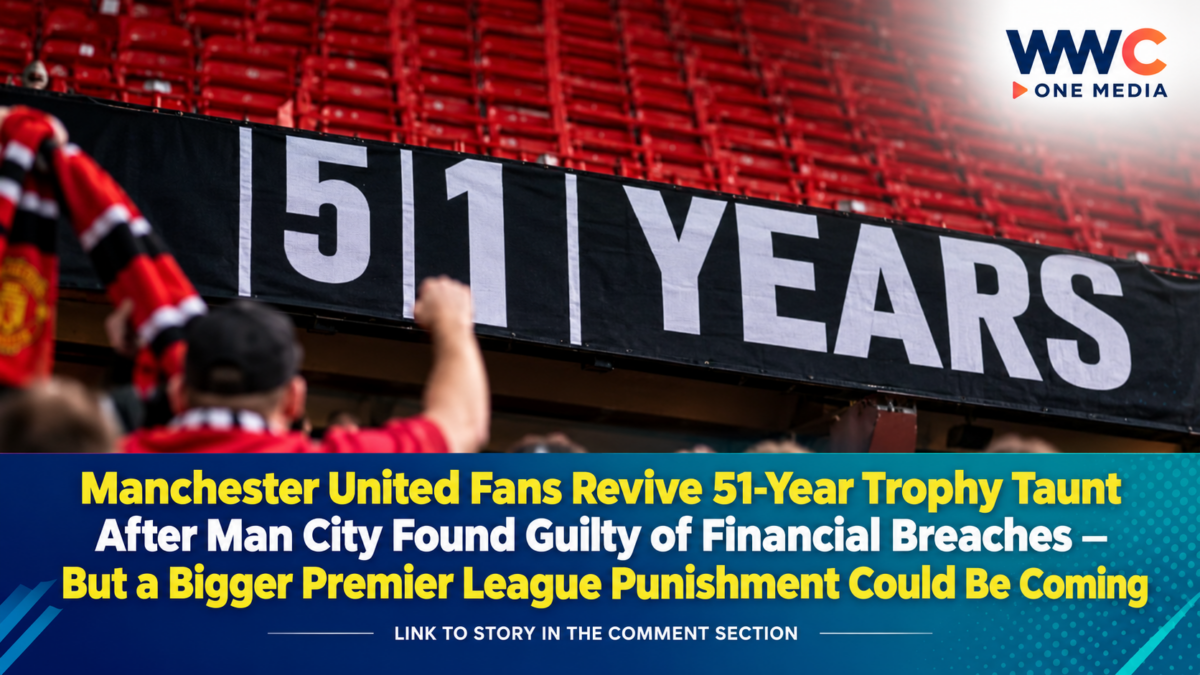
Manchester United fans have resurrected their legendary ticker banner to mock cross-city rivals Manchester City following a landmark ruling concerning the club’s financial conduct.
The banner, displaying the words “51 YEARS,” appeared at Old Trafford’s famous Stretford End during United’s Premier League clash against Tottenham Hotspur on Saturday, October 10.
According to Reuters, in a report carried by Channel NewsAsia, the message was a deliberate reference to City’s last major trophy before its modern era of success: the 1976 League Cup.
By displaying the number 51, United supporters were suggesting that City’s modern trophy-winning years should be disregarded because of the financial rule breaches identified by the independent commission.
The message was symbolic rather than an official declaration that any Manchester City trophies had been revoked.
Nevertheless, its timing was unmistakable.
The demonstration came less than two weeks after the Premier League announced that an independent commission had found City guilty of serious financial misconduct.
The club has rejected the findings and launched an appeal.
As that legal process continues, the controversy is expanding beyond football regulations into questions about sporting fairness, club ownership, sponsorship income and the legitimacy of achievements during one of English football’s most successful periods.
Manchester United’s Famous Ticker Banner Returns After 15 Years
For longtime Manchester United supporters, the appearance of the banner revived a familiar part of the city’s football history.
The original ticker was introduced in 2000, when City had endured 24 years without winning a major trophy.
Displayed at Old Trafford, the banner tracked the length of City’s trophy drought.
The number increased every year, becoming a recurring source of embarrassment for United’s local rivals.
At the time, United were enjoying sustained success under manager Sir Alex Ferguson, while City struggled to match their neighbors’ achievements.
The ticker eventually reached 35 years.
It disappeared after Manchester City defeated Stoke City in the 2011 FA Cup final, ending their long wait for major silverware.
That victory marked the beginning of a remarkable transformation.
City went on to win multiple Premier League championships, domestic cups and their first UEFA Champions League title in 2023.
But the financial case against the club has now given United fans a reason to revive the taunt.
Their new banner is effectively questioning the legitimacy of City’s modern era of success.
The display is intended as football rivalry and protest, not as a legally binding judgment on the club’s historical titles.
Why the Banner Says 51 Years
The calculation reflects the gap between City’s 1976 League Cup triumph and the 2026–27 football season.
The figure also carries a wider accusation.
United supporters are treating City’s post-2008 achievements as disputed because of the Premier League’s findings concerning financial arrangements during the 2009–2018 period.
The new banner therefore attempts to erase, symbolically, decades of progress made by the club following its acquisition by Abu Dhabi-based investors.
However, an important distinction remains.
The Premier League has not announced that all Manchester City trophies won since 2009 have been stripped.
Nor has a final appeal judgment established what disciplinary sanctions will apply.
The commission’s financial misconduct findings are serious, but the club’s historical trophy record remains officially intact pending any applicable decision.
The “51 YEARS” display represents the position taken by rival supporters.
It is not the official position of the Premier League.
Premier League Finds Manchester City Guilty of Serious Financial Breaches
The controversy intensified on September 29, 2026, when the Premier League published the findings of an independent commission.
The commission concluded that Manchester City had breached financial regulations over nine seasons, from 2009–10 through 2017–18.
The original case involved more than 100 alleged breaches, commonly described as the 115 charges.
According to the Premier League’s official statement, the commission upheld all charges involving serious breaches of financial rules and most allegations concerning failures to cooperate with the investigation.
The findings involved commercial contracts, financial reporting and compliance with spending restrictions.
The commission found that some agreements did not accurately reflect the genuine financial arrangements between the club and commercial partners.
It also concluded that City’s accounts misrepresented its financial position.
These findings represent an official commission ruling, but they remain under appeal.
Manchester City disputes the conclusions and continues to maintain that it has not committed the misconduct alleged.
Financial Times: More Than £900 Million in Financial Misstatements
Additional reporting by the Financial Times provides further context on the scale of the case.
The publication reported that the commission identified financial arrangements that inflated revenue and understated costs by more than £900 million over the nine-year period.
The findings involved commercial agreements that the commission concluded had been structured or presented in ways that misrepresented their underlying financial purpose.
These arrangements allegedly allowed City to present a stronger financial position than its actual circumstances justified under football spending rules.
The importance of these rules lies in their role in limiting spending that exceeds permitted financial thresholds.
Clubs rely on revenue from broadcasting, sponsorship, ticket sales, commercial activities and other legitimate sources to fund their operations.
If certain financial arrangements artificially increase reported revenue, clubs may appear to have greater spending capacity than they would otherwise possess.
That can affect competition for players, wages and transfer spending.
However, the more than £900-million figure is not an established fine, compensation award or amount that City has been ordered to repay.
It reflects financial misstatements identified in the commission’s contested findings.
Manchester City Appeals and Denies Wrongdoing
Manchester City has strongly rejected the commission’s conclusions.
According to Reuters, the club lodged its appeal on October 1, challenging the verdict on legal and factual grounds.
City maintains that the findings do not accurately reflect the evidence and insists that it has acted properly.
The appeal will be considered by a separate independent panel.
The process means that the commission’s conclusions are not yet the final word in the disciplinary case.
City could seek to overturn findings, challenge the interpretation of the evidence or contest any resulting penalties.
The appeal could also affect the timing of disciplinary measures.
As of October 11, no final appeal decision or definitive sanctions had been announced in the reporting reviewed.
That uncertainty is crucial when assessing claims about relegation, title stripping or points deductions.
Such penalties remain possible outcomes, not confirmed punishments already imposed.
Could Manchester City Lose Premier League Titles?
The possibility of losing historical titles has become one of the most controversial questions surrounding the case.
Manchester City’s period of dominance includes several Premier League championships won during and after the seasons examined by the commission.
Some supporters and commentators argue that confirmed financial misconduct undermines the fairness of competitions involving clubs that complied with spending rules.
Others caution that withdrawing past trophies would have complicated consequences for teams, players, competitions and historical records.
The issue would also require a clear legal and regulatory basis.
A finding of financial misconduct does not automatically result in historical titles being transferred to runners-up.
Any such action would require an explicit disciplinary decision and could become the subject of further legal challenges.
For that reason, suggestions that Manchester United, Liverpool or other clubs should be retrospectively declared champions remain speculative.
The outcome will depend on the governing rules, the appeal and any sanctions ultimately imposed.
Points Deductions and Relegation Remain Possible
The range of potential punishments is significant.
Financial rule breaches can expose clubs to sanctions such as fines and points deductions.
More severe disciplinary measures could potentially include relegation or exclusion from competitions.
However, the appropriate penalty depends on the specific rules, legal findings, proportionality and decisions of the relevant authorities.
The Premier League has not issued a final sanction that can be treated as settled while the appeal process continues.
The Financial Times has described the controversy as an extraordinary test of English football’s ability to enforce its rules against one of its most powerful clubs.
For Manchester City, the consequences could extend into broadcasting income, commercial relationships, sponsorship arrangements and future player recruitment.
But those effects would depend on the actual sanction, its timing and whether it survives legal challenge.
United Manager Michael Carrick Calls for a Swift Resolution
Manchester United manager Michael Carrick has also addressed the controversy.
According to Reuters on October 9, Carrick called for a quick and clear conclusion to Manchester City’s financial case.
The issue has personal significance because Carrick played for United during seasons when City emerged as a dominant Premier League rival.
He experienced some of the fierce title battles between the two clubs.
Nevertheless, Carrick avoided demanding that United be awarded historical championships.
His main concern was that the disciplinary process should reach a clear conclusion.
For players and managers who competed against City during the period under investigation, the controversy raises difficult questions about fairness.
But those sporting concerns remain separate from the legal task of determining appropriate penalties.
City Manager Enzo Maresca Defends the Club
Manchester City manager Enzo Maresca has expressed support for the club despite the serious findings.
Associated Press reported that Maresca maintained confidence in the club’s leadership and said he did not believe the verdict diminished the achievements of its players and coaches.
He also emphasized the importance of focusing on upcoming football matches while the appeal proceeds.
That position reflects the challenge facing City’s current squad.
Many of the players now representing the club were not involved in the historical transactions examined by the commission.
Yet the consequences of an eventual sanction could affect the current team.
City must therefore manage an extraordinary legal distraction while continuing to compete in domestic and international competitions.
The club’s next Premier League fixture against Liverpool at Anfield on October 11 will be its first since the commission’s ruling.
Manchester United’s On-Field Problems Remain
The banner attracted attention during a difficult period for Manchester United themselves.
United were held to a 1-1 draw by Tottenham Hotspur at Old Trafford on October 10.
Bryan Mbeumo gave United the lead in the second half, but Dominic Solanke scored a late equalizer for Spurs.
Tottenham managed to salvage the draw despite being reduced to 10 players.
According to The Guardian, United’s difficult start to the Premier League season is their worst at this stage since 1986.
That contrast added another layer of irony to the ticker display.
United fans were mocking City’s disputed success while their own club continued struggling to regain consistent form.
For Carrick, the priority remains improving results and stabilizing his team’s performances.
The City controversy may provide supporters with a memorable moment of rivalry, but it does not solve United’s problems on the pitch.
Liverpool Clash Puts Manchester City Under the Spotlight
City’s visit to Liverpool on October 11 has taken on additional significance.
The match will be the club’s first Premier League fixture since the announcement of the commission’s findings.
Liverpool have historically been among City’s strongest challengers during the modern Premier League era.
Their rivalry intensified under former managers Jürgen Klopp and Pep Guardiola, with both clubs competing for major trophies.
Some Liverpool supporters and commentators have questioned whether the financial findings should change how past title races are viewed.
However, City continues to reject the commission’s conclusions.
The upcoming match presents a sporting test at a moment of intense public scrutiny.
While City attempt to concentrate on results, the legal controversy is likely to remain a major topic surrounding the club.
Financial Times: Manchester City’s Ownership Raises Wider Questions
The case is also attracting attention because of Manchester City’s ownership structure.
The club has been controlled by Sheikh Mansour of Abu Dhabi since 2008.
The ownership change was followed by substantial investment in players, infrastructure and the club’s commercial operations.
City developed into one of Europe’s leading football organizations, achieving major success while also expanding its international profile.
The Financial Times has examined how the financial misconduct controversy creates wider questions about the relationship between major football clubs, wealthy international owners and sporting regulators.
The case highlights the difficulty of ensuring that financial oversight remains credible when clubs command enormous economic and political influence.
However, questions about state-linked investment and international relationships should not be confused with a judicial finding that any particular government committed wrongdoing.
The specific disciplinary case concerns Manchester City’s compliance with Premier League financial regulations.
The Case Could Change How Football Clubs Are Audited
A separate Financial Times report has focused on the implications for auditing and financial transparency.
The commission’s findings have drawn attention to BDO, which audited Manchester City’s accounts during the period under scrutiny.
Questions are being raised about whether existing oversight arrangements are sufficiently robust for large privately owned football clubs.
The issue extends beyond one team’s alleged financial irregularities.
Football organizations can operate complex businesses involving sponsorship arrangements, transfers, related-party transactions and international investment structures.
Auditors and regulators must assess whether those arrangements are properly disclosed and valued.
However, scrutiny of an auditing firm does not mean that the auditor has been found guilty of misconduct.
Any disciplinary or professional findings would require a separate investigation.
The broader concern is whether financial reporting requirements need to become more transparent and consistent across the industry.
Why the Scandal Matters to Football Fans in Asia and the Philippines
The Premier League has a large international following, including millions of supporters across Southeast Asia.
Manchester United, Manchester City, Liverpool and other English clubs have significant fan communities in the Philippines, Singapore, Malaysia, Indonesia and Thailand.
For supporters, the controversy raises fundamental questions about the fairness of football competitions.
Fans expect league titles and other honors to be decided through sporting performance under rules applied consistently to all clubs.
Financial regulations are intended to help maintain that competitive framework.
When a major club is found to have breached those rules, confidence in league governance can be affected.
The final legal outcome will therefore matter beyond England.
It could influence perceptions of the Premier League’s credibility among international audiences and commercial partners.
The Bigger Picture: A Rivalry Banner Becomes a Symbol of English Football’s Biggest Financial Test
Manchester United’s revival of the famous ticker banner may have started as a familiar act of football rivalry.
But the “51 YEARS” message has taken on wider meaning because of the unprecedented financial case confronting Manchester City.
An independent commission has found City guilty of serious breaches covering nine seasons.
The club denies wrongdoing and is appealing the findings.
Potential sanctions could have major consequences for City and the Premier League, although no final punishment has been established.
The dispute has also renewed debate about how clubs are financed, how financial rules are enforced and whether regulators can hold major football institutions accountable.
For United supporters, the revived ticker represents an opportunity to challenge their rivals’ extraordinary success.
For City, it is another public reminder of the legal and reputational battle ahead.
Manchester United fans may have brought back the 51-year trophy taunt, but the Premier League has not stripped Manchester City of its titles.
The bigger test will come when the appeal and disciplinary processes determine whether the commission’s findings stand — and what punishment, if any, the club must face.
The result could shape not only Manchester City’s future but also the credibility of financial regulation across English football.