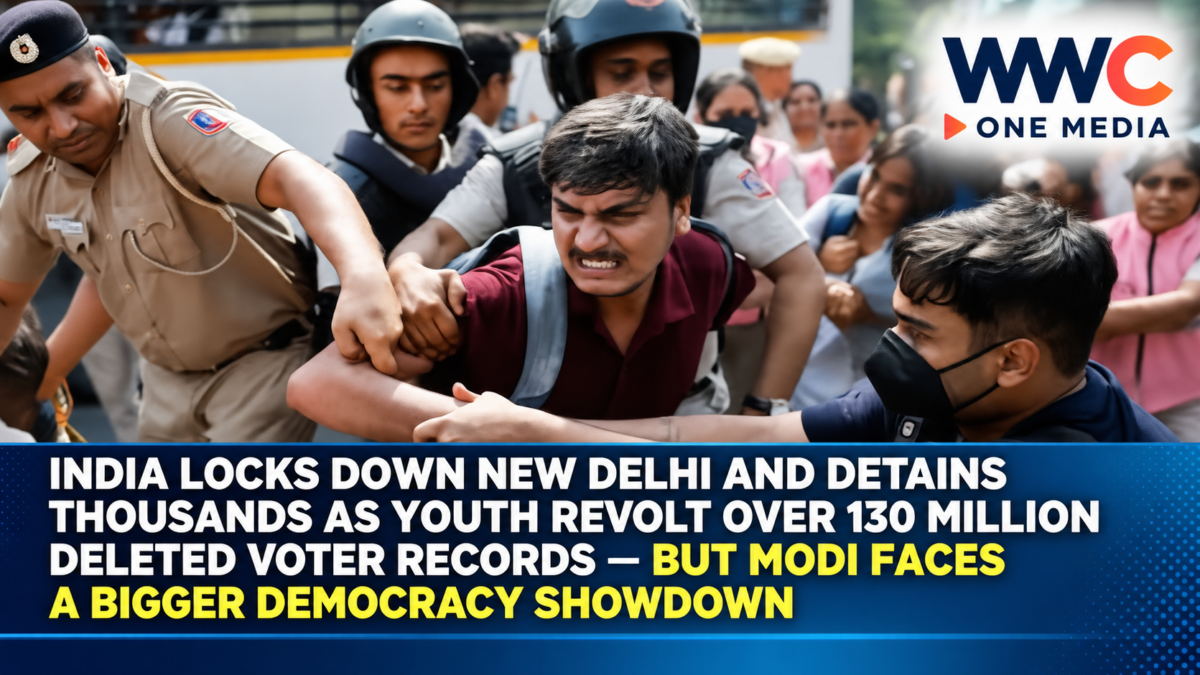
NEW DELHI, INDIA — Indian authorities have detained thousands of demonstrators, shut down parts of the capital and disrupted mobile internet services in an extraordinary security operation aimed at stopping a youth-led protest demanding the resignation of Chief Election Commissioner Gyanesh Kumar. The crackdown comes amid allegations that approximately 130 million voter entries were removed during a controversial electoral roll revision, raising serious questions about voting rights, political accountability and the future of the world’s largest democracy.
India is confronting a major political confrontation after security forces effectively locked down large parts of New Delhi on Saturday, October 10, to prevent thousands of young demonstrators from gathering in protest against the country’s election authorities.
The massive operation involved police and paramilitary personnel, road checkpoints, barricades, public transportation restrictions and temporary mobile internet shutdowns.
According to Reuters, in reporting carried by Channel NewsAsia, more than 2,000 people were detained in Delhi as authorities moved to stop a rally organized by the youth-led Cockroach Janta Party, or CJP.
The Indian Express separately estimated that approximately 7,000 people were detained during the day’s broader crackdown.
The protest was organized to demand the resignation of Chief Election Commissioner Gyanesh Kumar following controversial revisions to India’s electoral rolls.
Opposition parties and activists allege that the process removed eligible voters and disproportionately benefited Prime Minister Narendra Modi’s ruling Bharatiya Janata Party, or BJP.
The Election Commission and BJP deny wrongdoing.
The dispute has rapidly expanded beyond an administrative disagreement over voter registration.
It has become a wider confrontation over the fairness of elections, constitutional rights and the government’s response to public dissent.
Delhi Brought Under Heavy Security as Thousands Are Detained
Authorities deployed thousands of police and paramilitary personnel throughout the national capital to prevent protesters from reaching Jantar Mantar, a well-known location for political demonstrations.
Major roads were barricaded, security checkpoints were established and officers inspected vehicles entering sensitive areas.
Mobile internet services were temporarily suspended in parts of central Delhi, while dozens of metro stations and markets were shut or affected by security restrictions.
The measures disrupted transportation and commercial activity across parts of the city.
A Home Ministry official told Reuters that more than 2,000 people had been detained in Delhi.
Local media also reported approximately 400 detentions in Mumbai, where supporters attempted to organize related demonstrations.
Meanwhile, The Indian Express estimated that around 7,000 people had been detained across Delhi, based on its reporting of the wider police operation.
The differing figures illustrate the difficulty of determining a final detention total during a rapidly developing security crackdown.
The authorities had not provided a comprehensive, independently verified final tally in the reporting available by October 11.
Although the restrictions were widely described as a lockdown, this was a security operation targeting demonstrations and movement through affected areas, not a nationwide public-health lockdown.
Cockroach Janta Party Founder Abhijeet Dipke Detained at Airport
One of the most significant developments was the detention of Abhijeet Dipke, the founder of the Cockroach Janta Party.
Dipke was stopped by police after arriving in Delhi on a flight from Mumbai.
Senior movement members Saurav Das and Ashutosh Ranka were also detained, according to the organization.
Television footage showed Dipke confronting officers as they approached him aboard the aircraft.
The movement condemned the detention and accused authorities of attempting to silence peaceful political opposition.
Its leaders pledged to continue demonstrating until Chief Election Commissioner Gyanesh Kumar resigns.
Dipke’s detention was particularly significant because he has become one of the most recognizable faces of India’s emerging youth protest movement.
His supporters view the government’s actions as an effort to prevent a growing political movement from gaining further momentum.
Authorities, however, maintain that restrictions on public gatherings can be imposed when required to protect public order.
The legal basis and proportionality of individual detentions remain matters of public controversy.
How a Viral Cockroach Post Became a Political Movement
The Cockroach Janta Party began as an unusual online movement before developing into a serious political force.
Reuters reported that Dipke, a 31-year-old political strategist and Dalit activist, gained widespread attention after responding to a derogatory comparison involving unemployed young people.
His social media response asked what might happen if people dismissed as cockroaches united.
The message became a rallying point for frustrated young Indians.
The movement adopted the cockroach identity as a symbol of collective resistance and political frustration.
Although it uses the name of a political party, CJP describes itself primarily as a pressure movement rather than a conventional electoral party.
Its campaigns have focused on issues including unemployment, education, examination irregularities and democratic accountability.
Earlier demonstrations over examination paper leaks contributed to political pressure that preceded the resignation of Education Minister Dharmendra Pradhan in July 2026.
The movement has since expanded its agenda to include concerns about electoral transparency and voting rights.
Its latest confrontation with the government demonstrates how online activism can evolve into organized political mobilization.
Controversial Electoral Roll Revision Removes Around 130 Million Entries
At the center of the unrest is India’s Special Intensive Revision, or SIR, of electoral rolls.
The verification exercise was intended to update voter registration records by identifying ineligible, duplicate, outdated or otherwise invalid entries.
According to Election Commission data cited by Reuters, approximately 130 million entries were removed during the review process.
The commission’s reported categories included around 63 million entries associated with people who had relocated, 30 million involving individuals who could not be traced and 28 million linked to deceased voters.
Those categories account for a substantial proportion of the overall reported removals.
However, the distinction between removed voter-list entries and confirmed disenfranchised eligible voters is crucial.
The removal of an entry does not, by itself, prove that an eligible citizen was unlawfully prevented from voting.
Election authorities say the process was intended to improve the accuracy of voter records and that eligible individuals incorrectly removed can apply to re-enrol.
Opposition parties argue that legitimate voters may nevertheless have been excluded, particularly among socially and economically vulnerable communities.
The scale of the exercise has made it one of the most politically contentious electoral controversies facing the Modi administration.
Election Commission Faces Allegations of Political Bias
Chief Election Commissioner Gyanesh Kumar has become the central target of the protests.
Opposition parties allege that the electoral roll revisions may have influenced recent state elections in favor of the ruling BJP.
Their allegations intensified after The Indian Express reported that two election commissioners had raised internal concerns about the revision process.
The disclosure prompted fresh demands for Kumar’s resignation and an independent examination of how voter entries were removed.
The opposition argues that election administration must remain impartial and transparent, particularly when registration changes affect large numbers of citizens.
For India’s election authorities, the challenge is demonstrating that the verification process was conducted lawfully and without political discrimination.
The Election Commission has rejected allegations of wrongdoing.
The BJP also denies benefiting from improper voter deletions, arguing that its electoral success reflects public support and the government’s record.
No final judicial finding establishing systematic electoral manipulation through the reported deletions has been confirmed in the sources reviewed.
The Indian Express Reports Detentions Across Multiple Protest Locations
Local reporting indicates that demonstrators continued organizing despite the security restrictions.
The Indian Express reported that groups of approximately 100 to 150 people staged spontaneous protests at locations including Connaught Place, Dilli Haat, Raj Ghat and the Safdarjung flyover.
Police moved to disperse the gatherings and detained participants.
The newspaper also described protesters being transported to temporary detention facilities.
Some detainees said they had difficulty contacting relatives or obtaining information about their legal status.
Separate reporting identified detention facilities at locations including Chhatrasal Stadium and Rajiv Gandhi Stadium.
Accounts from detainees raised concerns about access to food, drinking water and communication with family members.
These accounts require evaluation alongside official explanations of detention procedures and security conditions.
Nevertheless, they add to concerns about the humanitarian and civil liberties implications of large-scale preventive detentions.
Opposition Leaders and Journalists Caught in Crackdown
The crackdown extended beyond the youth movement’s organizers.
According to Reuters and CNA, several opposition figures were detained, including Mamata Banerjee, Arvind Kejriwal and Pinarayi Vijayan, all prominent political personalities who have served in senior state leadership roles.
Journalists covering the protests were also affected.
Representatives of two digital news outlets reported that four journalists had been briefly detained.
A Reuters journalist was also temporarily held before being released.
The detention of reporters raises additional questions about press freedom and the ability of journalists to document political demonstrations.
Authorities have the responsibility to maintain public safety, but restrictions affecting journalists and peaceful demonstrators also require scrutiny under legal protections for expression and assembly.
For civil society groups, the breadth of the security operation has become as controversial as the electoral dispute itself.
United Nations Raises Concerns Over Mass Detentions
The United Nations human rights office expressed concern over the restrictions and detentions.
UN Human Rights spokesperson Thameen Al-Kheetan called on Indian authorities to respect the right to peaceful assembly and engage meaningfully with the concerns raised by protesters.
The statement added international attention to an already politically sensitive domestic confrontation.
India’s mission to the United Nations in Geneva rejected the criticism.
The mission argued that the UN’s concerns were misplaced and constituted inappropriate interference in India’s internal affairs.
It maintained that India’s Constitution protects peaceful assembly while allowing reasonable restrictions to safeguard public order.
The opposing positions reflect a broader debate over how governments should balance security responsibilities against political freedoms.
International human rights standards recognize the legitimacy of certain narrowly tailored restrictions, but they also emphasize necessity, proportionality and protection of peaceful participation.
The controversy could intensify if large-scale detentions continue or if additional legal challenges emerge.
Modi’s BJP Says Protest Movement Is Being Used by Political Rivals
The ruling BJP has rejected allegations that the voter-list revisions were manipulated for political advantage.
Party representatives argue that the opposition is exploiting electoral disputes to challenge results it was unable to defeat through voting.
Senior BJP politician Ravi Shankar Prasad accused opposition forces of turning demonstrations into political weapons following election losses.
The government and its supporters maintain that election records must be regularly updated to remove invalid entries and preserve electoral integrity.
They also argue that large gatherings can create public-order risks requiring police intervention.
Opposition leaders counter that peaceful protests are a legitimate democratic response when citizens question electoral procedures.
Congress leader Rahul Gandhi said opponents of the Modi government would continue challenging the disputed revisions.
The confrontation has therefore become a test of competing political narratives.
For the BJP, the dispute concerns electoral administration and public order.
For critics, it concerns whether voters and demonstrators can exercise democratic rights without intimidation or unjustified exclusion.
Financial Times: Youth Movement Becomes a Major Challenge for Modi
The Financial Times reported that the Cockroach Janta Party has rapidly emerged as an unusual but increasingly influential source of political pressure.
Its ability to mobilize younger citizens distinguishes it from conventional opposition campaigns.
Many of its supporters are concerned about economic opportunity, access to education and the transparency of public institutions.
The detention of Dipke and other organizers may weaken immediate mobilization by disrupting leadership and coordination.
However, it could also increase the movement’s visibility and attract sympathy among citizens critical of the security response.
That possibility remains political analysis rather than a guaranteed outcome.
The government’s next decisions will be important in determining whether the protests subside or continue spreading.
Supreme Court Scrutiny Could Become a Decisive Factor
The electoral dispute has also generated legal challenges.
The Supreme Court has been drawn into questions surrounding voter-list revisions and the restrictions imposed during demonstrations.
Judicial proceedings could examine the legal basis for particular government actions and whether the rights of affected individuals have been respected.
The outcome could influence both election administration and the authorities’ handling of protests.
However, the existence of a court challenge does not mean that allegations against the Election Commission have been proven.
Judicial findings must be distinguished from claims made by political parties, activists or media commentators.
A transparent legal process could help clarify the dispute and establish which measures, if any, require correction.
Why the Crisis Matters Ahead of India’s 2027 Elections
The protests come before a series of important state elections beginning in early 2027.
Electoral registration is particularly sensitive because accurate voter rolls are essential to the legitimacy of democratic elections.
Governments have a responsibility to remove invalid entries while ensuring eligible citizens retain meaningful access to registration and voting.
A process that is too weak may leave outdated or erroneous records in place.
A process that is too aggressive or poorly administered may create barriers for eligible voters.
The controversy surrounding the Special Intensive Revision illustrates the difficulty of balancing these objectives.
The public response also suggests that election management has become a central concern for politically engaged young Indians.
Whether the movement translates into sustained electoral consequences remains uncertain.
That will depend on future protests, legal developments, government responses and voting behavior.
What India’s Political Unrest Means for Asia
India is one of Asia’s most important political and economic powers.
Developments affecting its governance and institutions attract attention throughout the region.
A prolonged political confrontation could influence investor sentiment and public confidence, although the current reporting does not establish a major financial-market disruption caused by the protests.
The episode also reflects wider questions affecting democracies across Asia.
Election authorities must maintain public trust.
Governments must balance security with constitutional protections.
Social media can rapidly mobilize political movements, particularly among younger generations frustrated by economic and institutional problems.
For the Philippines and other democratic countries, the events provide a reminder that credible voter registration systems and transparent election procedures are fundamental to public confidence.
However, India’s legal institutions and political circumstances are specific to the country.
The controversy should not automatically be treated as evidence of similar electoral problems elsewhere.
The Bigger Picture: India’s Youth Revolt Tests Democratic Confidence
The October 10 crackdown has turned a planned protest against India’s election chief into a broader political confrontation.
Thousands of demonstrators were detained, security restrictions disrupted Delhi and opposition figures joined the growing criticism of the government’s response.
At the center of the dispute is an electoral roll revision involving approximately 130 million removed entries.
The Election Commission says the exercise was intended to improve the accuracy of voter registration.
Opponents allege that the process may have excluded eligible voters and influenced political competition.
Those allegations remain contested.
But the scale of the protests shows that the issue has become a major test of public confidence in India’s democratic institutions.
Prime Minister Narendra Modi’s government now faces pressure to defend both the integrity of the election process and its handling of dissent.
India’s detention of thousands of demonstrators has temporarily disrupted a major youth-led protest, but it has not resolved the underlying dispute over electoral transparency.
The bigger question is whether the confrontation will lead to credible answers about the removed voter records — or deepen mistrust between the government, election authorities and an increasingly mobilized generation of young Indians.
With important elections approaching in 2027, the outcome could shape not only the future of the Cockroach Janta Party movement but also the public’s confidence in the institutions responsible for protecting India’s democracy.