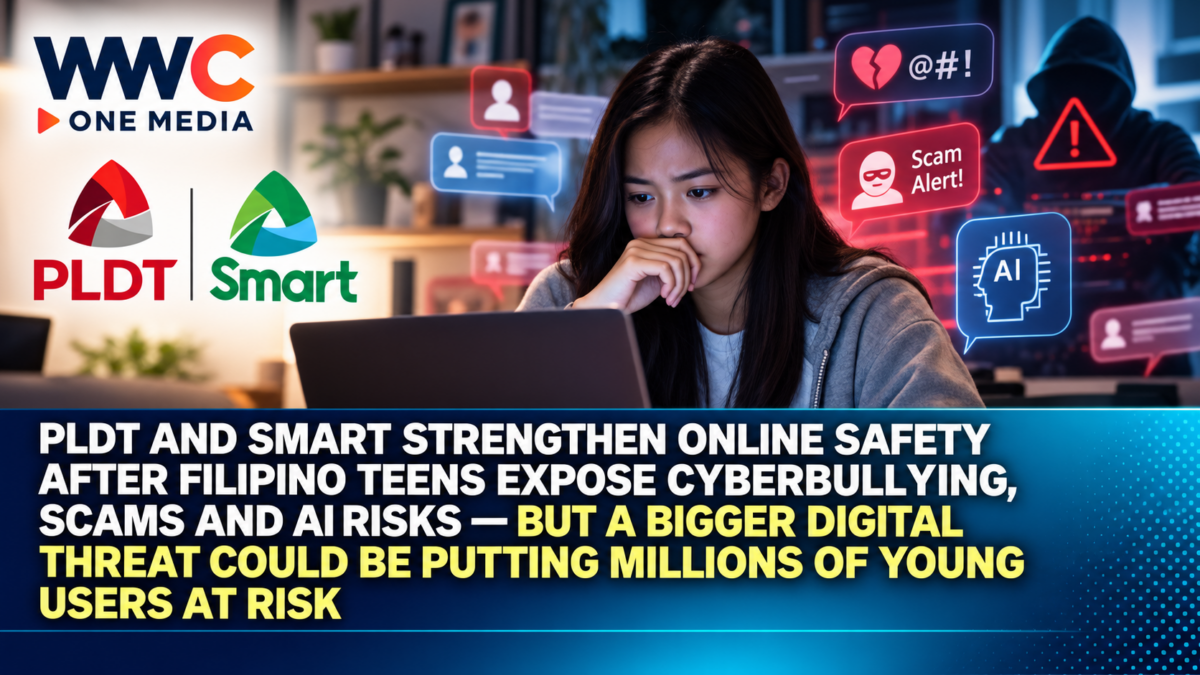
MANILA, PHILIPPINES — Telecommunications giants PLDT Inc. and Smart Communications are strengthening protections for children and teenagers after young Filipinos raised serious concerns about cyberbullying, online scams, misinformation and the growing risks associated with artificial intelligence. With the companies reporting more than 213 billion blocked attempts to access malicious domains during the first half of 2026, the findings have intensified calls for safer digital platforms, stronger accountability and greater protection for millions of young internet users.
The Philippines’ increasingly connected younger generation is delivering a powerful warning to technology companies: the internet may provide enormous opportunities for education, communication and creativity, but it is also exposing children to threats that traditional safety measures are struggling to contain.
PLDT and its wireless subsidiary Smart Communications are responding by reinforcing their child protection and responsible artificial intelligence safeguards.
According to an October 10 report by Bilyonaryo, the telecommunications group consulted Filipino teenagers to better understand their experiences with online risks and emerging digital technologies.
The consultations exposed concerns about cyberbullying, internet fraud, misleading content and the reliability of information generated by artificial intelligence.
The findings come as the Philippines intensifies efforts to protect children from harmful digital content, online exploitation and technology-enabled scams.
But the issue extends beyond telecommunications networks.
Social media companies, schools, parents, regulators and digital platforms are facing mounting pressure to ensure that younger internet users can explore online spaces without unnecessary exposure to abuse, manipulation and fraud.
Filipino Teenagers Speak Out About Cyberbullying and Online Scams
PLDT and Smart partnered with Child Rights Coalition Asia to gather feedback from young people aged 13 to 19 across Luzon, Visayas and Mindanao.
The consultations gave teenagers an opportunity to share their experiences, concerns and expectations regarding online safety.
Participants described digital environments as potentially unsafe, pointing to experiences involving cyberbullying, scams and misleading information.
They also expressed concern about the increasing use of artificial intelligence in everyday online activities.
Although many acknowledged that AI can support education, research and content creation, they called for greater transparency and safeguards against inaccurate or misleading AI-generated information.
Their feedback highlights a fundamental challenge for companies developing digital services.
Young people are not simply passive users of technology.
They are increasingly aware of how platforms influence their education, relationships, personal information and sense of security.
For PLDT and Smart, the consultations provide direct insight into the risks facing one of the country’s most digitally engaged population groups.
PLDT and Smart Update Child Protection Policies
The feedback gathered during the consultations contributed to updated child safeguarding policies within the telecommunications group.
These policies emphasize safety-by-design and the responsible use of artificial intelligence.
Safety-by-design means considering potential harm during the development of a technology product or service instead of introducing protections only after problems occur.
For digital platforms, this approach can include appropriate access restrictions, secure default settings, privacy protections and mechanisms for reporting harmful behavior.
PLDT and Smart said the policy updates build on their adoption of the Children’s Rights and Business Principles framework in 2018.
That framework encourages businesses to consider how their activities, products and services affect children.
The policy changes reflect a broader shift in corporate responsibility.
Telecommunications companies are increasingly expected not only to provide connectivity but also to help protect customers from digital threats.
However, policy updates alone cannot guarantee that every harmful interaction will be prevented.
Their effectiveness will depend on implementation, cooperation with other platforms, technical safeguards and continued evaluation.
PLDT Blocks More Than 213 Billion Malicious Domain Access Attempts
The scale of PLDT and Smart’s cybersecurity operations underscores the enormous volume of potentially harmful internet activity affecting digital networks.
According to the company’s first-half 2026 disclosures, the telecommunications group prevented more than 213 billion attempts to access malicious domains.
It also disabled approximately 373,000 mobile numbers associated with phishing, smishing and voice-related scams.
The company reported blocking more than one million access attempts involving websites linked to online sexual abuse and exploitation of children.
Since June 2021, PLDT and Smart have blocked more than 2.3 million URLs associated with child exploitation material.
These figures reflect the company’s reported cybersecurity operations.
Importantly, blocked access attempts should not be interpreted as the number of individual victims, unique users or separate criminal incidents.
A single malicious domain may generate many attempted connections, while one individual or device may account for repeated attempts.
Nevertheless, the figures illustrate the scale of automated protection required to defend modern telecommunications networks.
Smart Blocks More Than 955 Million Scam Text Messages in Three Months
Additional company reporting reveals the scale of mobile fraud threats.
In May 2026, Smart announced that it had blocked more than 955 million scam- and phishing-related text messages during the first quarter of the year.
The mobile operator also blacklisted nearly 200,000 phone numbers linked to fraudulent activity during that period.
PLDT Chief Operating Officer and Head of Network Menardo “Butch” Jimenez Jr. warned that scammers were using increasingly sophisticated tools to reach potential victims.
Some criminals deploy equipment capable of imitating legitimate cellular towers, allowing fraudulent messages to reach nearby mobile devices.
These devices, often called rogue base stations or IMSI catchers, can exploit weaknesses in older mobile network technologies.
The technique can make suspicious messages appear more credible to unsuspecting users.
Smart has urged customers to avoid clicking unsolicited links and to verify suspicious messages through official company channels.
Its HuliScam reporting platform provides another avenue for flagging suspected fraudulent communications.
For teenagers, who frequently interact with online stores, gaming services and social media platforms, digital awareness remains an important layer of protection.
AI-Powered Scams Are Becoming Harder to Recognize
Artificial intelligence is creating new opportunities for education and communication.
But it can also make online deception more convincing.
AI-powered tools can generate realistic-looking images, create persuasive messages, imitate voices and produce fabricated videos.
These capabilities can be misused by scammers attempting to impersonate trusted individuals or institutions.
In September, technology publication Technobaboy highlighted PLDT Home’s Online Alerto campaign, which warns families about fraud involving AI-generated content.
The campaign explains how scammers may exploit familiar voices, fake notifications and misleading messages to convince people to reveal sensitive information.
Children and teenagers may be particularly vulnerable when fraudulent content is disguised as messages from schools, friends, gaming platforms or popular online personalities.
The risks extend beyond financial theft.
Fabricated images or videos can also contribute to harassment, reputational harm and manipulation.
However, AI itself is not inherently fraudulent.
The danger arises when criminals use the technology to deceive, exploit or harm others.
Cyberbullying Remains a Major Concern for Filipino Youth
Cyberbullying was among the concerns raised during PLDT and Smart’s youth consultations.
Unlike traditional bullying, online harassment can continue beyond schools and other physical environments.
Harmful messages, humiliating posts and abusive interactions may circulate widely through digital platforms.
The persistent nature of online content can also make it difficult for affected individuals to escape harassment.
For teenagers, the consequences can interfere with school activities, relationships and personal well-being.
The consultations highlight the importance of giving young people safe channels for reporting abusive behavior.
Parents, teachers and schools also play important roles in recognizing problems and responding appropriately.
However, responsibility should not fall entirely on young users.
Platforms and service providers need to establish clear reporting procedures, enforce applicable safety rules and cooperate with relevant authorities when serious threats arise.
The challenge is creating digital environments in which children can participate without being expected to manage every safety risk on their own.
PLDT and Smart Push for a Nationwide Child Online Safety Coalition
The latest policy measures build on earlier efforts to strengthen cooperation across multiple sectors.
At the Safe Online Space Forum held on September 30, representatives from government agencies, telecommunications companies, technology platforms, schools and child protection organizations discussed strategies to reduce online risks.
Participants included representatives associated with the Department of Education, Philippine National Police, Cybercrime Investigation and Coordinating Center, Department of Social Welfare and Development, TikTok, Converge ICT Solutions and other organizations.
The discussions focused on problems ranging from harmful online content to technology-enabled risks that can affect children’s safety in the physical world.
PLDT and Smart emphasized the need for coordinated action.
Telecommunications companies can help restrict access to known harmful destinations, while technology platforms can strengthen content moderation and account protections.
Schools can provide digital literacy education, and government agencies can investigate suspected criminal activity.
No single organization can address the full range of risks on its own.
This makes interagency and public-private cooperation an important part of a more comprehensive online safety strategy.
Philippine Government Intensifies Action Against Harmful Online Content
The telecommunications industry’s efforts coincide with a broader government campaign against dangerous online material.
In August 2026, the Philippine News Agency reported that the Department of Information and Communications Technology was strengthening coordination with telecommunications providers and law enforcement agencies.
The initiative involved the National Telecommunications Commission, Cybercrime Investigation and Coordinating Center, Philippine National Police and major internet service providers.
Participating telecommunications companies included PLDT, Smart, Globe Telecom and Converge ICT Solutions.
The coordinated effort focuses on improving threat monitoring, information sharing and network-level safeguards against unlawful or harmful content.
This includes material associated with online child exploitation, scams and certain forms of violent content.
However, expanded blocking powers also require careful implementation.
Any restrictions on online content should be consistent with applicable laws, due process and protections for legitimate communication.
The challenge is preventing harm without creating unnecessary censorship or unjustified interference with lawful digital activity.
National Privacy Commission Warns Platforms About Children’s Data
The National Privacy Commission also strengthened its messaging to digital platforms in September 2026.
The regulator reminded social media services, online gaming platforms and other digital businesses that handle children’s personal information of their obligations under the Data Privacy Act of 2012.
The NPC called for appropriate privacy-preserving age-assurance mechanisms and stronger controls over access to content intended for mature audiences.
It also urged platforms to stop using behavioral profiling practices that push violent or harmful content toward children.
These recommendations reflect concern that digital services can expose young users to risks not only through malicious individuals but also through the design of recommendation systems and data-driven advertising practices.
For businesses, compliance requires more than publishing privacy notices.
They must consider legitimate purposes for data processing, proportionality, transparency and appropriate safeguards.
Failure to comply with applicable data privacy requirements may lead to regulatory action and other legal consequences.
Digital Safety Education Reaches Schools in Antipolo
PLDT and Smart have also been involved in initiatives intended to help young people recognize online threats.
In October, the companies supported a public-school safety caravan organized with Antipolo City.
The program visited four schools: Antipolo National High School, Old Boso-Boso National High School, Binayoyo Integrated School and San Roque National High School.
Students received information on online scams, personal data protection, potentially harmful interactions and emerging AI-related threats.
The sessions also addressed the online sexual abuse and exploitation of children.
The initiative reflects the importance of teaching digital literacy before young users encounter serious online risks.
Students who understand suspicious messages, privacy settings and reporting channels may be better prepared to respond to unsafe situations.
However, education should complement rather than replace effective platform safeguards and law enforcement.
PLDT Home’s Online Alerto Campaign Expands Public Awareness
PLDT Home is also promoting safer internet use through its Online Alerto advocacy program.
The campaign encourages families to recognize phishing, identity theft, misinformation and other digital threats.
According to the company’s June 2026 announcement, Online Alerto combines online educational material with campus awareness sessions.
PLDT also reported that its Online AlerTour program had reached more than 500 students from institutions including Far Eastern University, Universidad de Manila and Polytechnic University of the Philippines.
The campaign was developed against a backdrop of significant online fraud exposure.
PLDT cited TransUnion research indicating that 72% of surveyed Filipino consumers had experienced attempted digital fraud through online channels, calls, emails or text messages during a specified period in late 2025.
The figure describes respondents reporting attempted fraud, not the proportion who suffered confirmed financial losses.
The findings nevertheless reinforce the need for public education and better digital safeguards.
Why the Philippines Needs Stronger Protection for Young Internet Users
The Philippines has a highly connected population, with digital services playing an important role in education, entertainment and everyday communication.
Young people use online platforms to access learning materials, maintain friendships, develop creative skills and participate in digital communities.
Artificial intelligence is creating additional possibilities, including personalized educational assistance and more accessible creative tools.
But the same environment can expose minors to manipulation, misinformation, fraud and privacy risks.
A safer digital ecosystem requires several layers of protection.
Telecommunications providers need effective network defenses.
Technology platforms must address harmful behavior and protect user information.
Schools should teach practical digital literacy skills.
Parents and guardians need accessible guidance on identifying risks and supporting children who encounter harmful interactions.
Government agencies must enforce applicable laws while respecting legitimate digital rights.
These responsibilities are interconnected.
No single technical solution can eliminate all online dangers.
The Bigger Picture: PLDT and Smart Face a Growing Digital Trust Test
PLDT and Smart’s latest child safety initiatives highlight a growing reality for the Philippine telecommunications industry.
Providing reliable internet connectivity is no longer the only measure of a successful digital service.
Consumers increasingly expect companies to protect networks, safeguard personal information and contribute to safer online environments.
The consultations with Filipino teenagers underscore why those expectations matter.
Young internet users recognize the benefits of technology, but they also understand that cyberbullying, scams, misinformation and AI-generated deception can undermine their ability to participate safely.
The companies’ reported blocking of hundreds of billions of malicious-domain access attempts demonstrates the scale of network-level protection being deployed.
Yet the persistence of online threats also shows the limitations of technical defenses.
PLDT and Smart are strengthening safeguards as Filipino teenagers call for greater protection against cyberbullying, online fraud and the misuse of artificial intelligence.
But the bigger challenge is whether the country’s telecommunications companies, digital platforms, schools and regulators can work together quickly enough to protect young users as online threats become more sophisticated.
For millions of Filipino families, the future of digital connectivity may depend not simply on faster internet speeds — but on whether the online world becomes safer for the next generation.