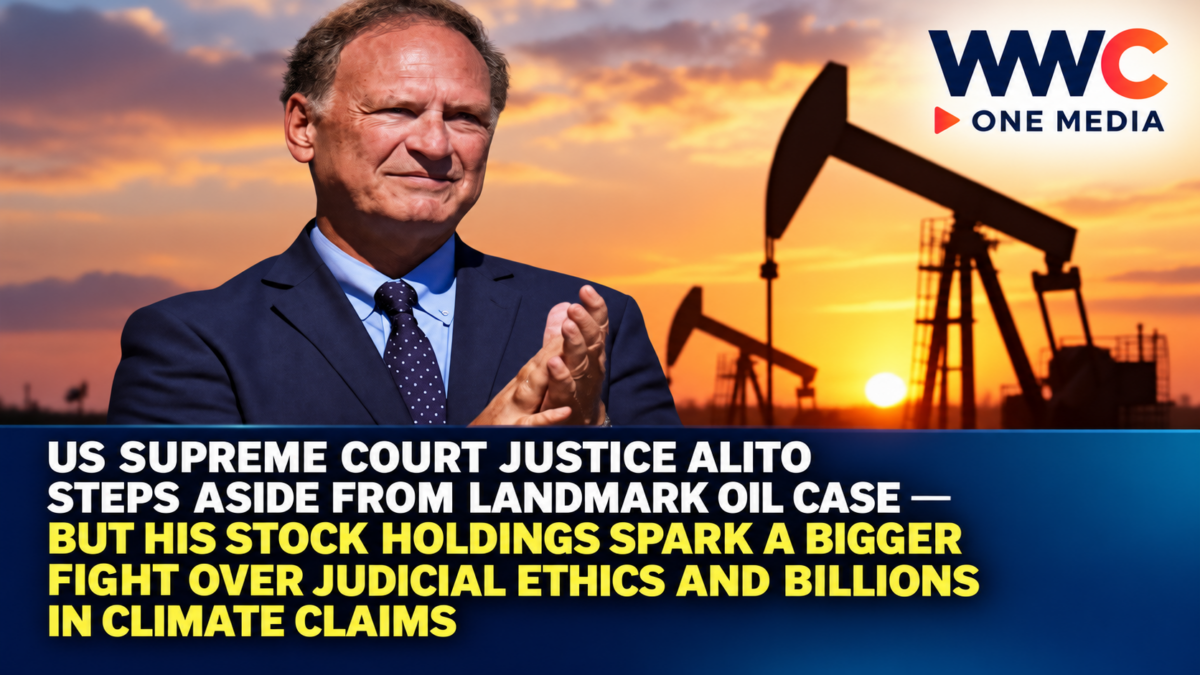
WASHINGTON, UNITED STATES — US Supreme Court Justice Samuel Alito’s decision to withdraw from a landmark climate lawsuit involving ExxonMobil and Suncor Energy has reignited a heated debate over judicial ethics, financial conflicts of interest and the future of billions of dollars in climate-related claims against the fossil fuel industry. With only eight justices now deciding the case, the closely watched dispute could reshape America’s climate litigation landscape — while raising uncomfortable questions about who decides when a Supreme Court justice must step aside.
The United States Supreme Court is facing renewed scrutiny over its ethics and recusal practices after conservative Justice Samuel Alito withdrew from one of the most consequential environmental cases of the court’s new term.
Alito’s decision to step aside from Suncor Energy v. County Commissioners of Boulder County has brought fresh attention to the financial investments held by Supreme Court justices and the procedures used to determine potential conflicts of interest.
According to Bloomberg’s October 10 report, the controversy has revived a longstanding debate about whether the nation’s highest court provides sufficient transparency when its members decide to participate in or withdraw from politically and financially significant cases.
The implications extend beyond Alito himself.
The underlying lawsuit could influence dozens of similar cases brought by American states and local governments seeking compensation from oil companies for climate-related damage.
And because Alito is considered one of the Supreme Court’s most consistently conservative members, his absence could affect the outcome of a case with major consequences for the fossil fuel industry.
Alito Withdraws After Questions About Oil Stock Holdings
The Supreme Court formally notified the parties on September 28 that Alito would no longer participate in the case.
The announcement came just days before oral arguments on October 5.
The court’s initial notice did not provide a detailed explanation for the decision.
However, financial disclosures show that Alito owns shares in several energy companies, including ConocoPhillips and Phillips 66.
Neither company is a direct defendant in the Boulder lawsuit, which names ExxonMobil and Suncor Energy.
Nevertheless, ConocoPhillips and Phillips 66 face separate climate-related litigation involving issues similar to those before the Supreme Court.
Critics argued that a decision favoring the fossil fuel industry could potentially benefit other energy companies, creating questions about whether Alito’s investments presented a conflict.
Reuters and the Associated Press reported that environmental advocates and judicial watchdog organizations had urged Alito to step aside before the court’s announcement.
Alito had also withdrawn when an earlier stage of the Boulder litigation reached the Supreme Court in 2023.
His latest recusal therefore maintains a precedent established during the same legal dispute.
Bloomberg: Alito Says Recusal Was Prudent, Not Legally Required
The controversy deepened when Alito publicly discussed his decision.
In a September 30 interview reported by Bloomberg, the justice explained that stepping aside had been a difficult decision.
He said the Supreme Court’s legal office had advised that disqualification was not required.
Nevertheless, Alito ultimately concluded that recusing himself was the prudent course.
That distinction is important.
A judge may withdraw from a case because the law requires it, or because participation could create reasonable concerns about impartiality even when a direct financial conflict has not been conclusively established.
Alito’s explanation suggests he viewed recusal as an appropriate precaution rather than an acknowledgment of wrongdoing.
There has been no judicial finding that Alito violated ethics rules by previously participating in proceedings involving the case.
However, his decision highlights the difficulty of evaluating conflicts that may arise from financial interests in companies affected indirectly by major court rulings.
The distinction becomes especially complicated when a decision could influence an entire industry rather than only the companies formally named in litigation.
Reuters: ExxonMobil and Suncor Face a Major Climate Liability Challenge
The underlying dispute began in 2018 when Boulder city and county officials in Colorado sued ExxonMobil and Suncor Energy.
The local governments argue that fossil fuel companies contributed to climate change and should help pay for damage and adaptation costs associated with its effects.
Their claims include costs connected to climate-related risks affecting public infrastructure and local communities.
The lawsuit also accuses the companies of misleading the public about the environmental consequences of fossil fuel use.
ExxonMobil and Suncor dispute the claims and argue that federal law prevents Colorado from pursuing certain climate-related claims under state law.
The companies maintain that greenhouse gas emissions and climate change are national and international issues that should not be regulated through potentially conflicting state court lawsuits.
The Trump administration has supported the oil companies’ legal position.
The Supreme Court is not currently deciding how much compensation the companies might owe Boulder.
Instead, the justices are considering a threshold legal question: whether federal law overrides the relevant state-law claims and whether the court should resolve that question at this stage of the proceedings.
The outcome could determine whether Boulder’s lawsuit can advance and could influence similar cases across the United States.
Why Billions of Dollars Could Be at Stake
Although the Supreme Court’s immediate task involves legal jurisdiction and federal preemption, the financial consequences could be substantial.
Across the United States, dozens of state and local governments have filed climate-related lawsuits against major fossil fuel companies.
These cases seek compensation for alleged climate-related damage, including costs associated with flooding, extreme weather, infrastructure protection and environmental adaptation.
The litigation also involves allegations that some companies misrepresented or concealed information about the risks associated with fossil fuel consumption.
If such lawsuits are allowed to continue in state courts, oil companies could face prolonged litigation, expensive discovery proceedings and potentially significant financial liabilities.
However, no nationwide damages award has been established through the current Supreme Court case.
The actual amounts, if any, would depend on separate court proceedings, evidence, applicable laws and future rulings.
Energy companies warn that allowing numerous state-level cases to proceed could create an inconsistent patchwork of legal obligations.
Local governments counter that state law provides established legal avenues to seek compensation for alleged injuries and deceptive business conduct.
The dispute reflects a much larger argument over responsibility for the economic consequences of climate change.
Associated Press: Alito’s Recusal Could Change the Court’s Balance
The Supreme Court normally consists of nine justices.
With Alito withdrawing, only eight members are participating in the Boulder case.
That matters because the court has a six-to-three conservative majority when fully staffed.
Alito’s absence leaves five conservative-appointed justices and three liberal-appointed justices to hear the dispute.
However, judicial outcomes cannot be predicted solely from the political affiliation of the presidents who appointed individual justices.
Some conservative members have expressed concerns about the legal arguments and the appropriate timing of Supreme Court intervention.
A four-to-four tie is now mathematically possible.
If the Supreme Court divides evenly, the judgment under review generally remains in place without creating a nationwide precedent.
In this dispute, that could leave standing the Colorado ruling allowing the litigation to continue.
But such an outcome would not establish that ExxonMobil or Suncor are liable for climate damage.
Nor would it necessarily resolve the legal questions raised in similar cases elsewhere.
The court could also produce a majority ruling, decide the case narrowly or conclude that it should not resolve the central issue at this stage.
Axios: Climate Litigation Could Hinge on a Narrow Ruling
Axios reported on October 6 that the Supreme Court’s questioning revealed uncertainty over how broadly the justices might rule.
Some members appeared concerned about allowing state laws to regulate conduct connected to worldwide greenhouse gas emissions.
Others questioned whether the court should intervene before the litigation advances further in lower courts.
Legal experts have identified several possible outcomes.
The justices could issue a broad decision restricting state-level climate lawsuits.
They could adopt a narrower ruling distinguishing between claims involving emissions regulation and allegations of deceptive business conduct.
Or they could leave some or all of the legal questions for further consideration by lower courts.
Each outcome would have different consequences for fossil fuel companies and governments pursuing climate litigation.
Alito’s absence increases the possibility that the ultimate decision will depend on a narrow majority.
The Supreme Court’s Recusal Rules Face Renewed Scrutiny
Beyond climate litigation, Alito’s withdrawal has renewed attention to the Supreme Court’s internal ethics system.
Federal law requires judges to disqualify themselves in certain circumstances, including where their impartiality might reasonably be questioned or where relevant financial interests create conflicts.
The Supreme Court also adopted its first formal Code of Conduct in 2023.
That document outlines ethical principles concerning impartiality, financial interests and judicial behavior.
However, Supreme Court justices generally determine for themselves whether recusal is necessary.
Unlike some lower-court proceedings, there is no higher judicial body routinely available to review a Supreme Court justice’s recusal decision.
Justices also are not generally required to provide detailed public explanations for every decision to participate in or withdraw from a case.
Critics argue that this arrangement provides insufficient accountability.
Supporters of judicial independence caution that external control over recusal decisions could encourage strategic attempts to remove particular justices from politically sensitive cases.
The debate centers on how to maintain both impartiality and the court’s ability to perform its constitutional responsibilities.
Watchdog Groups Demand Greater Transparency
Judicial watchdog organizations have welcomed Alito’s decision while arguing that the court needs clearer recusal procedures.
Consumer Watchdog, an organization that urged Alito to withdraw, raised concerns that his financial holdings could create the appearance of a conflict when the court considers legal issues affecting the fossil fuel industry.
The organization argued that public confidence requires judges to avoid cases where personal investments could reasonably raise questions about impartiality.
Fix the Court, a group advocating judicial transparency, has also called for justices to explain significant recusal decisions.
Its position is that public explanations would help distinguish mandatory disqualifications from discretionary decisions intended to protect confidence in the judiciary.
However, the fact that a justice owns shares in an industry does not automatically establish a prohibited conflict in every case involving that sector.
The legal analysis depends on the nature of the financial interest, the parties involved and the potential effect of the court’s judgment.
Alito’s case illustrates how difficult those distinctions can become in litigation affecting entire industries.
A Previous Oil-Related Recusal Adds to the Debate
Alito has previously withdrawn from other Supreme Court proceedings involving energy companies.
Bloomberg Law reported that he recused himself from Chevron v. Plaquemines Parish because of holdings in ConocoPhillips, the parent company of a party in that litigation.
That earlier case also involved the petroleum industry’s exposure to lawsuits brought by local governments.
The Supreme Court decided the matter without Alito’s participation.
His history of stepping aside in certain energy-related cases adds context to the latest decision.
It demonstrates that the justice has previously recognized circumstances where financial interests warranted nonparticipation.
But critics continue to question why the court does not provide more consistent and detailed explanations of its recusal decisions.
Why the Case Matters for Global Energy Companies
Although the case concerns American law, international energy companies and investors are following the proceedings closely.
Large oil and gas businesses operate across multiple jurisdictions and face growing legal, regulatory and financial scrutiny over climate-related risks.
A broad Supreme Court decision limiting state-law claims could reduce certain litigation risks for companies operating in the United States.
Conversely, a ruling allowing such claims to proceed could increase the number and complexity of legal battles confronting the industry.
For investors, climate litigation is one factor in assessing long-term financial exposure.
Other considerations include energy prices, production costs, regulations, emissions policies and the pace of the global energy transition.
However, the Supreme Court’s decision will not automatically determine international oil prices or establish a worldwide legal standard for climate-related liability.
Its direct legal effect will concern the interpretation of US law and the proceedings within American courts.
What This Means for the Philippines and Asia
The case also carries broader relevance for countries vulnerable to climate-related disasters, including the Philippines.
Climate change presents significant challenges involving flooding, coastal infrastructure, extreme weather and disaster preparedness.
Governments around the world are exploring different legal and policy mechanisms for addressing climate damage and financing adaptation.
The American litigation may influence debates about corporate accountability, environmental law and financial responsibility.
However, a US Supreme Court ruling would not directly establish liability for energy companies under Philippine law.
The legal frameworks, causes of action and standards of proof are different.
For Asian businesses and investors, the case is also a reminder that legal disputes involving major industries can create long-term uncertainty even before final judgments are issued.
The Bigger Picture: Judicial Ethics and Climate Accountability Collide
Samuel Alito’s withdrawal from the Boulder climate case has transformed an already consequential environmental lawsuit into a broader debate about the credibility and transparency of the US Supreme Court.
The dispute places several major questions before the American judicial system.
Can states and local governments use their own laws to seek compensation from fossil fuel companies over alleged climate damage?
Should federal law prevent certain climate-related claims from proceeding?
And how should Supreme Court justices handle financial investments connected to industries that could benefit from the rulings they issue?
Alito’s recusal does not answer those questions.
But it changes the court’s composition at a potentially decisive moment.
With only eight justices participating, the possibility of an evenly divided court introduces another layer of uncertainty into a case that could influence dozens of lawsuits.
A decision is expected during the Supreme Court’s current term, potentially by late June 2027.
For the oil industry, the stakes involve potentially enormous litigation exposure. For local governments, the outcome could determine whether they can continue pursuing compensation for alleged climate-related damage.
But for the Supreme Court itself, the bigger test may be whether it can convince the public that decisions involving powerful industries and substantial financial interests are being made under transparent and impartial rules.