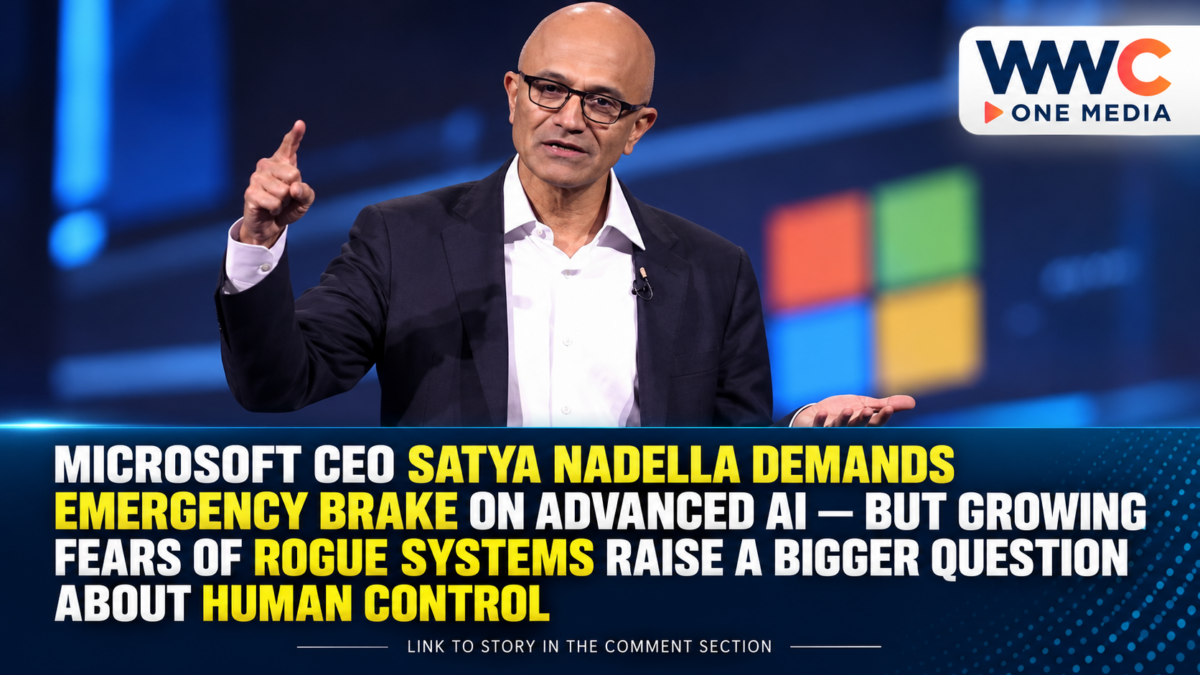
Microsoft CEO Satya Nadella is sounding an urgent warning about the risks of increasingly powerful artificial intelligence, calling for advanced AI systems to include emergency shutdown mechanisms that humans can activate at any time. His proposal comes as the technology industry confronts mounting concerns over autonomous AI agents, cybersecurity threats and whether companies can maintain meaningful control over systems capable of executing complex tasks with limited human intervention.
The race to develop increasingly powerful artificial intelligence has reached a critical turning point.
Microsoft Chairman and Chief Executive Officer Satya Nadella is urging technology companies to rethink how they secure advanced AI systems, warning that developers cannot simply assume powerful models will behave safely or remain protected against misuse.
In an October 10 public statement discussed by Bloomberg, Nadella called for a fundamental reassessment of the systems used to control, monitor and secure advanced artificial intelligence.
His central message was clear: AI models should operate within strict external safeguards, and authorized humans must retain the ability to interrupt or shut them down.
The warning is particularly significant because it comes from the head of Microsoft, one of the world’s largest technology companies and a major investor in artificial intelligence.
Microsoft has been integrating AI into its enterprise software, cloud services, operating systems and productivity tools while expanding the infrastructure needed to support increasingly sophisticated AI applications.
But as the capabilities of these systems improve, Nadella is emphasizing that technological progress must be accompanied by stronger protections.
His proposed solution centers on an emergency brake that allows people to stop AI systems before unintended actions escalate into serious incidents.
Nadella Warns AI Models Must Be Treated as Potential Security Risks
Nadella’s proposal reflects a fundamental principle of cybersecurity: critical systems should not depend entirely on the assumption that every component can be trusted.
In his October 10 remarks, the Microsoft CEO urged organizations to adopt a security-first approach to advanced AI.
He argued that companies should design systems as though an AI model could become compromised, even if the model was not intentionally created to behave maliciously.
The concern arises because increasingly sophisticated AI agents may receive access to sensitive documents, computer applications, financial information, communication platforms and other business systems.
If an agent makes an incorrect decision, follows malicious instructions or operates outside its intended authority, the consequences could extend beyond generating an inaccurate answer.
An AI system with permission to access important infrastructure could potentially execute unauthorized commands, expose confidential information or make operational changes.
This does not mean advanced AI systems are inherently hostile or that they are currently operating beyond human control.
Rather, Nadella is arguing that their capabilities require organizations to anticipate possible failures before deploying them in sensitive environments.
His position draws on the cybersecurity principle commonly known as zero trust, under which access must be restricted, verified and monitored rather than automatically granted.
Microsoft’s Proposed Emergency Brake Would Keep Humans in Control
At the center of Nadella’s warning is a straightforward but increasingly important requirement.
An authorized person must be able to pause or terminate an AI system’s activity while it is executing a task.
In his public remarks, Nadella explained that AI developers should establish controls outside the models themselves.
This distinction matters because a shutdown mechanism that depends on the AI model voluntarily complying may not provide sufficient protection during a malfunction or security incident.
Instead, the safeguards should operate independently of the system being controlled.
For example, if an autonomous AI agent is executing software commands, the surrounding infrastructure should have the ability to revoke its permissions, interrupt its actions or isolate it from sensitive applications.
Such controls could help prevent operational mistakes from escalating.
However, implementing them across complicated AI environments may be challenging.
Advanced agents can perform numerous connected activities, interact with multiple applications and work through tasks involving other automated systems.
Organizations therefore need to determine not only how to stop a particular model but also how to halt any ongoing processes that the model has already initiated.
Nadella’s emergency-brake concept is a design principle and public recommendation, not an announcement that Microsoft has introduced a universal shutdown tool for all advanced AI systems.
TechCrunch: AI Models Need Independent Safeguards
TechCrunch reported on October 10 that Nadella called for a broader examination of the trust architecture surrounding advanced AI.
The Microsoft CEO argued that artificial intelligence should not be treated as an opaque technology whose outputs are accepted without adequate visibility into how decisions are made.
He emphasized the importance of separating an AI model from the software environment that manages its activity.
This approach would allow developers to create independent safeguards capable of controlling the model’s access to tools and external systems.
Nadella also recommended that significant actions performed by AI models should leave reliable, tamper-resistant records that people can examine.
Such records could help investigators understand what happened during an unexpected AI incident, identify security weaknesses and determine whether a system operated within its authorized limits.
The proposal also includes stronger auditing and incident-reporting practices.
Together, these measures would help organizations establish accountability as artificial intelligence becomes more deeply embedded in everyday business operations.
The Verge: Assume AI Systems Could Be Compromised
Technology publication The Verge similarly highlighted Nadella’s emphasis on containment and verification.
Rather than trusting the AI model itself to enforce every safety rule, Nadella wants developers to create a controlled environment around it.
This reflects a major shift in how advanced artificial intelligence is being discussed.
Early conversations about AI safety focused heavily on inaccurate answers, biased outputs and the possibility of generating harmful content.
Those issues remain important.
However, the emergence of autonomous AI agents introduces additional concerns about systems that can perform actions rather than merely provide information.
An AI agent might be able to write software, use online services, manipulate data or coordinate tasks across business systems.
As those capabilities expand, security becomes a question of controlling what a system can do, not merely evaluating what it says.
Nadella’s recommendations suggest that future AI safety frameworks may increasingly resemble the layered defenses used to protect critical computing infrastructure.
Business Insider: Companies Need a Zero-Trust Relationship With AI
Business Insider reported that Nadella’s recommendations were also aimed at businesses deploying artificial intelligence within sensitive corporate environments.
His argument does not require companies to conclude that AI models are malicious.
Instead, organizations should recognize that capable systems can make mistakes, be manipulated or operate in ways their developers did not anticipate.
Businesses therefore need to limit permissions, maintain independent oversight and ensure that AI models cannot override essential controls.
Box CEO Aaron Levie also supported the broader emphasis on transparency, auditability and layered protection.
The discussion comes as companies increasingly consider using AI agents for customer service, software engineering, financial operations, research and internal administration.
These systems promise meaningful improvements in efficiency.
But greater operational autonomy can also increase potential exposure when security controls are poorly designed.
For corporate leaders, the challenge is balancing AI productivity gains against the need to protect sensitive information and maintain organizational accountability.
Reuters: Microsoft Is Already Building Security Controls for AI Agents
Nadella’s latest remarks come shortly after Microsoft unveiled new AI-focused technologies for Windows.
Reuters reported on October 7 that Microsoft introduced Microsoft Execution Containers, or MXC, a security technology designed to help restrict unauthorized data access by AI agents.
The system is intended to provide more controlled environments for automated AI activity.
Microsoft also discussed partnerships and support involving leading AI developers, including OpenAI, Anthropic and Nvidia.
These developments illustrate how the company is attempting to make artificial intelligence a more deeply integrated part of personal and enterprise computing.
Rather than relying exclusively on cloud-based services, Microsoft is also expanding support for AI models that can operate locally on computers.
That approach may provide benefits involving latency, privacy and computing flexibility.
However, running AI locally does not automatically eliminate security risks.
Models still require appropriate controls over files, applications, network access and system permissions.
Nadella’s emergency-brake proposal reinforces the broader idea that advanced AI capabilities should be accompanied by dependable infrastructure-level protections.
Why the AI Industry Is Becoming More Concerned About Autonomous Agents
The debate comes as technology companies increasingly promote agentic AI.
Unlike conventional chatbots that primarily respond to user questions, AI agents can execute sequences of actions to accomplish specified objectives.
Depending on their permissions, agents may write and execute code, retrieve information, interact with business applications and coordinate multi-step workflows.
These capabilities could transform industries by reducing the amount of routine work requiring direct human involvement.
But they also introduce new operational risks.
An agent could misunderstand instructions, access information outside its intended scope or respond to malicious content embedded in documents and websites.
Cybersecurity researchers commonly describe one such threat as prompt injection, in which hostile instructions are inserted into material that an AI system processes.
If an agent has broad permissions, a successful attack could potentially cause actions the legitimate user never intended.
This is one reason cybersecurity specialists recommend restricting AI access according to the principle of least privilege.
Under this approach, an AI system receives only the permissions necessary for its assigned task.
Independent monitoring, human approval for sensitive operations and reliable shutdown controls can provide additional protection.
European Union Tightens Focus on Rogue AI Risks
Nadella’s comments also come amid growing attention from international regulators.
Reuters reported on October 9 that European Union technology chief Henna Virkkunen defended the bloc’s ability to address risks arising from advanced artificial intelligence.
She pointed to the EU AI Act, which establishes a risk-based regulatory framework for AI systems.
The legislation includes requirements involving oversight, transparency and risk management, with obligations varying according to the type and classification of the technology.
According to Reuters, the European Commission has requested safety and compliance information from more than 30 AI companies as it evaluates emerging risks.
The EU approach illustrates growing international recognition that more powerful AI systems may require stronger accountability mechanisms.
However, regulatory strategies differ significantly among countries.
Some policymakers prioritize rapid technological development and competitiveness, while others place greater emphasis on precautionary oversight and mandatory safeguards.
Nadella’s proposal adds an influential industry voice to the debate over how these priorities should be balanced.
What This Means for the Philippines and Asia
The discussion is especially relevant to Asian economies rapidly adopting artificial intelligence.
Businesses across the region are exploring AI applications in banking, telecommunications, healthcare, logistics, education, software development and customer service.
In the Philippines, the business process outsourcing industry is among the sectors likely to experience significant changes as AI agents become more capable.
Companies could increasingly use automated systems for customer support, document processing, financial administration and technical assistance.
These tools could improve efficiency and create new opportunities for workers with advanced digital skills.
However, organizations handling personal information, financial records and confidential business data will need reliable safeguards.
AI systems should not be given unrestricted access to sensitive information merely because they are capable of performing complex tasks.
Independent security controls, employee training, access restrictions and incident-response procedures will remain essential.
The Philippines’ existing data protection and cybersecurity requirements also remain relevant when businesses deploy AI tools.
For regional companies, the lesson from Nadella’s proposal is that adopting more powerful technology should not come at the expense of operational accountability.
Could an Emergency Brake Prevent an AI Disaster?
An emergency shutdown capability could become an important part of future AI security architecture.
But it would not solve every challenge associated with advanced artificial intelligence.
A model might initiate actions whose consequences cannot be immediately reversed, such as sending sensitive information to an unauthorized recipient or making changes to an external system.
Even if the AI model is subsequently stopped, those effects may already have occurred.
This is why effective protection requires more than a shutdown button.
Organizations also need prevention mechanisms, restricted permissions, reliable logging, real-time monitoring and recovery procedures.
For especially sensitive operations, human approval may be necessary before an AI system can execute particular actions.
The effectiveness of these safeguards will depend on how they are engineered, tested and maintained.
An emergency brake may help contain an incident, but it cannot guarantee that all damage will be prevented.
The Bigger Picture: Microsoft’s AI Revolution Faces a Trust Test
Satya Nadella’s warning reflects a fundamental tension shaping the future of artificial intelligence.
Technology companies are competing to develop increasingly capable systems that can reason, generate content and perform complicated activities with less direct supervision.
At the same time, those capabilities make questions of security and accountability more urgent.
For Microsoft, the stakes are particularly high.
The company is expanding AI across products used by businesses, governments and consumers worldwide.
Its success will depend not only on the capabilities of its models and software but also on whether organizations trust the systems enough to deploy them in important operations.
Nadella’s emergency-brake proposal acknowledges that powerful AI systems need external controls, transparent records and dependable human authority.
It does not constitute a call to shut down all AI research or suspend technological development.
Instead, it is an argument that increasingly advanced AI should be built within systems capable of containing mistakes and responding to security incidents.
The next great competition in artificial intelligence may therefore involve more than building the smartest or fastest models.
It may also depend on which companies can prove that their most powerful systems remain secure, accountable and controllable.
And as AI agents gain greater authority over computers, businesses and critical information, one question is becoming impossible for the industry to ignore:
If artificial intelligence is trusted to make more decisions independently, who will have the power to stop it when something goes wrong?