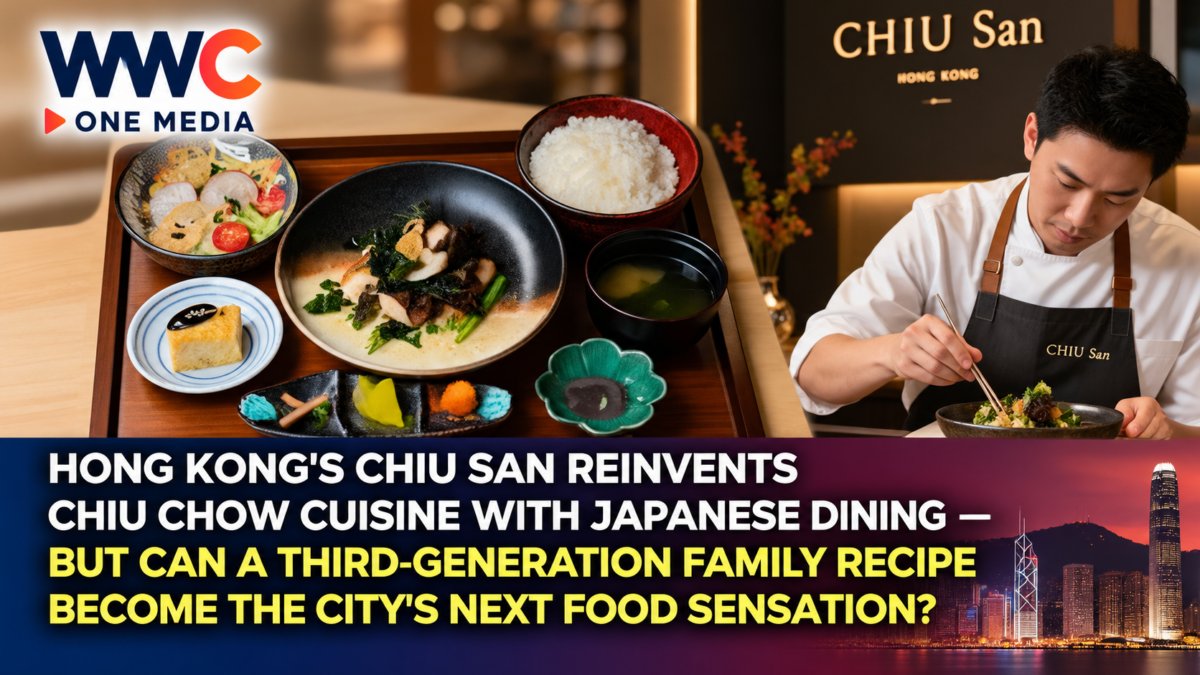
HONG KONG — October 10, 2026 — A new restaurant in Hong Kong is turning traditional Chiu Chow cooking into one of the city’s most intriguing dining experiments, combining family recipes passed down through generations with the precision, presentation and structure of Japanese cuisine.
CHIU San, a recently opened restaurant in Kennedy Town, is attracting attention for its unusual fusion concept, which brings together the rich flavors of Chiu Chow food and Japan’s familiar teishoku-style set meals.
The restaurant was launched by third-generation descendants of a longstanding Chiu Chow restaurant family, offering a contemporary interpretation of their culinary heritage.
Rather than presenting traditional dishes exactly as they have been served for decades, the team has developed a menu that mixes regional Chinese ingredients and seasonings with Japanese cooking techniques.
Its signature dishes include salt-grilled yellow croaker with homemade miso sauce, stone-grilled beef short ribs with Chiu Chow satay and teriyaki, and pomegranate-shaped chicken dumplings.
The restaurant is also using modern design, graffiti-inspired branding and lifestyle merchandise to appeal to younger diners.
But the bigger question is whether CHIU San can transform an experimental culinary concept into a lasting restaurant brand without losing the traditions that make Chiu Chow cuisine distinctive.
A New Culinary Concept Arrives in Kennedy Town
CHIU San opened in August 2026 on North Street in Kennedy Town, an established Hong Kong neighborhood that has become increasingly associated with independent restaurants and contemporary cafés.
Its concept is built around the meeting of two Asian culinary traditions.
Chiu Chow cuisine, also commonly known as Teochew cuisine, originates from the Chaoshan region of Guangdong province in southern China.
It has a long history in Hong Kong, where Chiu Chow communities have helped establish restaurants serving seafood, braised meats, pickled vegetables and other regional specialties.
Japanese cuisine, meanwhile, is known for carefully structured meals, seasonal ingredients and detailed presentation.
CHIU San brings these traditions together in a casual dining format.
The restaurant’s founders are not abandoning their family’s heritage.
Instead, they are adapting familiar flavors for an audience that may be more accustomed to Japanese set meals and contemporary fusion dining.
Third-Generation Restaurateurs Give Tradition a New Identity
One of the most compelling elements of CHIU San’s story is its family background.
The restaurant is operated by third-generation descendants of a longstanding Chiu Chow dining business.
That heritage gives the concept a foundation beyond the novelty of combining different cuisines.
Recipes and techniques associated with regional cooking can carry memories of family meals, cultural celebrations and community identity.
For younger restaurateurs, however, preserving tradition does not necessarily mean recreating an older restaurant format.
CHIU San’s team has chosen to reinterpret established flavors through a Japanese-inspired menu.
This approach may introduce Chiu Chow cooking to customers who have never visited a traditional Chiu Chow restaurant.
It also raises a familiar challenge for family food businesses.
How much can a recipe change before customers begin to question its authenticity?
The answer will depend partly on whether the new dishes retain recognizable links to the original culinary tradition.
Japanese Teishoku Meals Meet Chiu Chow Flavors
The menu centers on four Japanese-style teishoku sets.
A teishoku is a structured meal typically served with a main dish, rice, soup and accompaniments.
At CHIU San, that format is used to showcase ingredients and flavors associated with Chiu Chow cooking.
The restaurant’s sets include a main dish accompanied by items such as soup, rice and pickles.
This gives diners an opportunity to experience the combination as a complete meal rather than ordering several unfamiliar dishes individually.
The structure also makes the restaurant attractive to customers seeking a convenient lunch or casual dinner.
Independent dining coverage lists the signature sets at approximately HK$138 to HK$158, depending on the selected main dish.
Menu prices may change, so diners should verify current offerings before visiting.
Salt-Grilled Yellow Croaker Meets Homemade Miso Sauce
One of the restaurant’s featured dishes is salt-grilled yellow croaker with homemade miso sauce.
Seafood is central to many Chiu Chow culinary traditions.
Japanese cuisine also places considerable emphasis on fish and careful preparation that preserves natural flavor.
The pairing therefore has a clear culinary rationale.
Grilling allows the fish to develop a lightly charred exterior, while the miso-based sauce introduces a savory Japanese element.
The dish reflects CHIU San’s broader strategy.
Instead of combining unrelated ingredients merely for novelty, it uses overlapping culinary strengths to create a recognizable but different eating experience.
The yellow croaker set has been listed at approximately HK$138 in local dining guides.
Its popularity and long-term performance, however, cannot be established from promotional coverage alone.
Beef Short Ribs Combine Chiu Chow Satay and Japanese Teriyaki
Another standout is the stone-grilled beef short rib.
The dish combines Chiu Chow satay sauce with Japanese-style teriyaki flavors.
The result is a blend of savory, aromatic and sweet elements.
According to Time Out Hong Kong, the restaurant uses a house-blended Chiu Chow satay and teriyaki sauce to finish the beef.
The stone-grilling presentation adds a visual and sensory element to the meal.
The beef set has been advertised at approximately HK$158.
For customers familiar with Japanese beef dishes, the addition of Chiu Chow seasoning offers a different flavor profile.
For those who grew up eating Chiu Chow food, the dish provides a new presentation of familiar ingredients.
That dual appeal is central to the restaurant’s identity.
A Smoking-Dome Chicken Dish Adds Theater
CHIU San also offers a soy-glazed fish sauce chicken thigh finished with black garlic oil.
The dish is presented under a smoking dome, adding a theatrical element to the dining experience.
Its flavor profile connects regional Chinese seasonings with Japanese-influenced presentation.
Fish sauce and soy-based marinades can create a deep savory character.
Black garlic oil adds another layer of aromatic richness.
The smoking-dome presentation also makes the dish visually distinctive.
In an era when diners frequently discover restaurants through social media, presentation can be commercially important.
A memorable dish can generate customer photographs, videos and word-of-mouth interest.
However, striking presentation alone does not guarantee repeat visits.
Taste, consistency, service and value remain essential to a restaurant’s long-term success.
Pomegranate-Shaped Dumplings Put a Creative Spin on Tradition
One of CHIU San’s smaller dishes is a pomegranate-shaped chicken dumpling.
The preparation draws on a traditional Chinese dumpling form associated with festive presentation.
The restaurant’s version contains ingredients including chicken, ham and shiitake mushrooms.
It is finished with fish roe, creating a combination of different textures and flavors.
Time Out describes the dumpling as fried until golden, making it a contrast to the steamed dumplings commonly associated with Chinese dining.
The item has been listed at approximately HK$28.
Its compact format allows customers to experiment with the fusion concept without ordering a full additional meal.
For the restaurant, small plates can also encourage sharing and introduce diners to dishes that do not fit neatly into the set-meal format.
Even Desserts Reflect the Cross-Cultural Experiment
The Chiu Chow-Japanese approach extends to smaller sweets and snacks.
One reported example is a matcha crystal sweet dumpling, combining a recognizable Japanese green-tea flavor with a Chinese-inspired dessert format.
Matcha has become a widely used ingredient in Asian cafés and dessert shops.
Its distinctive taste and green color make it suitable for desserts that balance sweetness with a slightly bitter flavor.
CHIU San uses such combinations to reinforce its broader concept.
The menu is not simply a traditional Chinese meal followed by Japanese dessert.
Instead, the cuisines are blended throughout the dining experience.
Local guides have listed the matcha sweet dumpling at approximately HK$18.
As with other menu items, availability and prices should be confirmed directly with the restaurant.
Graffiti and Merchandise Make CHIU San More Than a Restaurant
CHIU San’s branding is intentionally contemporary.
The restaurant features a bold graffiti-style exterior and sells branded lifestyle merchandise.
Reported products include clothing, bags and smaller accessories.
This creates a different impression from a conventional family-run Chinese restaurant.
Rather than relying exclusively on food and interior design, the business is attempting to develop an identity that customers can recognize beyond the dining table.
A distinctive visual brand may help attract attention online.
Merchandise can also give loyal customers another way to engage with the restaurant.
But expanding into lifestyle products introduces additional considerations.
Restaurants must balance branding expenses with their core food, labor and operating costs.
A recognizable logo or popular social media photograph cannot substitute for a sustainable dining business.
Why Chiu Chow and Japanese Cuisine Can Work Together
The pairing may sound unexpected, but it has several logical culinary connections.
Both traditions place value on seafood and the natural flavor of ingredients.
Savory depth, careful seasoning and contrasting textures are important in both cuisines.
Chiu Chow cooking frequently uses ingredients such as soy-based sauces, pickled vegetables, preserved products and aromatic condiments.
Japanese dishes commonly incorporate miso, soy sauce, pickles and broths that provide balance and umami.
These similarities make it possible to combine familiar components without forcing an entirely unrelated flavor profile.
At the same time, the two traditions have distinct histories and methods.
The challenge for chefs is to create something that feels deliberate rather than simply adding a Japanese ingredient to a Chinese recipe.
CHIU San’s strongest menu concepts are those in which the combination supports the dish rather than overshadowing it.
Hong Kong’s Restaurant Market Is Embracing More Culinary Experiments
CHIU San’s arrival comes amid a series of new restaurant openings across Hong Kong.
Local dining publications have highlighted new ventures offering regional Chinese cooking, Japanese-inspired menus, Korean desserts and European concepts.
The competition is substantial.
Restaurants must attract customers who have a wide range of dining options across different price points.
A new concept can help an establishment stand out.
However, novelty can fade quickly in a competitive market.
For CHIU San, maintaining customer interest will depend on food quality, service, affordability and the ability to evolve its menu without losing its identity.
The restaurant’s family background may provide a competitive advantage by giving its dishes a story and cultural foundation.
But successful execution will determine whether that advantage translates into a durable business.
The Business Opportunity Behind Modernizing Traditional Cuisine
CHIU San represents a broader business idea: established food traditions can provide the foundation for new restaurant concepts.
Family operators may possess recipes, supplier relationships and cooking expertise that newer businesses cannot easily reproduce.
Younger generations can combine those strengths with modern branding, digital marketing and new menu formats.
That can help traditional cuisine reach customers who might otherwise overlook it.
The strategy is not without risk.
Longtime customers may prefer familiar dishes and presentations.
New customers may be attracted by novelty but expect prices and service comparable with other contemporary restaurants.
Balancing those groups requires a clear understanding of the target market.
CHIU San is attempting to use its Chiu Chow heritage as a point of differentiation rather than treating it as a limitation.
What CHIU San’s Concept Means for Other Asian Restaurants
The restaurant offers an example relevant to food entrepreneurs throughout Asia.
Traditional dishes can be adapted without necessarily abandoning their cultural roots.
Restaurants in the Philippines, Singapore, Malaysia and other markets regularly explore new interpretations of familiar flavors.
But successful fusion requires more than combining ingredients from different countries.
The resulting dishes must make culinary sense, meet customer expectations and remain commercially viable.
CHIU San’s approach demonstrates how the structure of one cuisine can be used to introduce the flavors of another.
Its Japanese set-meal format may make Chiu Chow dishes easier for new customers to approach.
For restaurateurs, the larger lesson is that cultural heritage and innovation do not have to be opposing strategies.
They can strengthen one another when the concept is coherent.
What Diners Should Know Before Visiting
CHIU San is located at Shop A, ground floor, 16 North Street, Kennedy Town, Hong Kong Island.
The restaurant is listed by Time Out Hong Kong and other local dining guides as a casual Chiu Chow-Japanese fusion establishment.
Its menu is centered on four teishoku sets, alongside smaller dishes and desserts.
Local reporting places signature sets at approximately HK$138 to HK$158.
Some guides describe the restaurant as walk-in-only, while another provides a WhatsApp contact for booking inquiries.
Because booking procedures and opening hours can change, visitors should check the restaurant’s current arrangements before making a special journey.
There is no verified Michelin award or formal international restaurant ranking associated with CHIU San in the sources reviewed.
Its growing visibility comes primarily from local dining coverage and the novelty of its concept.
The Bigger Picture: Can Heritage Become Hong Kong’s Next Dining Trend?
The success of CHIU San could offer an interesting indication of how Hong Kong diners respond to modern interpretations of regional Chinese cuisine.
The city has a deep culinary history shaped by migration, trade and international influences.
Its restaurants have long combined different food traditions.
What makes CHIU San distinctive is its deliberate focus on Chiu Chow flavors within a Japanese meal structure.
The concept gives a younger generation of restaurateurs an opportunity to introduce family cooking to a different audience.
However, its future depends on factors that cannot yet be measured from opening coverage alone.
Customer retention, operating costs, menu development and sustained demand will all matter.
Early media attention can help create curiosity.
Building a long-lasting restaurant requires turning that curiosity into repeat business.
THE BOTTOM LINE
Hong Kong’s CHIU San is bringing together Chiu Chow and Japanese cuisine in a new restaurant concept in Kennedy Town.
Opened in August 2026 by third-generation descendants of a longstanding Chiu Chow restaurant family, the venue uses Japanese-style teishoku meals to showcase regional Chinese flavors.
Its signature dishes include grilled yellow croaker with homemade miso, beef short ribs with Chiu Chow satay and teriyaki, and inventive small plates.
The restaurant also uses graffiti-inspired branding and merchandise to appeal to contemporary diners.
The bigger question is whether CHIU San can turn a clever fusion idea into a sustainable dining business while protecting the family food traditions that inspired it.
Hong Kong has no shortage of creative restaurants. But CHIU San is betting that the city’s next memorable dining concept could come not from abandoning tradition — but from giving it an unexpected Japanese twist.