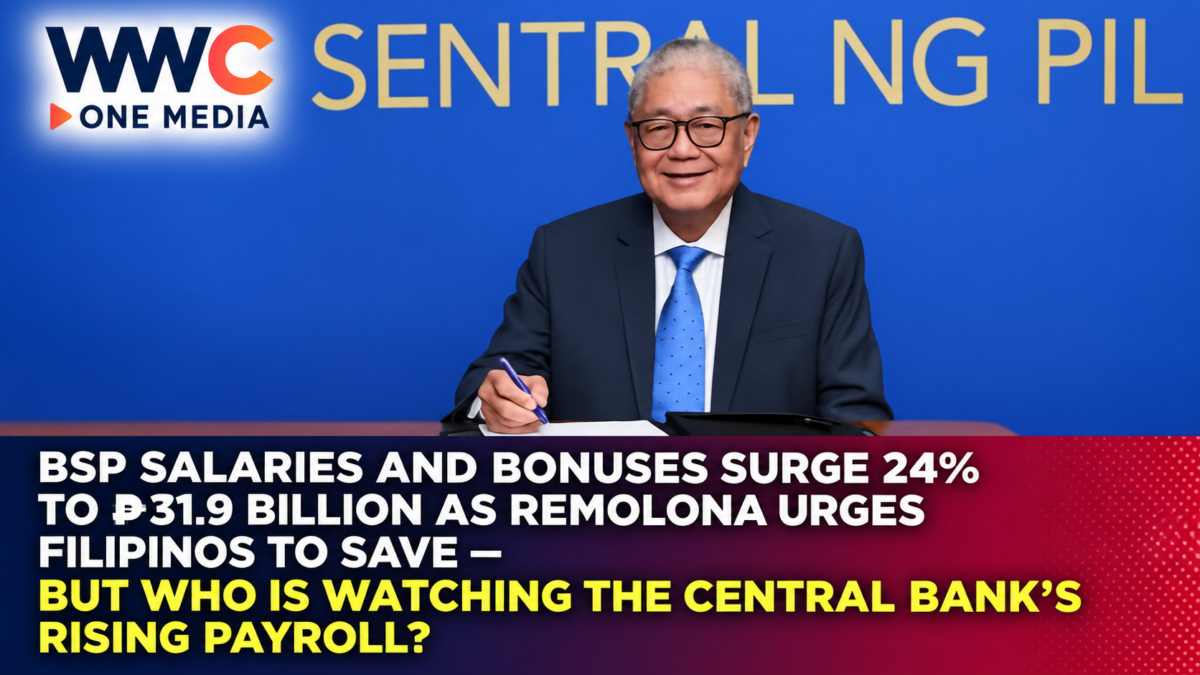
MANILA, Philippines — The Bangko Sentral ng Pilipinas (BSP) is facing renewed questions about government compensation and financial accountability after its spending on salaries, allowances and bonuses surged 24.3% to ₱31.93 billion in 2025, nearly doubling over four years even as its workforce expanded at a much slower pace.
The sharp increase has drawn attention because BSP Governor Eli Remolona Jr. recently urged Filipinos to save more and rethink their spending habits as the country grapples with a weak peso, rising prices and economic uncertainty.
According to an October 5 report by Bilyonaryo, based on the central bank’s audited financial statements, the BSP spent ₱6.24 billion more on salaries, allowances and bonuses in 2025 than it did in 2024.
However, employee headcount increased by only 4.8%, raising questions about how much of the additional spending reflected higher compensation, benefits, incentives or changes in the bank’s workforce structure.
The findings have placed one of the Philippines’ most financially independent public institutions under greater scrutiny.
The bigger question is whether the central bank can justify its rapidly increasing compensation costs while encouraging ordinary Filipinos to exercise greater financial discipline.
BSP Payroll Jumps ₱6.24 Billion in Just One Year
The BSP’s spending on salaries, allowances and bonuses reached ₱31.93 billion in 2025, compared with ₱25.69 billion in 2024.
That represents an increase of approximately 24.3%.
During the same period, the central bank’s workforce grew from 6,510 to 6,825 employees.
The addition of 315 workers translated into headcount growth of just 4.8%.
The difference is striking.
While the number of employees increased by less than 5%, aggregate salary, allowance and bonus spending grew roughly five times as fast.
This suggests that additional hiring alone cannot explain the rise.
However, the available figures do not establish precisely how much of the increase resulted from basic salary adjustments, performance incentives, allowances, staff promotions, changes in employee mix or other compensation components.
A more detailed breakdown would be necessary to identify the principal drivers of the increase.
BSP Compensation Spending Nearly Doubles Since 2021
The longer-term comparison is even more substantial.
In 2021, the BSP employed 5,575 people and spent approximately ₱16.16 billion on salaries, allowances and bonuses.
By the end of 2025, its workforce had increased to 6,825 employees.
That represents employee growth of approximately 22.4% over four years.
But aggregate compensation spending increased by approximately 97.6% during the same period.
In peso terms, the central bank was spending around ₱15.77 billion more on salaries, allowances and bonuses in 2025 than it was in 2021.
The increase occurred across a period involving changing inflation conditions, monetary policy challenges and growing demands on financial regulators.
However, a near-doubling of nominal compensation spending does not necessarily mean individual employee salaries doubled.
Changes in workforce composition, compensation structures, inflation and benefit payments can all influence aggregate figures.
For accountability purposes, those factors should be examined separately.
Remolona’s Own Compensation Reaches ₱52.76 Million
The spotlight has also returned to BSP Governor Eli Remolona Jr.’s personal compensation.
According to the Commission on Audit’s 2025 Report on Salaries and Allowances, Remolona received approximately ₱52.76 million in compensation during the year.
That placed him at the top of the list of highest-paid non-elected Philippine government officials.
His compensation rose from approximately ₱47.97 million in 2024 and ₱35.48 million in 2023.
The increase from 2023 to 2025 was approximately 48.7%.
The Philippine Star reported that his 2025 remuneration included approximately ₱12 million in basic salary, ₱18.02 million in allowances and ₱21.67 million in bonuses, incentives and benefits.
Additional compensation categories account for the remainder of the total.
The report also identified several other senior BSP officials among the government’s highest-paid executives.
In fact, 15 BSP officials appeared among the top 20 highest-paid government officials in the Commission on Audit’s report.
The findings have intensified public debate about compensation levels within the central bank.
However, the figures come from official compensation disclosures and should not be interpreted as evidence of illegal payments or misconduct.
Why BSP Officials Earn More Than Most Government Employees
Unlike many government agencies, the BSP operates under a legal framework granting it substantial fiscal and administrative autonomy.
Its charter allows the Monetary Board to establish compensation structures based on job evaluations, wage surveys and other considerations.
According to a May 2026 GMA News explainer, the arrangement was designed to help the BSP attract and retain highly qualified professionals.
Central banking requires specialized expertise in monetary policy, banking supervision, financial markets, economics, payments and risk management.
These skills are also in demand among private financial institutions and international organizations.
The ability to offer competitive compensation can therefore help the central bank recruit and retain experienced personnel.
This provides an important justification for salary arrangements that differ from those used by ordinary national government agencies.
However, fiscal autonomy does not eliminate the need for transparency and accountability.
The debate is not simply whether central bank employees should receive competitive salaries.
It is whether compensation increases are adequately explained, independently reviewed and proportionate to the institution’s responsibilities and performance.
Palace Previously Defended High BSP Compensation
The controversy is not entirely new.
In May 2026, Malacañang addressed questions about the substantial remuneration received by top BSP officials.
The issue arose after the Commission on Audit published its annual government compensation report.
Palace Press Officer Claire Castro discussed the BSP’s compensation structure during a May 25 press briefing.
The administration noted the central bank’s separate legal authority over employee remuneration.
That explanation is consistent with the BSP’s charter, which gives its governing body greater flexibility in setting salaries and benefits.
However, the latest financial statements raise a broader question than the compensation of a handful of senior officials.
They show that overall salaries, allowances and bonuses across the institution increased substantially.
That creates a need to examine spending patterns throughout the organization rather than focusing exclusively on the governor’s remuneration.
Remolona Urges Filipinos to Save More as Peso Weakens
The payroll figures have attracted particular attention because of Remolona’s remarks on Filipino spending habits.
During a Senate finance committee hearing on August 27, 2026, the BSP governor discussed the country’s relatively low savings rate and consumption patterns.
He urged Filipinos to increase their savings as a longer-term response to economic vulnerabilities.
Remolona also described what he viewed as a culture of excessive consumption, using the Filipino expression “mayabang tayo.”
His remarks were made during discussions about the peso’s weakness and the broader economic pressures facing the country.
The comments generated criticism because many Filipino households already face significant challenges in balancing essential expenses with limited disposable income.
For lower-income households, saving more may be difficult when food, transportation, housing and other basic costs absorb most earnings.
Remolona’s policy argument concerned national savings behavior and its long-term economic implications.
Nevertheless, the contrast between that message and the BSP’s rapidly rising compensation bill has become a politically sensitive issue.
It raises questions about consistency between the financial discipline encouraged among the public and the spending practices of a major public institution.
Total BSP Personnel Costs Reach ₱41.91 Billion
Salaries, allowances and bonuses represent only part of the central bank’s personnel-related spending.
According to the financial figures reported by Bilyonaryo, total spending on personnel services, benefits and training reached approximately ₱41.91 billion in 2025.
That was 21.3% higher than the ₱34.55 billion recorded in 2024.
The total includes nearly ₱9.6 billion in retirement, social security and other employee benefits.
These amounts illustrate the scale of the BSP’s obligations to current and former personnel.
However, the figures should not be confused with the ₱31.93-billion salary, allowance and bonus bill.
The broader ₱41.91-billion total includes additional personnel-related categories.
Combining the two amounts would double-count some expenses.
The distinction is important when assessing the central bank’s overall spending.
It is also necessary to separate ongoing employee compensation from other benefit obligations when evaluating long-term cost trends.
BSP’s Underlying Profit Declines Despite Higher Net Income
The central bank’s compensation growth occurred alongside mixed financial results.
According to Bilyonaryo’s review of its financial statements, BSP profit before foreign-exchange fluctuations fell to approximately ₱65.30 billion in 2025 from ₱72.53 billion in 2024.
That represents a decline of about 10%.
Meanwhile, reported net income increased to ₱124.62 billion, supported by approximately ₱58.94 billion in foreign-exchange gains.
The difference illustrates how currency movements can influence central bank financial statements.
Higher net income does not necessarily mean every component of operating performance improved.
Similarly, gains associated with gold reserves or foreign-exchange movements should not automatically be treated as recurring operating earnings.
These distinctions matter when comparing personnel expenses with financial performance.
However, a central bank is not a conventional commercial corporation.
Its primary responsibilities involve maintaining price stability, supporting financial stability and implementing monetary policy rather than maximizing accounting profit.
Its performance should therefore be assessed against its public mandate as well as financial efficiency.
What Do Ordinary Filipinos Have to Do With BSP Salaries?
The BSP’s compensation structure may appear distant from the daily concerns of Filipino households.
But the institution plays a central role in the country’s economic and financial system.
Its monetary policy decisions influence interest rates, credit conditions and inflation expectations.
Its supervisory functions help protect the banking system and maintain confidence in financial institutions.
Its payments initiatives also affect how individuals and businesses transfer money.
This gives the BSP considerable responsibility.
Competitive compensation may support the quality of its technical workforce.
At the same time, the public has a legitimate interest in whether a major public institution uses its financial resources efficiently and transparently.
The central bank’s financial autonomy does not make its spending irrelevant to the national interest.
Public confidence depends partly on whether institutions can clearly explain how their compensation arrangements support their responsibilities.
Lawmakers Raise Concerns About High Compensation
Some lawmakers have already questioned the scale of remuneration received by senior BSP officials.
In May 2026, ACT Teachers party-list Representative Antonio Tinio criticized the high salaries of central bank executives compared with compensation levels elsewhere in government.
His comments reflected concern about whether substantial remuneration was justified by institutional performance.
Supporters of the BSP’s special salary structure argue that central banking involves complex responsibilities and competition with private financial institutions for specialized expertise.
Critics, meanwhile, question whether the compensation gap is appropriate given broader economic pressures facing the country.
Both arguments raise issues that deserve evaluation.
The legal authority to pay higher salaries provides an explanation for why compensation levels differ.
It does not independently demonstrate that every increase represents the most efficient use of resources.
Likewise, high compensation figures alone do not establish misuse of public funds.
The more meaningful test is whether pay structures follow the law, are transparent and contribute to effective institutional performance.
Why the BSP’s 2025 Payroll Increase Deserves Closer Examination
The sharp rise in compensation spending creates several questions that could be addressed through more detailed public disclosures.
How much of the increase came from adjustments to basic salaries?
What proportion reflected additional bonuses or incentive payments?
Were new benefits introduced or existing compensation arrangements revised?
How much was attributable to promotions, changes in staffing levels or shifts toward higher-paid technical positions?
And what performance standards are used to determine compensation and incentives?
Answers to these questions would provide a clearer understanding of the 24.3% increase.
They could also help determine whether the near-doubling of compensation spending since 2021 reflects deliberate workforce investment, changing employment costs or other factors.
Without that detail, it would be premature to conclude that the increase was unjustified.
However, the size of the change makes greater transparency a reasonable expectation.
Central Bank Independence Must Be Balanced With Accountability
Central bank independence is widely considered important because it helps protect monetary policy from short-term political pressure.
An institution responsible for controlling inflation and maintaining financial stability must be able to make difficult decisions based on economic conditions.
Financial and administrative autonomy can support that objective.
But independence and accountability are not competing principles.
A credible central bank can maintain policy autonomy while disclosing how it manages personnel costs, compensation arrangements and institutional resources.
Transparency becomes particularly important when spending increases significantly faster than employee headcount.
For the BSP, providing a detailed explanation of its compensation growth could help address public concerns without undermining its independence.
Such disclosure would also allow policymakers, analysts and the public to assess the institution’s spending more accurately.
THE BOTTOM LINE
The Bangko Sentral ng Pilipinas spent approximately ₱31.93 billion on salaries, allowances and bonuses in 2025, an increase of 24.3% from the previous year.
The amount has nearly doubled from ₱16.16 billion in 2021, even though the central bank’s workforce grew by a considerably smaller percentage.
Governor Eli Remolona Jr. also remained the highest-paid non-elected Philippine government official in 2025, with reported compensation of approximately ₱52.76 million.
The figures have attracted attention because Remolona recently urged Filipinos to save more and reconsider their spending habits amid difficult economic conditions.
The BSP has legal authority to establish its own compensation structure, and higher salaries can help attract specialized financial and technical professionals.
But that autonomy makes transparent explanations of substantial cost increases particularly important.
For Filipino households being encouraged to tighten their budgets, the central question is not simply why BSP officials are well paid — but whether the central bank can clearly demonstrate why its compensation spending has increased so rapidly.
The bigger test for the BSP is whether it can defend its financial independence while convincing the public that accountability and spending discipline also apply inside the institution itself.