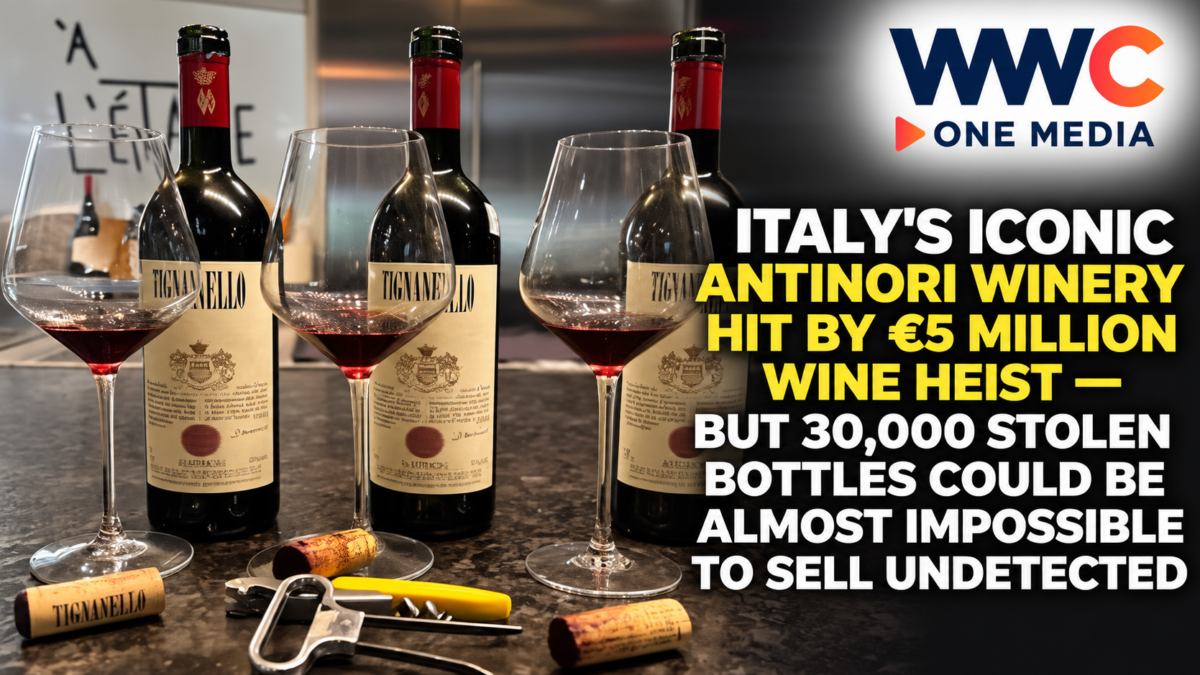
TUSCANY, ITALY — A winery that has survived more than six centuries of wars, economic upheavals and changing generations has suffered one of the most extraordinary thefts in Italian wine history.
Marchesi Antinori, one of Italy’s most prestigious family-owned wine producers, has lost approximately 30,000 bottles of premium wine worth €5 million after a gang of masked thieves raided its storage facility in Cortona, Tuscany.
The operation was anything but an ordinary break-in.
According to the Financial Times and Italian news outlets, at least seven thieves disabled security systems, entered the facility with two large trucks and escaped with thousands of bottles of some of Italy’s most internationally sought-after wines.
Among the missing inventory are celebrated Antinori labels including Solaia, Tignanello and Guado al Tasso, with approximately 10,000 bottles of Solaia alone reportedly stolen.
The audacious operation has triggered a police investigation and an international warning to wine merchants and collectors.
But the biggest question may not be how the thieves escaped with two truckloads of wine. It is how they intend to sell thousands of valuable, recognizable bottles without exposing the operation.
Seven masked thieves, two trucks and a carefully planned operation
The robbery targeted Antinori’s storage facility near Cortona, in the province of Arezzo.
Reports differ slightly over whether the operation began late Saturday or during the early hours of Sunday, October 4. However, they agree on the basic sequence of events.
The thieves reportedly disabled the facility’s alarms and interfered with surveillance equipment before loading substantial quantities of wine into two trucks.
Italian reports also describe the use of forklifts available at the facility to move the heavy shipments.
The stolen merchandise consisted largely of premium bottles from the 2023 vintage, which were being stored ahead of distribution to customers.
The theft was discovered on Monday morning when employees returned to the site.
Security footage and other evidence are now part of the investigation. As of the October 9 reports reviewed, no arrests had been announced.
The number of suspects, selection of bottles and apparent familiarity with warehouse operations have prompted descriptions of the robbery as a professionally organized heist. That assessment does not establish who carried it out or whether anyone had inside assistance.
Inside Italy’s extraordinary €5 million wine theft
€5M
Estimated value of stolen wine
30,000
Wine bottles stolen
7+
Suspected thieves involved
10,000
Reported Solaia bottles taken
Reported figures from the Financial Times, Sky TG24, Corriere della Sera and La Nazione, October 9, 2026. Values remain estimates.
The estimated €5 million loss makes the robbery one of the largest reported wine thefts in Italy.
Antinori executives and Italian media have described it as potentially the biggest such heist in the country’s history.
That characterization reflects the size and reported value of the operation, although a comprehensive global or historical ranking has not been independently established.
The theft also exposes the vulnerability of premium wine inventories, where a relatively small number of recognizable products can represent millions of euros in merchandise.
Why these stolen wines are so valuable
Antinori SolaiaOne of Antinori’s most prestigious Tuscan wines, associated with high-end collectors and international fine-wine markets. Approximately 10,000 bottles were reportedly among those stolen.
Antinori Tignanello
An influential Super Tuscan wine whose reputation helped establish Tuscany as an important producer of premium modern Italian reds.
Antinori Guado al Tasso
A celebrated Bolgheri wine produced on the Tuscan coast, recognized for its premium positioning and international distribution.
Italian reporting places the retail prices of the stolen labels broadly in the hundreds of euros per bottle, depending on the wine, vintage and market.
The total €5 million valuation implies an average value of roughly €167 per bottle, though individual bottles can sell for considerably more.
For criminals, premium wines combine high value with a potential international resale market. For legitimate buyers, provenance and documentation are essential to confirming authenticity and lawful ownership.
A 641-year-old family business faces a historic loss
Marchesi Antinori is not an ordinary wine producer.
Its history dates to 1385, when Giovanni di Piero Antinori joined Florence’s winemakers’ guild. The company has remained under family management for 26 generations.
Today, the business is associated with the Antinori sisters — Albiera, Allegra and Alessia — supported by chief executive Renzo Cotarella.
Its reputation is rooted in centuries of Tuscan winemaking, premium production and innovation.
For the company, the theft represents more than missing inventory.
The stolen bottles embody years of vineyard cultivation, winemaking expertise, aging, storage and commercial planning. Unlike ordinary manufactured merchandise, wine from a particular vintage cannot simply be reproduced.
That gives the robbery a cultural and historical dimension alongside its financial consequences.
Antinori CEO warns international buyers about stolen wines
Chief executive Renzo Cotarella has appealed to the international wine community to remain alert for suspicious offers.
The company is informing customers and distributors about the missing bottles, hoping to make it more difficult for the thieves to introduce the wine into legitimate markets.
Cotarella expressed hope that the stolen shipment could still be recovered.
He also emphasized the emotional impact on employees, describing the distress experienced within the company after the robbery was discovered.
Although Antinori is financially capable of absorbing the reported loss, the theft has deeply affected staff and management.
The company is now relying partly on the visibility of its premium labels and the vigilance of global merchants to help trace the missing inventory.
Could 30,000 bottles disappear into the global luxury wine market?
That is perhaps the most intriguing question surrounding the case.
The stolen inventory is not a collection of anonymous, low-value products. It consists of internationally recognized wines, many sold through established importers, specialist merchants and luxury retailers.
Attempting to sell thousands of such bottles could attract attention, especially if unusually large volumes appeared through unfamiliar distributors or at unexpectedly low prices.
Investigators may therefore examine possible resale channels, transport routes and connections between the theft and prospective purchasers.
However, there is no confirmed public evidence establishing where the wine has been taken, whether it has crossed international borders or whether the thieves already have buyers.
The idea that the robbery was carried out to fulfill a prearranged order remains a possibility, not an established fact.
For collectors and businesses, the incident highlights the importance of requesting invoices, checking supplier credibility and examining the provenance of expensive wines.
Italy’s luxury wine industry faces a wider security concern
The Antinori case is not the first major theft to strike an Italian premium wine producer.
Financial Times reporting identified previous incidents involving wineries such as Banfi di Montalcino and Conterno Fantino.
What distinguishes the Antinori robbery is its reported scale: two truckloads, approximately 30,000 bottles and an estimated €5 million in value.
The case illustrates a potential vulnerability across the luxury wine industry.
Winemakers invest heavily in protecting vineyards, managing production quality and maintaining brand reputation. Yet warehouses and distribution facilities hold large volumes of finished products that can be attractive targets for organized criminals.
The robbery could prompt operators to review warehouse access, alarm systems, inventory tracking and arrangements for transporting valuable shipments.
Whether the Antinori case leads to broader industry changes will depend in part on the investigation and what it reveals about the thieves’ methods.
The bigger picture: Stealing the wine was only the beginning
The Antinori heist has all the elements of a major international crime story: a centuries-old luxury brand, millions of euros in stolen merchandise, masked suspects and a carefully coordinated escape.
But the final outcome remains uncertain.
Italian police must establish who organized the theft, how the criminals planned the operation and where the missing bottles have gone.
The winery, meanwhile, faces the challenge of warning legitimate buyers without undermining confidence in its distribution network.
The suspects may have succeeded in removing an enormous quantity of valuable wine from a secured facility.
But turning 30,000 recognizable luxury bottles into money — without attracting the attention of police, distributors and collectors — could prove far more difficult than stealing them.
That is the next chapter in a robbery already being described as one of the biggest wine heists in Italian history.