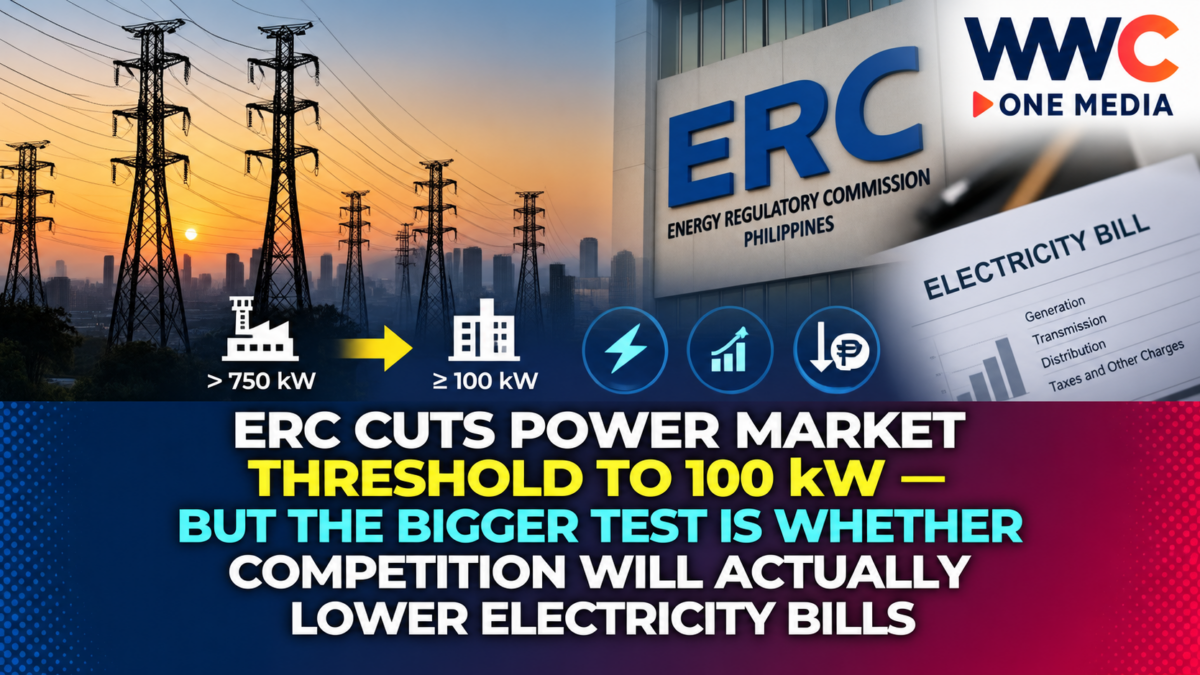
MANILA — Thousands more Philippine businesses can now shop around for their electricity supplier after the Energy Regulatory Commission lowered the threshold for Retail Competition and Open Access to just 100 kilowatts, one of the biggest expansions of consumer choice since the country’s power sector was restructured more than two decades ago.
The rule took effect on:
June 26, 2026.
The old eligibility threshold was:
500 kW.
The new threshold is:
100 kW average monthly peak demand.
That means many medium-sized businesses that previously had no choice but to buy electricity through their local distribution utility can now directly negotiate with:
Retail Electricity Suppliers, or RES.
The move potentially changes the electricity economics of thousands of:
Restaurants
Hotels
Hospitals
Schools
Office buildings
Supermarkets
and
Manufacturing facilities.
But the biggest question remains:
Will more competition actually translate into materially lower power bills?
THE THRESHOLD HAS BEEN CUT BY 80%
The scale of the change is easy to underestimate.
A customer previously needed at least:
500 kW
of average monthly peak demand to qualify directly for the competitive retail market.
That requirement has now fallen to:
100 kW.
That is an:
80% reduction.
For the first time, many medium-sized establishments can participate directly without needing the electricity demand of a large factory or mall.
That dramatically widens the contestable market.
WHAT DOES 100 KW LOOK LIKE IN THE REAL WORLD?
A 100-kW electricity demand is not a giant industrial load.
Industry examples suggest it can correspond to businesses such as:
A 300- to 400-square-meter restaurant
or
A grocery or supermarket around 500 to 1,000 square meters.
It can also cover:
Medium-sized offices
Hotels
Medical facilities
and
Small manufacturing operations.
That means the policy is no longer aimed only at major corporations.
It increasingly reaches ordinary Philippine SMEs.
THIS IS WHAT “CONTESTABLE CUSTOMER” ACTUALLY MEANS
A contestable customer can choose who supplies the electricity it buys.
That does not mean disconnecting from the local distribution utility.
The wires still belong to the:
Distribution Utility, or DU.
The DU still delivers electricity physically.
But the customer can separately choose:
who sells the electricity itself.
That distinction is crucial.
The distribution network remains regulated.
The energy supply becomes competitive.
CUSTOMERS CAN NOW SHOP FOR A BETTER ELECTRICITY CONTRACT
Instead of automatically accepting the generation cost passed through by the local utility, eligible businesses can negotiate with licensed Retail Electricity Suppliers.
They may compare:
Price
Contract length
Fuel mix
Payment terms
Price protection
and
Renewable-energy options.
In theory, competition forces suppliers to offer better terms.
A business that receives an expensive quotation from one supplier can approach another.
That is the central idea behind Retail Competition and Open Access.
THE ERC CALLS THIS THE “POWER OF CHOICE”
The Energy Regulatory Commission describes the change as a major consumer milestone.
The regulator’s position is straightforward.
More supplier choice should create:
Stronger competition
Better service
More innovative contracts
and potentially
Lower electricity costs.
But the word:
potentially
matters.
Competitive markets do not automatically guarantee lower bills every month.
POWER PRICES STILL DEPEND ON THE WHOLESALE MARKET
Retail suppliers must still obtain electricity somewhere.
Their costs are influenced by:
Power plant fuel prices
Wholesale Electricity Spot Market prices
Transmission charges
and
Generation availability.
When coal, natural gas or oil becomes expensive, retail electricity suppliers cannot completely escape those costs.
Competition can improve procurement.
It cannot eliminate energy-market fundamentals.
THIS MEANS BUSINESSES MUST COMPARE CONTRACTS CAREFULLY
The cheapest headline price may not always be the best contract.
Businesses need to examine:
Fixed versus variable pricing
Pass-through charges
Contract duration
Early termination penalties
and
Minimum demand requirements.
A fixed-price contract can protect a company when wholesale prices surge.
But it can look expensive if market prices fall.
A floating contract can provide savings when electricity is cheap.
But it also exposes the customer to spikes.
RCOA HAS BEEN EXPANDING GRADUALLY FOR YEARS
The Philippines did not open retail electricity competition all at once.
The process has been gradual.
When RCOA first became operational in:
2013,
the threshold was around:
1 megawatt.
It later fell to:
500 kW.
Now it has dropped to:
100 kW.
That shows the government’s long-term direction.
More electricity customers are gradually being moved from:
captive purchasing
toward
consumer choice.
THE POLICY COMES FROM EPIRA
The legal foundation is the:
Electric Power Industry Reform Act of 2001, or EPIRA.
EPIRA reorganized the Philippine electricity sector.
Among its goals were:
Competition
Private investment
Consumer choice
and
Transparent electricity markets.
Retail Competition and Open Access is one of the most important unfinished pieces of that reform.
More than two decades later, the market is still gradually opening.
THE 100-KW RULE IS THE FOURTH MAJOR PHASE
InsiderPH describes the latest expansion as another major phase in RCOA implementation.
Every reduction in the threshold increases the number of eligible customers.
The jump from:
500 kW
to
100 kW
is particularly significant because it brings a much larger group of businesses into the market at once.
This is where retail competition stops being only a large-corporate issue.
It starts becoming an SME issue.
SMALLER CONSUMERS HAVE ANOTHER OPTION: AGGREGATION
What happens if a business uses less than:
100 kW?
It may still have a pathway through the:
Retail Aggregation Program, or RAP.
Under RAP, multiple electricity users can combine their demand into a:
Retail Aggregated Group.
That group’s combined demand can then qualify for the competitive retail market.
This is particularly useful for:
Small businesses
Commercial buildings
and potentially
Groups of households.
AGGREGATION COULD MAKE SMALL CONSUMERS MORE POWERFUL
Electricity procurement follows the same logic as many other markets.
Large buyers often receive better terms.
A single small business may have limited negotiating power.
But if dozens of businesses combine demand, the group becomes more attractive to suppliers.
That can create:
Volume discounts
and
More competitive offers.
RAP essentially allows smaller consumers to negotiate like a larger customer.
THERE ARE RULES AROUND WHO CAN AGGREGATE
Aggregation is not completely unrestricted.
Customers generally need to comply with:
Eligibility rules
Metering requirements
and
Switching procedures.
There were also transition rules for groups formed under the previous 500-kW threshold.
The ERC issued clarificatory guidance shortly after the 100-kW rule took effect to ensure that pending applications were handled consistently.
That shows how complicated the transition can be operationally.
RETAIL METERING IS A CRITICAL PIECE
Competitive electricity markets require accurate measurement.
That means distribution utilities must register as:
Retail Metering Services Providers.
The ERC has been pushing utilities to complete that registration.
As of April 2026, several distribution utilities across:
Luzon
Visayas
and
Mindanao
had not yet completed registration.
That is one example of why market reform involves more than simply changing a threshold.
The physical and administrative systems must also work.
THE ERC HAS WARNED UTILITIES TO COMPLY
The regulator has reminded distribution utilities that failing to register properly can trigger:
sanctions.
Why is that important?
Because customers cannot easily switch suppliers if:
Metering
billing
and
settlement systems
are not ready.
Competition requires reliable infrastructure underneath it.
Otherwise, a legal right to choose exists only on paper.
RETAIL ELECTRICITY SUPPLIERS NOW HAVE A MUCH BIGGER MARKET
The rule is also important for suppliers.
Before June 26, the number of customers they could compete for was limited.
Now thousands more businesses could become potential clients.
That should intensify competition among:
Retail Electricity Suppliers.
The ERC maintains a list of licensed suppliers operating in the competitive retail market.
These include companies affiliated with major Philippine energy groups.
ENERGY COMPANIES WILL NOW COMPETE HARDER FOR SMEs
This is likely to change sales strategies.
Retail suppliers previously focused heavily on:
Factories
Malls
Large offices
and
Industrial estates.
The new market includes smaller accounts.
Suppliers may therefore build products specifically for:
Restaurants
Hotels
Schools
Warehouses
and
SMEs.
That could lead to more standardized contracts and digital onboarding.
VIVANT’S CORENERGY IS ONE OF THE PLAYERS PUSHING THIS MARKET
The October 8 forum highlighted by InsiderPH was organized with:
COREnergy Inc.
the retail electricity arm of:
Vivant Energy.
COREnergy is one of several companies looking to capture the newly expanded contestable market.
Its presence illustrates how power companies increasingly see retail supply as a growth opportunity.
As the threshold falls, the potential customer pool increases dramatically.
RENEWABLE ENERGY COULD BECOME PART OF THE SALES PITCH
Price will not be the only area of competition.
Some businesses want to reduce their:
Carbon footprint.
Retail electricity suppliers can differentiate themselves through:
Renewable-energy sourcing
and
Green contracts.
The Philippines also has the:
Green Energy Option Program, or GEOP.
GEOP allows eligible customers to source electricity from renewable-energy suppliers.
That creates another route for businesses seeking cleaner power.
MULTINATIONAL COMPANIES MAY PUSH SUPPLIERS TOWARD CLEANER ENERGY
Large international corporations increasingly have:
Net-zero targets
and
Renewable-energy commitments.
Their Philippine suppliers may also be asked to reduce emissions.
That can create pressure on:
Factories
Warehouses
and
Service companies
to buy cleaner electricity.
For some businesses, choosing a supplier may therefore become part of:
ESG compliance
and
global supply-chain competitiveness.
POWER COSTS REMAIN ONE OF THE PHILIPPINES’ BIGGEST BUSINESS PROBLEMS
This reform matters because electricity is a major operating expense.
The Philippines has historically had relatively high power costs compared with several regional competitors.
For businesses, high electricity prices affect:
Profit margins
Expansion decisions
and
Competitiveness.
Manufacturing is particularly sensitive.
Every peso saved per kilowatt-hour can become significant when multiplied across large monthly consumption.
EVEN A SMALL PRICE DIFFERENCE CAN BECOME BIG MONEY
Consider a business consuming:
100,000 kWh per month.
A reduction of:
₱0.50 per kWh
would save:
₱50,000 per month.
That becomes:
₱600,000 per year.
A reduction of:
₱1 per kWh
would double those savings.
That is why businesses should take the new supplier-choice opportunity seriously.
Electricity procurement can become a strategic financial decision.
BUT SAVINGS WILL NOT BE THE SAME FOR EVERY CUSTOMER
Some customers may see large savings.
Others may see little difference.
The outcome depends on:
Location
Load profile
Consumption timing
Contract terms
and
Wholesale market conditions.
A business operating heavily during peak-demand hours may face different economics from one consuming electricity overnight.
Retail suppliers price that risk differently.
THE CUSTOMER’S LOAD PROFILE NOW HAS VALUE
Under a captive arrangement, many customers rarely think about how suppliers value their electricity use.
In a competitive market, consumption patterns matter.
A customer with:
Stable predictable demand
can be attractive to a supplier.
Predictability makes electricity procurement easier.
A highly volatile customer can create more risk.
Businesses that understand their own:
load profile
may negotiate better contracts.
ENERGY MANAGEMENT COULD BECOME MORE IMPORTANT
The 100-kW threshold may also encourage businesses to pay closer attention to electricity consumption.
Companies could invest in:
Smart meters
Energy-management software
Solar panels
Battery storage
and
Efficiency upgrades.
Why?
Because once electricity becomes actively procured rather than passively billed, management has more reason to optimize usage.
The reform could therefore create a broader energy-efficiency market.
SOLAR COULD BE COMBINED WITH RETAIL SUPPLY
A commercial customer might use:
Rooftop solar
during daytime hours
and
Retail electricity supply
for the remaining demand.
That combination can reduce exposure to grid prices.
Battery storage could eventually add another layer.
Businesses could store lower-cost electricity and use it during:
peak periods.
This is how electricity procurement is evolving globally.
The Philippines is moving in the same direction.
DISTRIBUTION UTILITIES DO NOT DISAPPEAR
This point deserves repeating.
Choosing a retail supplier does not mean leaving:
Meralco
or another distribution utility’s network.
The DU still operates the:
wires
poles
meters
and
local distribution system.
The customer still pays regulated network charges.
What changes is the supplier responsible for the:
generation component.
This is similar to choosing an internet content provider while still relying on physical infrastructure.
THAT MEANS NOT EVERY PART OF THE BILL BECOMES COMPETITIVE
Electricity bills contain multiple components.
These can include:
Generation
Transmission
Distribution
Taxes
and
Other regulated charges.
Retail competition primarily affects the:
electricity supply portion.
A lower generation price does not eliminate:
network charges
or
government-imposed fees.
Businesses should therefore compare the total bill impact rather than focusing only on the advertised energy rate.
CONTRACT TRANSPARENCY WILL BE CRUCIAL
As more SMEs enter the market, consumer protection becomes more important.
Large corporations often have:
procurement teams
and
lawyers
to review energy contracts.
Smaller businesses may not.
The ERC therefore needs clear rules around:
Disclosure
Billing
Switching
and
Contract terms.
Otherwise, competition could become confusing instead of empowering.
SUPPLIER FAILURE IS ALSO A RISK
Competitive electricity markets elsewhere have experienced situations where retail suppliers:
failed
or
became insolvent.
That can happen when suppliers promise fixed prices but wholesale electricity costs suddenly surge.
Philippine rules need mechanisms to protect customers if a supplier encounters financial trouble.
The cheapest supplier is not always the safest supplier.
Financial strength matters.
BUSINESSES SHOULD LOOK AT MORE THAN PRICE
When evaluating a Retail Electricity Supplier, businesses should consider:
Track record
Financial stability
Customer service
Contract flexibility
and
Energy sourcing.
A slightly cheaper contract can become expensive if:
billing problems
or
operational disputes
occur.
Electricity is essential infrastructure.
Reliability matters as much as savings.
THE NEXT STEP MAY BE BELOW 100 KW
The ERC is already preparing for that possibility.
In March, the regulator required Network Service Providers to begin submitting information on customers with demand between:
50 kW
and
100 kW.
The purpose is to prepare for further lowering of the eligibility threshold.
That is a strong signal.
The 100-kW level may not be the final destination.
EVENTUALLY, HOUSEHOLDS COULD GET SUPPLIER CHOICE TOO
The ERC has explicitly referred to preparing for threshold reductions:
up to the household level.
That would be transformative.
A residential customer could eventually choose among electricity suppliers much as consumers choose:
Mobile networks
or
Internet providers.
That is still a future possibility rather than today’s system.
But the direction is clear.
Retail competition is moving toward a broader consumer market.
HOUSEHOLD COMPETITION WOULD CHANGE THE INDUSTRY COMPLETELY
If millions of residential customers eventually become contestable, suppliers would need:
Mass-market brands
Apps
Customer-service systems
and
Simple pricing plans.
They might offer:
Fixed-price electricity
Green-energy packages
or
Bundles with solar and storage.
The electricity market would start looking much more like:
telecommunications.
That could become one of the largest structural changes in Philippine power.
BUT THE SYSTEM MUST PROVE ITSELF AT 100 KW FIRST
Before regulators go further, the current phase needs to work.
The ERC will need to track:
Customer switching
Price outcomes
Supplier competition
Billing complaints
and
Market concentration.
If customers actually save money and switching works smoothly, there will be a stronger case for further liberalization.
If problems emerge, regulators may slow down.
THE BIGGER STORY: PHILIPPINE BUSINESSES ARE FINALLY GETTING MORE POWER OVER THEIR POWER
For years, electricity has been treated by many businesses as a:
fixed operating cost.
The bill arrives.
The company pays it.
There is little negotiation.
The 100-kW threshold begins changing that mindset.
More businesses can now treat electricity like:
a contract that can be negotiated.
They can compare suppliers.
They can choose renewable options.
They can lock in prices.
They can aggregate demand.
And they can incorporate power procurement into broader:
cost management.
That is the real significance of the ERC’s decision.
The regulatory change itself is simple:
500 kW became 100 kW.
But the economic effect could be much larger.
It expands competition from a relatively small group of large electricity users toward thousands of medium-sized businesses across the Philippines.
The next test is whether suppliers respond with:
better pricing
better service
and
better products.
Because consumer choice only becomes meaningful when choosing actually produces a better outcome.
The ERC has opened the competitive power market to thousands more Philippine businesses — but the success of the reform will ultimately be measured not by how many customers are allowed to switch, but by how much money they actually save when they do.