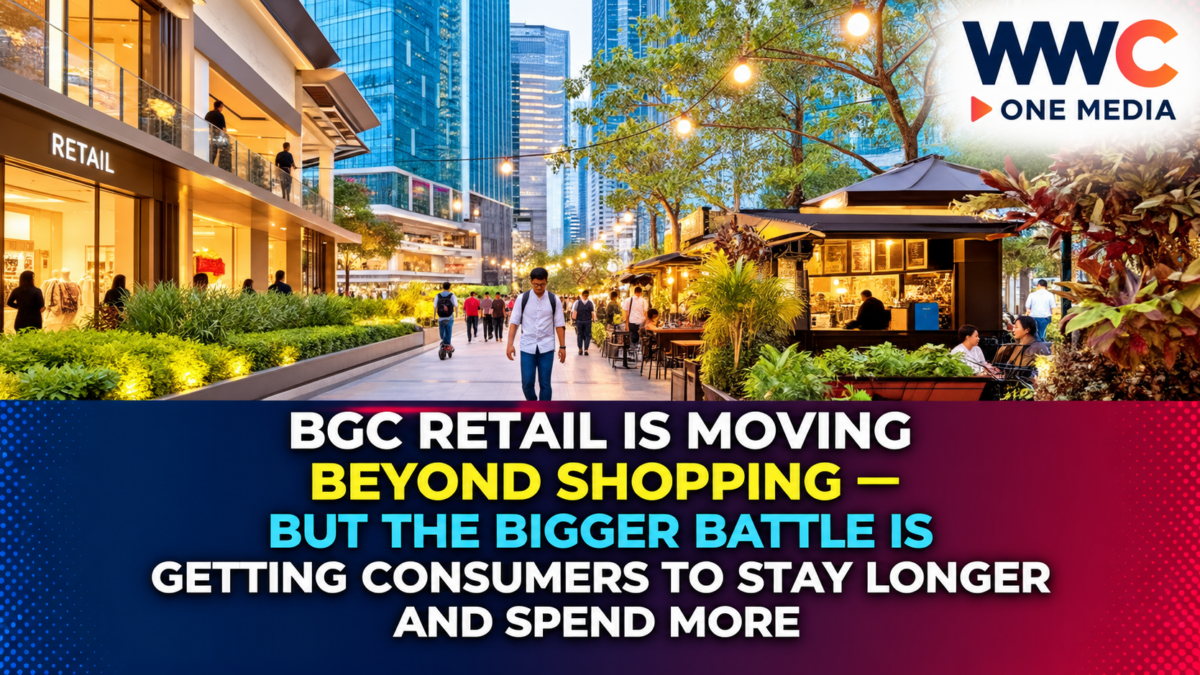
TAGUIG — Bonifacio Global City’s retail scene is changing again, and the next phase may have less to do with how many stores a mall can fit inside its walls and more to do with how many reasons consumers have to stay.
At Park Triangle Mall in BGC, the traditional retail formula is being replaced by something broader.
Instead of relying mainly on:
Fashion
Electronics
and
Merchandise,
the development is mixing:
Dining
Fitness
Wellness
Beauty
Gaming
Specialty grocery
Recreation
and
Creative spaces.
The strategy reflects a much larger transformation happening across Philippine retail.
Consumers can already buy almost anything online.
So physical malls increasingly need to offer something e-commerce cannot easily replicate:
Experience.
And in one of Metro Manila’s wealthiest and most densely developed business districts, that battle is becoming especially intense.
PARK TRIANGLE IS BETTING ON A DIFFERENT KIND OF MALL
Park Triangle sits at:
32nd Street and 11th Avenue
inside Bonifacio Global City.
Ayala Land identifies the first phase of the development as containing approximately:
9,000 square meters of gross leasable area.
That makes it relatively compact compared with some of Metro Manila’s giant malls.
But size is not necessarily the point.
The strategy is to become a convenient lifestyle destination for:
BGC residents
Office workers
and
Visitors.
Rather than trying to make customers spend an entire day walking through hundreds of stores, Park Triangle is curating a mix that allows someone to accomplish several things in one visit.
A CUSTOMER CAN NOW SHOP, WORK OUT, EAT AND RELAX IN ONE PLACE
That combination is becoming one of the defining features of modern urban retail.
A customer might:
Buy a new phone
then
Go to the gym
then
Eat dinner
then
Pick up groceries
and
Meet friends for coffee.
Each activity creates another reason to remain inside the development.
For landlords, that matters because more time spent in a retail environment can potentially produce:
More purchases
More food spending
and
More repeat visits.
The industry often refers to this as increasing:
dwell time.
TECHNOLOGY REMAINS PART OF THE MIX
Park Triangle includes technology retailers such as:
Power Mac Center
and
DataBlitz.
Those stores represent one of the strongest categories for physical retail because consumers often still want to:
Touch devices
Compare products
and
Ask questions
before buying expensive electronics.
Technology retail also creates natural repeat traffic.
Consumers return for:
Accessories
Upgrades
Gaming products
and
Repairs.
But technology alone is not enough to build a lifestyle destination.
That is why Park Triangle’s tenant mix is much broader.
FITNESS IS BECOMING RETAIL
The development includes:
Spice Up Fitness,
a female-focused gym concept.
It also includes sports and athletic brands such as:
Adidas
Anta
and
Saucony.
This reflects one of retail’s most powerful structural changes.
Fitness is no longer treated simply as:
exercise.
It increasingly overlaps with:
Fashion
Wellness
Social identity
and
Lifestyle spending.
Consumers buy running shoes not only to exercise.
They may wear them:
to work
to travel
or
every day.
That convergence makes athletic brands particularly valuable to modern malls.
WELLNESS IS BECOMING A MUCH BIGGER COMMERCIAL CATEGORY
Park Triangle’s mix also includes businesses connected to:
Supplements
Medical services
Beauty
and
Personal care.
Examples highlighted by InsiderPH include:
Heyday
Jan Medical
Nailtropics
and
Noontalk.
That diversification reflects how wellness spending has expanded.
Consumers increasingly spend money on:
Nutrition
Fitness
Preventive health
Beauty treatments
and
Self-care.
For landlords, these businesses have one important advantage over traditional merchandise retailers.
Many services cannot be delivered digitally.
A manicure cannot be downloaded.
A medical consultation may be booked online, but many services still require a physical location.
A fitness session still needs space.
That makes wellness tenants valuable in an e-commerce-heavy economy.
FOOD MAY BE THE MOST IMPORTANT FOOT-TRAFFIC DRIVER
One of the strongest trends in Philippine mall leasing is the growing importance of:
food and beverage.
Colliers says food and beverage operators remain among Metro Manila’s strongest takers of retail space.
That makes sense.
Consumers may buy clothes online.
But they still go out to:
Eat
Drink
Meet friends
and
Celebrate.
Food turns malls into social spaces.
Park Triangle’s dining mix includes concepts such as:
Siklab
Khao Khai
and
Hooroo.
Beverage concepts include:
CHAGEE
ZUS Coffee
and
Chotto Matcha.
The variety is intentional.
COFFEE SHOPS HAVE BECOME “THIRD PLACES”
Coffee shops are particularly important.
They are no longer simply places where customers buy:
coffee.
They function as:
Meeting spaces
Workspaces
Study areas
and
Social venues.
That makes them valuable anchors inside business districts such as BGC.
A customer who spends an hour inside a café may visit another tenant afterward.
That interaction helps the entire retail ecosystem.
This is why malls increasingly treat food and beverage as:
traffic infrastructure
rather than simply another rent-paying category.
SPECIALTY GROCERY IS ALSO BECOMING PART OF THE EXPERIENCE
Park Triangle includes:
One World Deli.
Specialty grocery is an interesting retail category because it combines:
necessity
and
discovery.
Consumers may enter intending to buy ingredients.
But curated imported products and premium food can encourage additional spending.
That fits the broader Filipino retail trend toward:
intentional shopping.
Consumers are increasingly selective.
But selective does not mean consumers are refusing premium products.
It means they want products that feel:
useful
authentic
or
worth the price.
FILIPINO SHOPPERS ARE BECOMING MORE DELIBERATE
Recent Lazada research highlights this change.
A regional study found approximately:
36% of Filipino online shoppers
qualified as highly “savvy” consumers.
That was reportedly the highest share among six Southeast Asian markets surveyed.
Another:
22%
were classified as near-savvy.
Combined, that means:
58%
of respondents displayed relatively sophisticated purchasing habits.
These consumers increasingly:
Compare prices
Check authenticity
Evaluate protection
and
Search for value.
That behavior affects physical retail too.
MALLS CAN NO LONGER RELY ON IMPULSE SHOPPING ALONE
The old retail model depended heavily on customers entering a mall and making unplanned purchases.
That still happens.
But consumers now have:
Price-comparison apps
online marketplaces
brand websites
and
social-media reviews.
They can check prices within seconds.
That makes ordinary merchandise easier to compare.
Physical retailers therefore need another advantage.
Experience becomes part of the product.
The environment itself has to provide value.
ART AND CUSTOMIZATION ADD ANOTHER LAYER
Park Triangle’s tenant mix also includes:
Kambal Gallery
and
Señorina,
along with variety retailer:
KKV.
These concepts add:
Art
Customization
and
Discovery-oriented retail.
That matters because one of the strongest reasons people still visit malls is:
surprise.
Online shopping is efficient.
But algorithms often show consumers products based on things they already viewed.
Physical retail can still provide:
unexpected discovery.
A gallery.
A pop-up.
A new restaurant.
A limited product.
Those experiences create reasons to return.
THE PHILIPPINE MALL INDUSTRY IS CLEARLY CHANGING
Colliers describes Metro Manila’s 2026 retail recovery as increasingly driven by:
premiumization
and
experiential retail.
Vacancy fell to:
10.8%
during the first quarter.
That was the lowest level since:
Q1 2020.
The improvement suggests physical retail remains resilient despite the explosive growth of online commerce.
But landlords are becoming more selective.
Developers are spending more time:
Curating tenants
Renovating malls
and
Optimizing existing space.
The objective is no longer simply:
Build more stores.
It is:
Build better reasons to visit.
AYALA LAND IS MAKING THAT SHIFT ACROSS ITS MALL PORTFOLIO
Ayala Land has explicitly described its malls as evolving beyond conventional retail.
In its latest integrated report, the company said malls are becoming:
social infrastructure.
That means places where people:
Gather
Connect
and
Spend time.
Ayala has been redeveloping major properties including:
Greenbelt
Glorietta
TriNoma
and
Ayala Center Cebu.
It is also expanding newer estate-based retail concepts.
Park Triangle fits directly into that strategy.
AYALA LAND’S MALLS ARE ALREADY SHOWING STRONG OCCUPANCY
Ayala Land reported approximately:
91% lease-out
across its mall portfolio.
Mall revenues grew even while major redevelopment projects were underway.
The company says upgraded properties could eventually generate:
higher rents
once redevelopment stabilizes.
That shows why experiential retail is not simply a design trend.
There is a financial objective.
A more attractive mall can potentially deliver:
More foot traffic
Higher tenant sales
and
Higher rents.
PARK TRIANGLE IS ALSO PART OF BGC’S “LIVE-WORK-PLAY” MODEL
BGC is particularly suited to this strategy.
Unlike isolated suburban malls, Park Triangle sits inside a district containing:
Offices
Condominiums
Hotels
Schools
and
Restaurants.
That creates a built-in customer population.
Someone living nearby does not necessarily need a destination mall.
They may want:
convenience.
A gym near home.
A grocery stop after work.
Coffee before a meeting.
Dinner without driving across Metro Manila.
This is why smaller lifestyle centers can sometimes compete effectively with giant malls.
CONVENIENCE MAY BE JUST AS IMPORTANT AS EXPERIENCE
“Experiential retail” often sounds like malls need:
Theme parks
or
Huge attractions.
That is not necessarily true.
For many urban consumers, the best experience is simply:
everything being easy.
A mall that combines:
food
health
fitness
services
and
shopping
can reduce the number of separate trips a consumer needs to make.
That is particularly valuable in Metro Manila, where traffic can turn a simple errand into a major time commitment.
TRAFFIC MAKES MIXED-USE RETAIL MORE VALUABLE
BGC may be dense and walkable by Philippine standards.
But Metro Manila congestion still shapes consumer behavior.
A shopper who can complete multiple tasks inside one neighborhood may prefer that over driving between:
Several malls
A gym
A grocery store
and
A restaurant.
That means mixed-use retail can effectively sell:
time savings.
And for affluent urban professionals, time can be as valuable as discounts.
THIS HELPS EXPLAIN WHY BGC RETAIL CAN SUPPORT PREMIUM CONCEPTS
BGC has a large population of:
Corporate professionals
Expats
Affluent residents
and
Visitors.
That creates demand for brands and services that might struggle elsewhere.
Examples include:
Premium grocery
Boutique fitness
Specialty coffee
and
Imported lifestyle brands.
Visa has also identified a broader shift among affluent Filipino consumers toward:
personalized experiences
across dining, wellness, travel and retail.
That overlaps directly with the Park Triangle model.
AFFLUENT CONSUMERS ARE CHANGING THE DEFINITION OF LUXURY
Traditional luxury was often associated with:
Designer goods
Jewelry
and
Status symbols.
Increasingly, affluent consumers spend on:
Dining
Travel
Fitness
Wellness
and
Experiences.
That means malls targeting higher-income customers need more than luxury boutiques.
They need an entire lifestyle ecosystem.
BGC is becoming one of Metro Manila’s clearest examples of that transition.
BONIFACIO HIGH STREET ALREADY PROVED THE MODEL
Park Triangle is not starting from zero.
BGC already has one of the Philippines’ best-known lifestyle-oriented retail districts:
Bonifacio High Street.
Its format combines:
Outdoor spaces
Dining
Retail
Events
and
Pedestrian activity.
One Bonifacio High Street expanded that ecosystem with brands including:
Zara
M Bakery
Wolfgang’s Steakhouse
and other premium concepts.
Ayala describes the district as a:
shopping, dining and entertainment centerpiece.
Park Triangle is extending that lifestyle approach into another part of BGC.
THE CHALLENGE IS DIFFERENTIATION
That creates a problem too.
BGC already has:
Bonifacio High Street
SM Aura
Uptown Mall
One Bonifacio High Street
and
Market! Market!
Consumers have many choices.
Park Triangle therefore cannot succeed simply by offering:
another collection of stores.
Its tenant mix must feel distinct enough to generate repeat visits.
That is why:
wellness
specialty food
recreation
and
creative concepts
matter.
They create differentiation.
EVERY NEW MALL IS COMPETING FOR THE SAME HOURS
Consumers have limited:
time
and
money.
A new mall does not create additional hours in the day.
It competes for:
Friday dinner
Saturday afternoon
Sunday family time
and
weekday errands.
That means the real competition between malls is not always:
retailer versus retailer.
It is:
destination versus destination.
Which place gives customers the strongest reason to spend their limited free time there?
RETAILERS ARE ALSO COMPETING WITH NETFLIX, TIKTOK AND DELIVERY APPS
The competitive field is even wider.
A consumer can stay at home and:
stream a movie
order food
buy clothes online
and
talk to friends digitally.
Physical retail therefore competes against the couch.
That changes everything.
A mall needs to provide something meaningful enough to justify:
travel
parking
and
time.
Dining, fitness and social experiences help solve that problem.
ENTERTAINMENT BECOMES A DEFENSE AGAINST E-COMMERCE
Park Triangle includes recreation concepts such as:
Breakout
and
Q Powerstation.
These businesses matter because entertainment is difficult to replace with conventional e-commerce.
You cannot ship an escape-room experience.
That gives entertainment tenants a structural advantage.
They create foot traffic that online retail cannot directly duplicate.
The same logic applies to:
Gyms
Restaurants
Beauty services
and
Events.
EXPERIENCE DOES NOT MEAN CONSUMERS HAVE STOPPED CARING ABOUT PRICE
This distinction is essential.
Filipino consumers remain highly price-sensitive.
Fuel costs.
Food inflation.
Housing expenses.
Interest rates.
All affect household budgets.
Colliers describes shoppers as:
cautious but resilient.
That means landlords need to balance:
premium experiences
with
affordability.
A mall filled only with expensive concepts risks narrowing its customer base.
VALUE AND PREMIUMIZATION CAN COEXIST
This may sound contradictory.
But shoppers can be value-conscious and still buy premium products.
The question is whether consumers believe something is:
worth it.
They may pay more for:
better coffee
higher-quality sportswear
or
a fitness membership
while reducing spending elsewhere.
That is why brands increasingly compete on:
perceived value
rather than simply low price.
Park Triangle’s mix reflects exactly that strategy.
MALL LANDLORDS ARE BECOMING CURATORS
Historically, mall operators often focused heavily on:
occupancy.
Fill every unit.
Collect rent.
Today, filling every unit is not enough.
The wrong mix can weaken a mall.
Too many similar stores create boredom.
Too little food reduces dwell time.
Too little entertainment reduces repeat visits.
Developers increasingly act like:
portfolio curators.
They decide how different categories interact.
The goal is to create a destination stronger than the sum of its tenants.
AYALA LAND CALLS THIS “MERCHANT OPTIMIZATION”
Ayala Land has explicitly highlighted:
merchant optimization
as part of its mall strategy.
That means evaluating which tenants create:
traffic
spending
and
energy
inside a property.
It may involve replacing weaker concepts with:
first-to-market brands
new dining operators
or
experience-driven businesses.
That is a much more active approach than simply renewing every existing lease.
THE PHYSICAL DESIGN MATTERS TOO
Experiential retail is not only about tenants.
Mall architecture affects how customers behave.
Developers increasingly prioritize:
Open spaces
Natural light
Walkability
Comfortable seating
and
Event areas.
Ayala Land’s broader mall redevelopment strategy specifically includes:
more open spaces
and
modernized environments.
The logic is simple.
Customers stay longer in places that feel good.
BGC HAS AN ADVANTAGE BECAUSE THE DISTRICT ITSELF IS PART OF THE EXPERIENCE
This is one of BGC’s strongest competitive advantages.
Retail does not exist separately from the surrounding city.
Consumers can move between:
Parks
Restaurants
Offices
Retail centers
and
Public spaces.
That makes the district itself a destination.
Park Triangle can therefore benefit from BGC foot traffic without needing to create every attraction internally.
It becomes another stop within a larger urban ecosystem.
BUT BGC ALSO FACES THE PROBLEM OF RETAIL SATURATION
A wealthy market attracts more retailers.
More retailers create more competition.
BGC therefore risks:
too much similar retail space.
Landlords have to continually refresh concepts.
A restaurant that feels new today may feel ordinary two years later.
A fitness trend can quickly be replaced by another.
That means experiential retail requires constant reinvention.
It is not a one-time investment.
TENANT TURNOVER MAY ACTUALLY BECOME PART OF THE STRATEGY
In older retail models, landlords often valued tenants that stayed for decades.
Long leases create predictable cash flow.
But modern malls may also benefit from:
pop-ups
limited concepts
and
shorter-term experimental tenants.
These create novelty.
Consumers have reasons to return because something changes.
The challenge is balancing:
financial stability
with
freshness.
SOCIAL MEDIA HAS CHANGED WHAT A STORE NEEDS TO DO
A modern physical store often has two audiences.
The person standing inside.
And the people who see it on:
TikTok
or
Facebook.
Retailers increasingly design spaces that customers want to:
photograph
and
share.
That turns customers into marketing channels.
A visually distinctive café or gallery can generate enormous exposure without traditional advertising.
That is another reason creative tenants matter.
THE FUTURE OF PHYSICAL RETAIL MAY BE LESS ABOUT TRANSACTIONS
Online platforms are excellent at:
transactions.
Search.
Compare.
Click.
Pay.
Deliver.
Physical retail therefore needs to specialize increasingly in things digital channels do less well.
Human interaction.
Discovery.
Community.
Entertainment.
Sensory experiences.
That does not mean traditional retail disappears.
It means stores become one part of a larger experience.
ONLINE AND OFFLINE RETAIL WILL KEEP MERGING
Consumers may:
discover a product on TikTok
visit a mall to examine it
compare the price online
and then buy through an app.
Retailers increasingly have to support that entire journey.
The store becomes:
showroom
service center
marketing platform
and
fulfillment point.
That changes how retailers measure success.
A store may influence sales even when the final transaction happens online.
THAT MAKES BGC AN IMPORTANT TEST MARKET
BGC contains many of the consumers most likely to adopt:
new brands
digital payments
fitness trends
premium food concepts
and
omnichannel retail.
That makes it a valuable laboratory.
Concepts that succeed there can expand to other urban markets.
Those that fail provide equally valuable information.
For Philippine retailers, BGC has increasingly become a place to test:
what comes next.
THE BIGGER STORY: THE MALL IS BECOMING A SERVICE PLATFORM
Park Triangle may look like another retail development.
But its tenant mix points toward something bigger.
The traditional mall was primarily a place where products were:
stored
displayed
and
sold.
The modern urban mall is becoming something closer to a:
lifestyle platform.
Consumers can:
Eat
Exercise
Socialize
Receive services
Discover products
Buy groceries
and
Spend leisure time
inside one ecosystem.
That gives physical retail a reason to exist in a world where almost anything can be delivered to the doorstep.
Ayala Land’s strategy shows it understands that shift.
Its malls are being redesigned around:
experience
merchant curation
and
social interaction.
Colliers sees the same shift across Metro Manila.
And consumers themselves are becoming more deliberate about where they spend money.
That creates a harder retail environment.
But it also creates opportunity.
The winner may no longer be the mall with:
the most stores.
It may be the place that gives consumers the most compelling reason to:
leave home
stay longer
and
come back.
BGC’s next retail war will not be fought simply over who can sell the most products — it will be fought over who can own the most valuable thing consumers increasingly refuse to waste: their time.