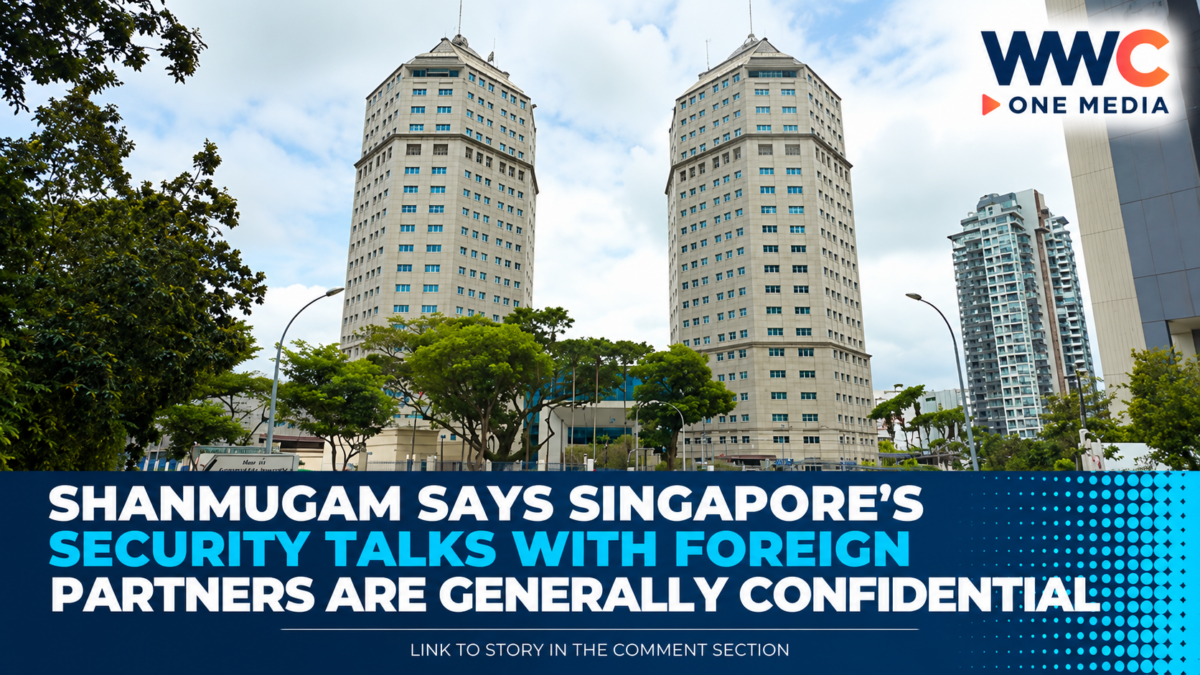
SINGAPORE — Singapore’s security engagements with foreign governments are generally kept confidential because of the sensitive nature of the information exchanged, Senior Minister and Minister for Home Affairs K. Shanmugam said in Parliament on Oct. 7.
His comments came in response to questions from Workers’ Party MP Fadli Fawzi about a recent meeting between Singapore officials and an Israeli delegation, including whether the two sides had discussed Israel’s policies in the West Bank and whether Singapore had requested that the meeting remain secret.
Shanmugam said the meeting was part of Singapore’s regular security and law-enforcement cooperation with international counterparts and was focused on operational and security matters, rather than broader foreign-policy issues.
Meeting with Israeli officials focused on security
The parliamentary exchange followed a September report by Israeli newspaper Haaretz about an Israeli delegation’s visit to Singapore in May.
Haaretz had reported that representatives from Israel’s National Security Ministry and Israel Prison Service made a secret visit to Singapore and that the death penalty was discussed during the meetings.
Singapore’s Ministry of Home Affairs subsequently rejected those claims, saying the report was false. MHA said the officials had instead discussed areas including emergency response, crime prevention and forensic practices. Israel’s National Security Ministry also told the newspaper that its representatives did not discuss the death penalty with Singaporean officials.
In his parliamentary reply, Shanmugam reiterated that the discussions with the Israeli delegation were confined to operational and security-related issues.
He said broader foreign-policy positions are handled through the appropriate diplomatic channels, including the Ministry of Foreign Affairs.
Fadli asks about West Bank issues and secrecy
Fadli had asked whether Singapore raised concerns with the Israeli officials about illegal settlements and settler violence in the West Bank.
He also asked whether Singapore had itself requested that the meeting be kept secret. If it had not, he questioned why the Government had not issued a correction direction under Singapore’s Protection from Online Falsehoods and Manipulation Act (POFMA) against Haaretz.
Shanmugam did not disclose the confidential contents of the meeting.
Instead, he explained that MHA regularly engages foreign counterparts on security and law-enforcement matters and that maintaining confidentiality is important to preserving those channels.
He said Singapore needs to be able to exchange information and intelligence with international partners to identify potential threats and intervene early when necessary.
MHA has held 11 bilateral exchanges since January 2025
Shanmugam disclosed that MHA has conducted 11 officials-level bilateral exchanges with foreign counterparts since January 2025, including several with partners from the Middle East.
Only one of those exchanges resulted in a public press release, and that was done at the request of the foreign counterpart involved.
The minister said the contents of MHA’s exchanges are generally not made public because of security considerations.
The approach applies to Singapore’s security cooperation more broadly, rather than being specific to Israel.
Why no POFMA direction was issued
Shanmugam also addressed why the Government did not issue a POFMA correction direction against Haaretz after MHA rejected its report.
He said MHA considered the newspaper’s claims about the meeting to be “categorically false” but, based on legal advice at the time, assessed that the public-interest grounds required for a POFMA direction were not met.
That decision does not necessarily close the door on future action.
Shanmugam said a POFMA direction could still be issued later if circumstances materially change and a different assessment becomes warranted.
Shanmugam challenges broader criticism of MHA’s approach
The minister also questioned whether Fadli’s position was that MHA should use operational security meetings to raise broader concerns about the policies or conduct of the governments involved.
Shanmugam asked whether such an approach should apply only to Israel or consistently to every country with which Singapore conducts security discussions.
He gave the example of Singapore’s engagements with other Middle Eastern and Asian countries, asking whether similar political concerns should also be raised during those operational meetings.
The question highlighted the distinction between security cooperation and foreign-policy diplomacy in Singapore’s engagement with other governments.
Singapore balances security cooperation and foreign policy
The parliamentary exchange illustrates the different channels through which Singapore conducts its international engagements.
MHA’s focus is on areas such as security, law enforcement, intelligence and operational cooperation. Foreign-policy positions, meanwhile, are handled through the Ministry of Foreign Affairs and other diplomatic channels.
For Singapore, maintaining working relationships with foreign security agencies can provide access to information and cooperation that authorities consider important to national security.
At the same time, questions from MPs such as Fadli show that the Government can face scrutiny over how those engagements are conducted and what issues are raised behind closed doors.
For now, Shanmugam has made clear that Singapore’s security discussions with foreign counterparts — including Israel — are generally confidential, and that the Government does not regard every operational engagement as a forum for discussing wider foreign-policy disputes.
The Government’s position is that maintaining those confidential channels serves a practical security purpose, while broader questions about Singapore’s foreign-policy positions remain the responsibility of the appropriate diplomatic authorities.