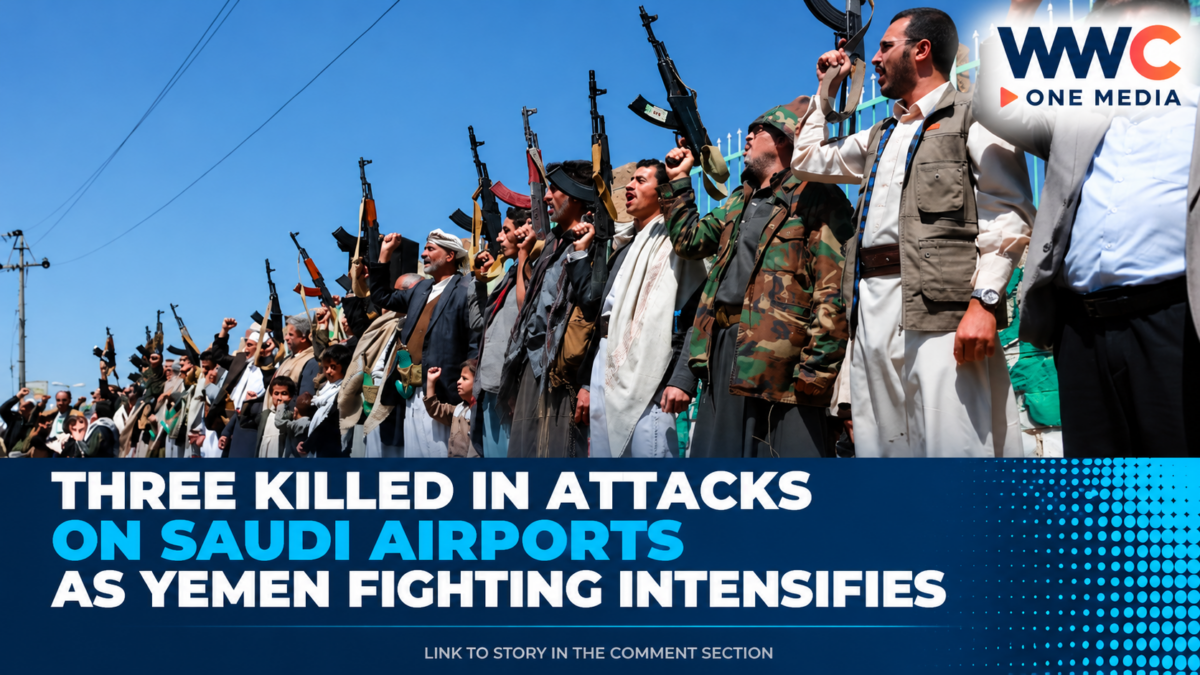
RIYADH — Three people were killed and more than 30 others injured in attacks on two Saudi Arabian airports, as fighting between Iran-aligned Houthi forces and Saudi-backed Yemeni government troops escalated into a wider regional confrontation.
The attacks targeted King Khalid International Airport in Riyadh and Abha International Airport on Tuesday and Wednesday, according to Saudi civil aviation authorities. The Houthis claimed responsibility for the strikes, although Saudi authorities did not independently attribute the attacks to the group in their initial statement.
At King Khalid airport, one person was killed and eight others were wounded. At Abha airport, two people were killed and 28 were injured. The victims included foreign nationals, according to Saudi officials.
The airport strikes came as Yemen’s conflict entered a new phase, with Saudi-backed forces launching a major counteroffensive against the Houthis around the strategically important Bab el-Mandeb Strait and the Red Sea coast.
Houthi attacks hit Saudi airports
The Houthi movement, which controls much of northern Yemen including the capital Sanaa, said it had launched missile and drone attacks against Saudi targets.
One of the attacks struck facilities at Abha airport in southwestern Saudi Arabia, while another targeted King Khalid International Airport in Riyadh.
Saudi authorities said the Abha attack killed two residents — a Moroccan and an Algerian — and wounded 28 people.
The Riyadh attack killed a Sudanese national and injured eight others.
The attacks added to concerns over the vulnerability of civilian aviation infrastructure as the conflict expands.
The Houthis also targeted Aden International Airport in Yemen on Wednesday with ballistic missiles and explosive-laden drones, according to Yemen’s Transport Ministry. One missile reportedly landed near the runway shortly before a flight from Cairo was due to arrive. No deaths were reported from that attack.
Saudi coalition vows retaliation
The Saudi-led coalition supporting Yemen’s internationally recognised government said the airport attacks would “not go unpunished” and announced a major round of strikes against Houthi positions.
The coalition said it had attacked more than 80 Houthi military sites across the Yemeni governorates of Saada, Hodeidah, Al Jawf and Marib.
Saudi forces also said they intercepted a ballistic missile north of Riyadh and destroyed a launch platform in Sanaa that had been used to attack the Saudi capital. The claims could not be independently verified.
The escalation raises the risk that attacks will continue to spread beyond frontline areas and threaten airports, energy infrastructure and commercial shipping.
Fighting intensifies around Bab el-Mandeb
The latest violence is closely tied to battles around the Bab el-Mandeb Strait, a narrow waterway linking the Red Sea with the Gulf of Aden.
The route is strategically important for global trade and energy shipments. Its importance has increased further amid disruption to traffic through the Strait of Hormuz following the wider US-Iran conflict.
Saudi-backed Yemeni forces launched a counteroffensive this week to regain territory near Bab el-Mandeb and the coastal town of Mocha that had been taken by the Houthis.
The fighting has reportedly spread across several fronts, while both sides have claimed battlefield successes that have not all been independently verified.
Yemeni government forces said they had carried out more than 2,100 operations against Houthi positions and claimed to have “neutralised” 1,860 fighters. Those figures were released by the government side and could not be independently verified.
Conflict is creating a new humanitarian crisis
The renewed fighting is also creating a growing humanitarian emergency.
The International Organization for Migration said more than 200,000 people have been displaced since the latest round of fighting began.
IOM Director General Amy Pope warned that civilians were struggling to find safe places as violence spread.
The United Nations has also warned about worsening food insecurity, with three out of four families reportedly going hungry in some parts of Yemen.
The renewed conflict threatens to deepen a humanitarian crisis that has already lasted for years.
Yemen’s civil war began escalating dramatically after the Houthis seized Sanaa in 2014. Saudi Arabia subsequently led a military coalition that intervened in support of the internationally recognised government.
A period of relative calm had reduced the intensity of the conflict, but the latest fighting has reopened several of the war’s most dangerous fronts.
Saudi Arabia drawn deeper into regional conflict
The airport attacks also highlight the growing connection between the Yemen conflict and wider Middle East tensions.
The Houthis are aligned with Iran, while Saudi Arabia has long viewed the group as a major security threat along its southern border.
The current escalation is occurring alongside the broader confrontation involving the United States and Iran, increasing the possibility that fighting in Yemen could have consequences beyond the country itself.
Saudi Arabia has sought additional international support for its efforts to contain the Houthi threat. Turkey has been discussing defensive and technical assistance, while Saudi Arabia has also sought support from other regional partners.
The strategic concern extends beyond Saudi territory because control or disruption of Bab el-Mandeb could affect one of the world’s major maritime trade routes.
Fresh attack reported on Riyadh airport
The situation remained fluid on Thursday.
The Houthis claimed responsibility for another ballistic missile attack targeting King Khalid International Airport in Riyadh. Saudi authorities had not immediately confirmed the latest claim or reported additional casualties at the time of the report.
The development suggests that the airport attacks may not be isolated incidents but part of a continuing campaign against Saudi targets.
For Saudi Arabia, the challenge is now twofold: protecting civilian infrastructure at home while supporting Yemeni forces fighting to regain strategic territory.
For Yemen’s civilian population, the renewed offensive threatens to bring another wave of displacement and shortages.
A dangerous new phase for Yemen
The latest attacks mark a significant escalation in a conflict that had appeared to be moving toward a quieter phase.
With Saudi airports coming under attack, fighting intensifying around Bab el-Mandeb and civilians fleeing their homes, the conflict is once again threatening to become a major regional security crisis.
The immediate military outcome remains uncertain.
But the growing number of attacks on airports and strategic infrastructure shows that the renewed fighting is no longer confined to Yemen’s traditional battlefronts — and the consequences could extend across the Red Sea, Saudi Arabia and vital international trade routes.