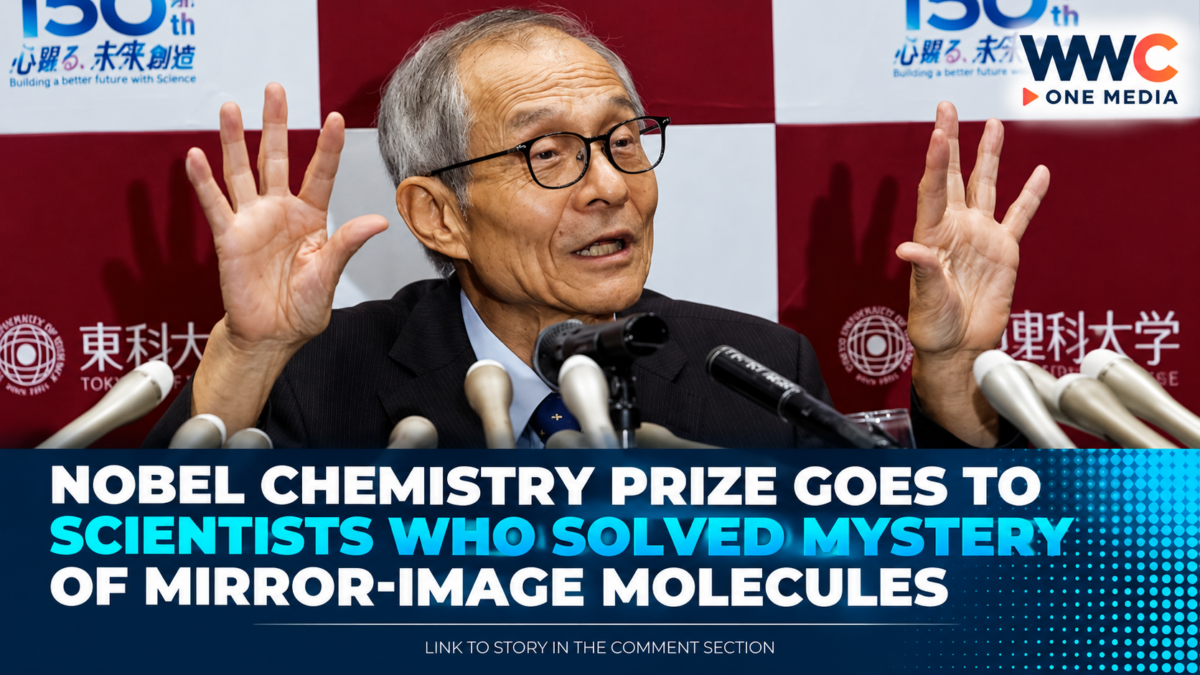
STOCKHOLM — French chemist Henri B. Kagan and Japanese scientist Kenso Soai have won the 2026 Nobel Prize in Chemistry for work that helped solve a century-old mystery about why living organisms overwhelmingly use one version of certain “mirror-image” molecules.
The Royal Swedish Academy of Sciences announced the award on Wednesday, Oct. 7, recognising the two scientists “for the discovery of non-linear effects and autocatalysis in asymmetric organic synthesis.”
Their research has helped chemists understand and control chirality, a property in which molecules can exist in two forms that are mirror images of one another — similar to the relationship between a person’s left and right hands.
The discovery has major implications for medicine because the two versions of a molecule can behave very differently when they interact with the human body. The ability to selectively produce the desired version is now an important part of pharmaceutical research and manufacturing.
A Century-Old Chemical Mystery
Many molecules found in nature come in two mirror-image forms, known as enantiomers.
A simple way to understand the difference is to think about hands. Your left hand and right hand are mirror images, but you cannot rotate one hand in three-dimensional space and make it exactly match the other.
Molecules can behave in much the same way.
The mystery that puzzled scientists was why life overwhelmingly chooses only one of these two possible forms.
For example, amino acids — the building blocks of proteins — can exist in two mirror-image variants, yet living organisms almost exclusively use one version in their proteins.
This phenomenon is known as homochirality, derived from the Greek word for “hand”.
Scientists had long struggled to explain how this molecular preference could emerge. When ordinary chemical reactions produce mirror-image molecules, they often generate roughly equal quantities of both versions.
Kagan and Soai’s research demonstrated how chemical processes could instead be driven toward producing one molecular “hand” preferentially.
Kagan Made the First Major Breakthrough
Kagan, now 95, was born in Boulogne-Billancourt, France, and became professor emeritus at Université Paris-Sud.
His decisive contribution came in 1986, when he discovered a way to manipulate chemical reactions so that a catalyst containing only a small imbalance between two mirror-image forms could produce a much larger imbalance in the resulting molecules.
The phenomenon became known as a non-linear effect.
In practical terms, Kagan showed that a tiny molecular preference could be amplified rather than simply reproduced at the same level.
That finding challenged the assumption that chemical reactions would always produce mirror-image molecules in equal proportions when the starting conditions were nearly balanced.
The discovery provided an important theoretical and experimental foundation for controlling molecular handedness.
Soai Took the Idea Even Further
Soai, 76, was born in Hiroshima, Japan, and is professor emeritus at Tokyo University of Science.
His work took the concept of molecular asymmetry into an even more unusual area: autocatalysis.
In an autocatalytic reaction, a product of the reaction helps accelerate the same reaction.
In 1995, Soai and his colleagues published research describing a chemical reaction with the potential to become completely dominated by one molecular mirror image.
Then, in 2003, his team demonstrated a reaction in which only one of the two possible mirror-image forms was produced.
The achievement was particularly significant because, before this work, nature was essentially the only known system capable of producing such a strongly one-sided molecular outcome through self-amplification.
The Nobel committee said Kagan and Soai’s combined discoveries provided a solution to the question of how homochirality can emerge spontaneously.
Why Mirror-Image Molecules Matter for Medicine
The research is not merely a theoretical explanation of how life works.
It has direct importance for drug development.
When a drug molecule exists in two mirror-image forms, the human body may interact with each version differently. One form may produce the desired therapeutic effect, while the other can have little effect or potentially cause harmful effects.
That makes the ability to manufacture a specific molecular form extremely valuable to pharmaceutical companies.
The history of medicine contains a particularly painful example of the consequences of molecular handedness.
During the 1960s, the drug thalidomide was linked to severe birth defects in thousands of children. Scientists later established that its molecular forms had different biological effects, highlighting the importance of understanding the three-dimensional structure of drug molecules.
The thalidomide tragedy helped demonstrate why controlling molecular structure is critical when developing medicines.
Today, controlling chirality is an established part of modern pharmaceutical chemistry, and the discoveries recognised by this year’s Nobel Prize helped provide scientists with powerful ways to achieve that control.
The Mystery Also Connects to the Origins of Life
The work of Kagan and Soai has another intriguing implication.
Scientists have long wondered how the first biological systems came to favour one molecular orientation over its mirror image.
If chemical reactions initially produce both forms, how did life eventually settle almost entirely on one?
Soai’s autocatalytic chemistry demonstrated that a very small initial imbalance can potentially be amplified through chemical reactions.
That does not by itself prove how life became homochiral, but it provides an important experimental model for understanding how a tiny molecular preference could become dominant.
The Nobel committee described their research as providing a solution to the more than century-old chemical mystery of how homochirality can emerge.
A Long-Awaited Recognition for Kagan
The award is also a major personal milestone for Kagan, whose work has influenced asymmetric chemistry for decades.
He is the third-oldest person to receive a Nobel Prize, according to Reuters. His daughter, Véronique Le Deunff, said the family was “very happy” with the recognition and praised the creativity and originality of his research.
Kagan had already been regarded as a major figure in asymmetric synthesis long before receiving the Nobel.
His work helped establish principles that later became central to the controlled production of chiral compounds, particularly in pharmaceutical chemistry.
The award therefore represents recognition not only for one discovery but for a lifetime of contributions to organic chemistry.
Soai Was Shopping When the Nobel Committee Called
Soai received the news in a rather ordinary setting.
Speaking by telephone during the Nobel announcement, he said he had been out grocery shopping when he learned that he had won the prize.
He said he was delighted to share the award with Kagan.
Japanese Prime Minister Sanae Takaichi congratulated Soai, saying she was proud of the scientist’s achievement. French President Emmanuel Macron also congratulated Kagan, describing the award as recognition appropriate to a lifetime of research.
Prize Worth 12 Million Swedish Kronor
Kagan and Soai will share the 12 million Swedish kronor prize, worth roughly US$1.2 million.
They will receive their medals and diplomas during the Nobel Prize ceremony in Stockholm on Dec. 10, the anniversary of Alfred Nobel’s death.
The chemistry award is the third of this year’s science prizes to be announced, following the Nobel Prizes in medicine and physics.
From Molecular Mirrors to Modern Medicine
The work recognised this year illustrates how a seemingly abstract chemical question can eventually have practical consequences for millions of people.
Why does life prefer one molecular “hand” over another?
For more than a century, scientists struggled to understand how such asymmetry could arise. Kagan’s work showed how small molecular differences could be amplified, while Soai demonstrated how chemical reactions could become self-reinforcing and strongly favour one molecular form.
Together, their discoveries helped chemists understand how chemical asymmetry can emerge and, crucially, how it can be controlled.
That knowledge now contributes to the development of medicines and other molecules in which getting the right mirror image can make all the difference.