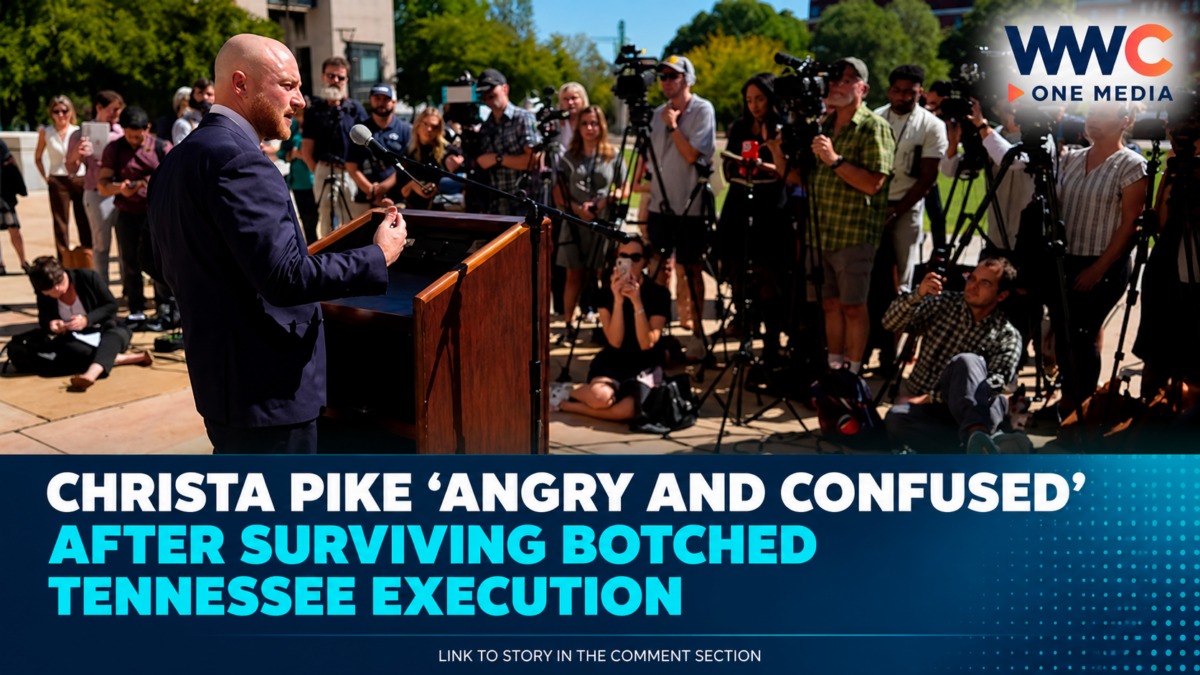
Death row inmate Christa Pike has regained consciousness and begun speaking after surviving Tennessee’s failed attempt to execute her by lethal injection, with her attorney saying she is now “angry and confused” about what happened.
Pike, 50, was taken to a Nashville hospital after the Sept 30 execution attempt left her unconscious and critically ill. She had received two injections of pentobarbital, but the procedure failed to kill her. Her lawyers initially feared she had suffered irreversible brain damage and were preparing for life support to be withdrawn.
Instead, almost six days after the execution attempt, Pike woke up and began talking, according to her attorney Randy Spivey.
Her recovery remains uncertain. Lawyers say she is suffering from pneumonia, a blood clot and severe swelling in her arms and hands, and currently cannot swallow or move her arms properly.
Pike Asked, “Where Am I?”
Spivey said Pike’s first reported questions after regaining consciousness were, “Where am I?” and “Who are you?”
Although she remains confused, her lawyers say she understands at least some of what happened.
“She is angry and confused about everything right now,” Spivey told reporters on Wednesday.
Pike has also asked about people in her life, including members of the family of the woman whose 1995 killing led to her death sentence.
Her lawyers said she remains in serious condition and faces a long recovery.
They are now seeking to have her death sentence commuted to life imprisonment, arguing that she has already endured a failed execution attempt and severe medical trauma.
What Happened During the Execution?
Pike was taken to the execution chamber at the Riverbend Maximum Security Institution in Nashville on Sept 30.
The procedure involved lethal doses of pentobarbital, a barbiturate used in Tennessee’s execution protocol.
According to court filings and statements from Pike’s lawyers, she complained that her arm was hurting shortly after the procedure began. She eventually lost consciousness but continued showing signs of distress before the media witnesses were escorted from the viewing area.
An ambulance subsequently transported her to a hospital.
Tennessee prison officials have not publicly provided a detailed explanation for why the execution failed.
The state’s Department of Correction said immediately after the incident that officials had followed the state’s established execution protocol and that Pike had been transported to an outside medical facility.
Possible IV Problem Under Investigation
Medical experts and Pike’s attorneys have focused on the possibility that the intravenous lines were not properly placed.
If the drug did not enter Pike’s bloodstream as intended, it may have accumulated in surrounding tissue instead, potentially explaining the severe injuries to her arms.
Pike’s attorneys have alleged that members of the execution team failed to recognise that the IV lines were improperly positioned.
The state has not confirmed that explanation, and officials have not yet released a definitive account of what went wrong.
A judge has now ordered Tennessee officials to preserve evidence from the failed execution so that the circumstances can be investigated.
Judge Orders Evidence Preserved
At a hearing in Nashville on Oct 7, Chancery Court Judge I’Ashea Myles directed state officials to preserve evidence connected to the execution attempt.
That includes syringes, drug packaging and lot numbers, IV lines, catheters, restraints, recordings, internal communications and accounts from people involved in the procedure.
Pike’s lawyers are also seeking access to any residual traces of the execution drugs so they can be independently analysed. The judge had not yet ruled on that request as of Wednesday.
The legal team argues that greater transparency is necessary because Pike survived an execution procedure that was expected to end her life.
They have described the situation as unprecedented and said the state should not be allowed to simply proceed with another execution without determining what went wrong.
A Potentially Unprecedented Legal Case
Pike’s survival could create an extraordinary legal question: Can Tennessee lawfully attempt to execute her again after she has already been subjected to lethal injection drugs?
The Death Penalty Information Center says Pike is believed to be the first person in the United States known to have survived after lethal injection drugs were actually administered during an execution.
There have been previous failed execution attempts in the US, but legal experts note an important distinction.
In several earlier cases, executions were stopped before the lethal drugs were administered. Pike’s case is different because she received the drugs and was subsequently hospitalised.
Experts say any attempt to execute her again could therefore trigger extensive constitutional litigation.
Questions could include whether another execution attempt would constitute cruel and unusual punishment under the Eighth Amendment, as well as whether Pike is medically and psychologically competent to be executed.
Tennessee Has Paused Executions
The incident has already prompted a broader review of Tennessee’s execution procedures.
Republican Gov. Bill Lee has paused executions in the state for the remainder of the year while officials review the failed procedures.
The pause follows another botched execution in Tennessee earlier this year involving death row inmate Tony Joe Carruthers, when prison officials were unable to establish the required intravenous access.
Tennessee’s correction commissioner also resigned following the latest controversy.
The state has faced growing scrutiny over its ability to carry out lethal injections reliably, particularly as US states have encountered difficulties obtaining execution drugs.
Pike’s Lawyers Had Warned About Her Veins
The problems encountered during the execution have particular significance because Pike’s lawyers had previously raised concerns about her veins.
Her legal team had argued before the execution that accessing her veins could be difficult and that a lethal injection could cause serious complications.
They had sought an alternative method of execution, but the challenge was unsuccessful.
After the failed procedure, those earlier warnings have become a major part of the legal debate surrounding Pike’s case.
Her lawyers now argue that another execution attempt should not be allowed.
Pike Was Convicted of a 1995 Murder
Pike was sentenced to death for her role in the 1995 torture and murder of 19-year-old Colleen Slemmer, a classmate at the Job Corps training centre in Knoxville, Tennessee.
Pike was a teenager at the time of the crime.
She was convicted of Slemmer’s murder and kidnapping and sentenced to death in 1996.
The case has remained controversial over the years, including questions raised by her defence lawyers about Pike’s mental health, childhood trauma and circumstances surrounding the crime.
Her lawyers have stressed those issues as part of their broader argument for clemency.
Supporters of Slemmer’s family, however, have rejected portrayals of Pike as the victim of the current situation.
During Wednesday’s court proceedings, one supporter of Slemmer’s family told reporters: “The victim is Colleen. The victim is not Christa Pike.”
The State Has Not Decided What Happens Next
For now, Pike remains under medical care while her lawyers pursue further legal action.
It is unclear whether she will regain the ability to move her arms, eat normally or fully recover cognitively. Her doctors and lawyers have said that determining her long-term prognosis could take considerable time.
It is also unclear whether Tennessee would ever seek another execution.
Gov. Lee has not publicly committed to another attempt, while Pike’s lawyers are calling for her sentence to be permanently commuted.
If Tennessee does seek to carry out another execution, the case could move through state and federal courts for years.
A New Chapter in the US Death Penalty Debate
Pike’s failed execution has become more than a question about one inmate’s medical condition.
It has renewed scrutiny of lethal injection procedures, execution secrecy, access to execution drugs and the constitutional limits of capital punishment.
Her case also presents a question that US courts have rarely confronted: what happens when an execution reaches the point of administering lethal drugs but fails to kill the prisoner?
For now, the immediate priority is Pike’s medical recovery and determining exactly what happened inside Tennessee’s execution chamber.
Her lawyers say she has already endured enough and should not face another execution attempt.
Tennessee officials, meanwhile, have yet to provide a definitive public explanation for the failure.
What happens next could ultimately establish a significant legal precedent for the future of capital punishment in the United States.