PARIS — France’s far-right National Rally is facing its most uncomfortable political test in years—and Marine Le Pen is moving to make sure she remains firmly in command.
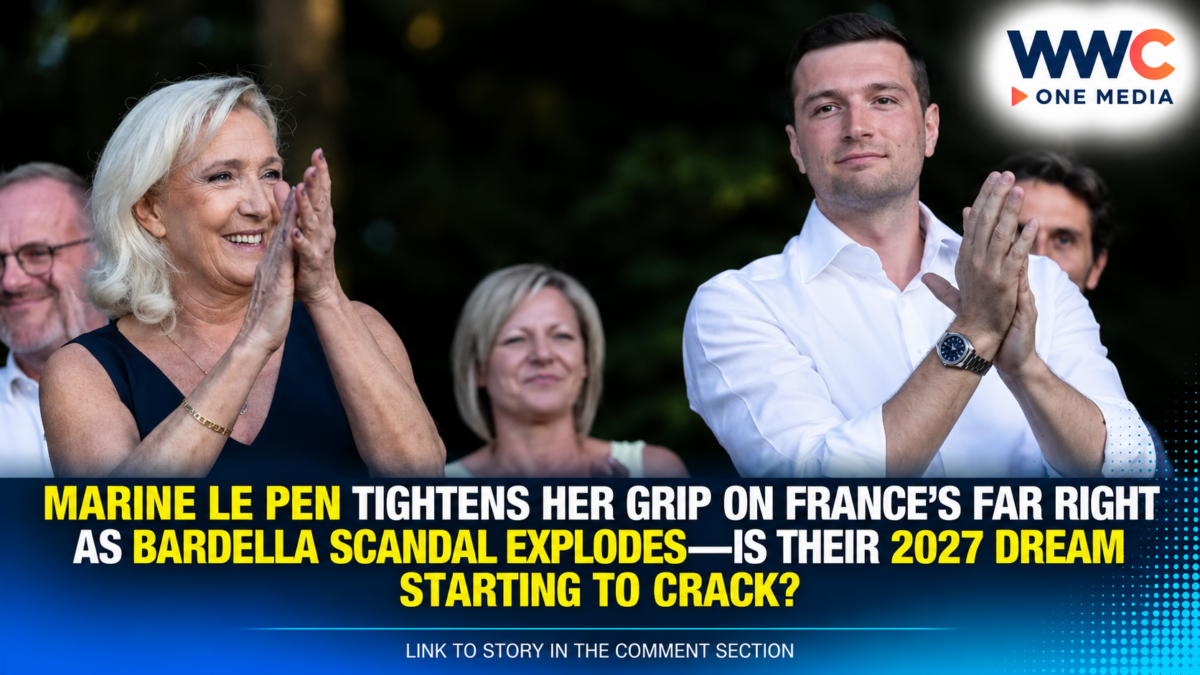
The party’s 2027 presidential strategy has increasingly revolved around a carefully constructed partnership: Marine Le Pen as the presidential candidate and Jordan Bardella as her expected prime minister.
But that arrangement is now under pressure.
Bardella, the 31-year-old president of the Rassemblement National (RN), is facing allegations over antisemitic messages allegedly written when he was a teenager. He strongly denies being the author and has filed legal complaints against the investigative outlet that published them.
Rather than distancing herself from her protégé, Le Pen has repeatedly defended him.
On October 7, she said she retained “1,000%” confidence in Bardella, according to Le Parisien.
That decision reveals the deeper political calculation.
Le Pen is not simply defending Bardella. She is defending the political partnership that could carry the National Rally to the Élysée Palace in 2027.
This is not a Bardella removal
Despite headlines suggesting that Le Pen has pushed her protégé aside, there is an important distinction.
Bardella remains president of the National Rally.
There has been no confirmed announcement that Le Pen has removed him from that position or formally replaced him as her prospective prime minister.
Instead, the latest developments point to Le Pen taking a more dominant role in defining the party’s political direction and presidential campaign while continuing to publicly support Bardella.
That distinction matters because Bardella remains one of the party’s most valuable political assets.
He has built a particularly strong following among younger voters and has become one of the most recognizable faces of France’s far right.
Le Pen needs him.
But she also needs to make sure that his controversies do not overwhelm her own campaign.
The Bardella controversy is threatening Le Pen’s biggest political achievement
For years, Marine Le Pen has worked to transform the National Rally from a party associated with the most controversial elements of France’s far right into a credible mainstream electoral force.
The strategy became known as “dédiabolisation” — de-demonization.
The objective was straightforward:
Make the party acceptable to voters who might agree with its positions on immigration, security and national sovereignty but remain uncomfortable with its historical associations.
Bardella became central to that effort.
His youth, social-media presence and relatively polished political image helped the party present a generational alternative to the older leadership.
That is why the allegations now carry such a potentially explosive political cost.
Le Monde reported that the controversy risks contaminating Le Pen’s campaign and damaging the party’s attempt to project a more normalized image.
What exactly is Bardella accused of?
The controversy stems from an investigation by Mediapart, which reported that Bardella allegedly wrote antisemitic and conspiratorial messages in private exchanges dating from around 2013, when he was approximately 17.
Bardella denies that he authored the messages and has described them as fabricated or manipulated.
He has also launched legal action, including a defamation complaint, against the investigative outlet.
Mediapart has subsequently published additional material that it says supports the authenticity of the messages, including evidence it says was authenticated through Meta and other sources.
That does not make the allegations judicially established facts.
Bardella’s denial remains part of the story, and the allegations should not be presented as a criminal or judicial finding against him.
But politically, the damage can occur long before any court resolves the dispute.
Le Pen has chosen loyalty over distance
This is where the story becomes more significant.
Le Pen could have attempted to create political distance between herself and Bardella.
Instead, she has done the opposite.
She has publicly defended him and framed the controversy as an attack intended to destabilize the National Rally’s presidential campaign.
That is a high-risk strategy.
If Bardella survives the controversy, Le Pen’s unwavering support could strengthen their partnership.
If the allegations continue to dominate headlines, however, Le Pen risks allowing the controversy to become attached to her own presidential campaign.
The political calculation is therefore brutal:
Protect Bardella and risk contamination—or abandon him and risk destroying the alliance that has helped build the RN’s 2027 campaign.
Bardella was supposed to be the future
The irony is that Bardella’s political rise was partly designed to solve exactly the problem now confronting the party.
At just 31, he represents a younger generation of National Rally leadership.
He became party president while Le Pen focused increasingly on the presidential race.
For years, the arrangement appeared strategically brilliant.
Le Pen had experience, a strong electoral base and a recognizable political brand.
Bardella had youth, digital reach and an ability to connect with voters who were less attached to the party’s older leadership.
Together, they offered the RN a two-generation political machine.
Now the same partnership is facing its biggest test.
The cracks were already visible before the scandal
The Bardella controversy did not appear in a vacuum.
The two leaders had already shown occasional differences over policy.
In September, Le Monde reported that Bardella had been uncomfortable with some of Le Pen’s positions on issues including headscarves and pensions, highlighting differences over how aggressively the party should present some of its most controversial proposals.
Earlier in the year, Bardella publicly diverged from Le Pen over pension policy, a particularly sensitive issue in French politics.
Those disagreements did not amount to an open leadership rebellion.
But they demonstrated that the RN’s carefully managed image of complete unity was never quite as simple as it appeared.
Le Pen has one major advantage: she is now eligible to run
The political equation changed dramatically in July.
Le Pen had faced the possibility of being barred from seeking the presidency after her conviction in the European Parliament assistants case.
An appeals court subsequently shortened the ban enough to allow her to announce a 2027 candidacy, although her conviction was upheld and she said she would appeal.
That transformed Bardella’s role.
Before the court ruling, he was widely seen as the potential substitute candidate if Le Pen remained ineligible.
Now Le Pen is back at the center of the presidential race.
And that gives her a much stronger reason to make sure the campaign remains under her control.
Bardella was once the insurance policy
Before the court decision, the RN had to prepare for two possibilities:
Le Pen runs.
Or:
Bardella runs instead.
That uncertainty had elevated Bardella’s importance inside the party.
Le Monde reported earlier this year that the RN was preparing for life beyond Le Pen because her legal battle could have prevented her from standing in 2027.
The July ruling changed that calculation.
Le Pen is now the candidate.
Bardella is positioned as the likely prime minister if she wins.
That means his political fortunes are increasingly tied to hers.
And Le Pen is already selling herself as a candidate of fiscal discipline
The latest crisis comes at a particularly important moment.
Le Pen has been trying to reassure voters and financial markets that the National Rally can manage France’s enormous fiscal problems.
On October 6, she unveiled an alternative budget promising approximately €140 billion in net savings by 2032, up from an earlier €125 billion target.
She said the plan would aim to bring France’s budget deficit below the EU’s 3% threshold by 2030.
The announcement was designed to counter one of the biggest weaknesses historically associated with the RN:
Can the far right actually govern France’s economy?
The timing could hardly have been worse for Bardella.
The controversy surrounding him overshadowed Le Pen’s effort to showcase fiscal credibility, according to Le Monde.
France’s bond market is watching
This is not merely an electoral soap opera.
France is already under intense pressure from bond investors.
Government borrowing costs have risen sharply, and the country’s debt burden has become a major political issue.
Reuters reported that Le Pen’s more aggressive spending-cut proposals briefly helped ease pressure in the French bond market, with the 10-year yield falling after she presented her fiscal strategy.
That gives Le Pen a powerful political opening.
She can argue that the RN is no longer simply an anti-establishment protest movement.
It wants to present itself as a government-in-waiting capable of managing debt, deficits and financial-market confidence.
But to make that argument credible, the party needs discipline.
And the Bardella controversy is testing precisely that.
The biggest risk is not losing Bardella—it is losing the message
The RN’s strategy for 2027 is based on a simple political narrative:
Le Pen can govern.
Bardella represents the next generation.
The party has become more professional and economically credible.
The traditional political establishment has failed France.
Every day the campaign is dominated by allegations surrounding Bardella instead of its economic program weakens that narrative.
The party can insist that the accusations are politically motivated.
But it cannot entirely control what voters discuss.
And presidential campaigns are often decided not only by policy but by which issues dominate the national conversation.
The controversy also revives the RN’s old problem
For years, Le Pen has tried to distance the National Rally from the legacy of its founder, Jean-Marie Le Pen, whose political career was repeatedly associated with antisemitic and racist remarks.
That history has been one of the biggest obstacles to the party’s attempt to become a governing force.
The latest Bardella controversy therefore touches a particularly sensitive nerve.
The question is not simply whether voters believe Bardella’s denials.
It is whether the controversy reinforces the perception among undecided voters that the RN has not changed as much as Le Pen claims.
Le Monde has argued that the affair risks exposing the limits of the party’s de-demonization strategy.
Yet abandoning Bardella could be even more dangerous
This is the trap facing Le Pen.
Bardella remains one of the RN’s most recognizable and electorally valuable figures.
He has a powerful social-media presence and considerable support among younger voters.
The Washington Post, citing AP reporting, noted that Bardella is particularly popular with young voters and that Le Pen has identified him as her intended prime minister if she wins.
Removing him abruptly could therefore create a different crisis.
It could suggest that the party believes the allegations are politically damaging.
It could create an internal leadership struggle.
And it could undermine the carefully constructed image of unity between Le Pen and Bardella.
Le Pen’s strategy appears to be that standing beside him is less dangerous than abandoning him.
The 2027 election is becoming a test of the RN’s transformation
The French presidential election is still months away.
But the political battlefield is already taking shape.
Le Pen is campaigning as the experienced candidate who has finally cleared the legal obstacle that once threatened her political future.
Bardella is positioned as the younger generation and potential future leader.
The party is simultaneously trying to prove that it can handle France’s finances, immigration, security and European policy.
The Bardella controversy hits all of those objectives at once.
It raises questions about the party’s leadership.
It threatens the de-demonization strategy.
And it distracts from the economic message Le Pen is trying to sell.
The party is fighting on another front, too
The RN is also increasingly using parliament as a campaign platform.
On October 8, the party planned a series of symbolic resolutions designed to force other French political parties to take positions on issues including low-emission zones, overseas water infrastructure and national preferences in public procurement.
That strategy allows the RN to keep its core campaign themes in the political spotlight while presenting itself as an increasingly powerful parliamentary force.
But again, the Bardella controversy threatens to hijack the message.
What happens if the scandal grows?
There are several possible scenarios.
Scenario 1: The controversy fades
If the public moves on, Le Pen’s strategy could work.
Bardella remains party president and prospective prime minister, while Le Pen focuses on the presidential race.
The RN returns to campaigning on immigration, purchasing power, national sovereignty and the economy.
Scenario 2: Bardella becomes a liability
If additional allegations or evidence emerge, Le Pen could face growing pressure from within the party to reconsider his role.
That would force her to choose between personal loyalty and electoral pragmatism.
Scenario 3: The controversy becomes a referendum on the RN itself
This may be the most dangerous outcome.
Instead of voters debating whether Le Pen’s economic program is credible, the election could become another argument over whether the National Rally has genuinely changed.
That would drag the party back toward the very political identity Le Pen has spent years trying to escape.
The bigger question is who really controls the RN
At the heart of the story is a question that goes beyond Bardella’s current controversy:
Who actually controls the future of France’s far right?
For years, the answer appeared to be a partnership.
Le Pen was the undisputed presidential leader.
Bardella was the younger successor.
But now Le Pen is once again the official presidential candidate.
That gives her a much stronger incentive to make the campaign revolve around her program, her economic credibility and her vision for France.
Bardella remains important.
But the hierarchy is becoming clearer.
The 2027 election is Marine Le Pen’s campaign.
Bardella’s job is increasingly to help her win it.
The Bottom Line
Marine Le Pen is not formally removing Jordan Bardella from the National Rally.
Instead, she is doing something more politically consequential: reasserting herself as the central figure of the party’s 2027 presidential campaign while refusing to abandon the young leader she has designated as her prospective prime minister.
That decision comes as Bardella faces allegations over antisemitic messages that he denies writing and as the controversy threatens Le Pen’s years-long effort to make the National Rally appear ready to govern.
At the same time, Le Pen is attempting to demonstrate economic credibility with a €140 billion fiscal-savings plan, while France struggles with high debt, political instability and rising borrowing costs.
The political calculation is therefore enormous.
If Le Pen protects Bardella and the scandal disappears, their partnership could emerge stronger.
If the controversy grows, however, she may discover that defending her protégé has tied his problems directly to her own presidential ambitions.