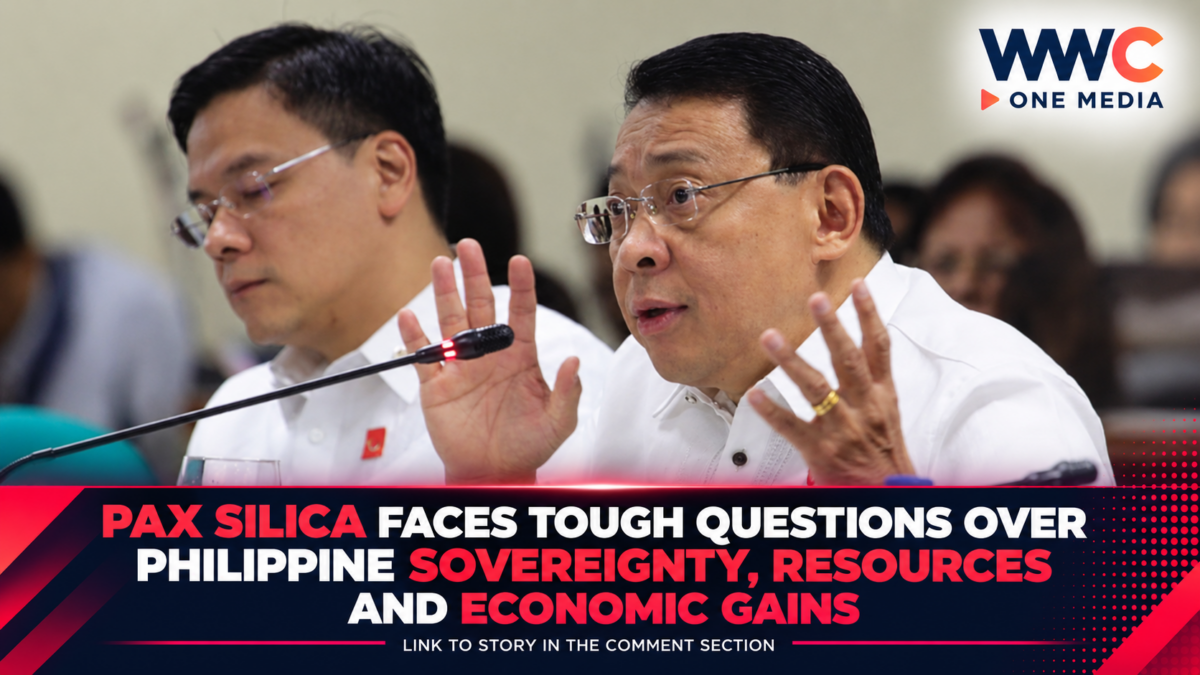
MANILA — The Philippines’ participation in the US-led Pax Silica initiative could offer a path into higher-value technology industries, but former Bangko Sentral ng Pilipinas Deputy Governor Diwa Guinigundo is warning that the opportunity should not come at the expense of national interests.
Guinigundo said the debate has become increasingly polarized, with supporters viewing Pax Silica as a chance to move the Philippines deeper into the global technology economy, while critics fear the country could end up supplying land, labor, minerals, energy and water without capturing enough of the resulting economic value.
The Bigger Question: Who Captures the Value?
Pax Silica is designed around emerging technology supply chains involving semiconductors, artificial intelligence, critical minerals, energy and advanced manufacturing.
For the Philippines, Guinigundo said the key issue should not simply be how much foreign investment the initiative attracts, but whether the country can move beyond its traditional role in lower-value assembly and become a producer and innovator.
That means securing technology transfers, developing Filipino engineers and scientists, strengthening local suppliers, expanding research and development and helping Philippine companies participate in higher-value parts of the technology chain.
Without those elements, he warned, the country could simply reproduce the same low-value position it has occupied in global manufacturing for decades.
Geopolitical Alignment Raises Concerns
Another major question is how closely Philippine participation could align the country with Washington’s strategic objectives.
Pax Silica has a clear geopolitical dimension because it seeks to build trusted technology and supply chains while reducing vulnerabilities associated with dependence on China.
Guinigundo said the Philippines should recognize that reality while protecting its ability to maintain relationships with other major economic powers.
He pointed to the country’s continuing openness to investments from the United States, China, Japan, South Korea, Europe, Australia and other partners, arguing that Pax Silica should be treated as one platform for economic diplomacy rather than a replacement for broader foreign economic relations.
Power and Water Are Critical Issues
The proposed development also raises questions about how much electricity and water future technology and manufacturing facilities could require.
Earlier discussions in Congress have already raised concerns over whether Pax Silica projects could increase pressure on electricity supplies, water resources and consumer costs. Government officials have said investors are expected to provide their own roads, power and water infrastructure.
The Bases Conversion and Development Authority has also said the planned development in New Clark City would rely on water harvesting, storage, treatment and recycling, while dedicated power facilities and renewable-energy options are being considered.
Guinigundo said the government should nevertheless require independent studies validating power and water requirements, transparent environmental safeguards and protections ensuring that industrial demand does not undermine household and agricultural needs.
Communities Must Be Protected
Land acquisition and potential effects on local communities are another concern.
Guinigundo said development should include transparent land information, environmental assessments, appropriate compensation and livelihood protections. Where legally required, free, prior and informed consent must also be secured.
The objective, he argued, should be development that creates higher-value industries without leaving surrounding communities worse off.
Transparency Could Determine Public Trust
Governance may ultimately be the most important test.
The Philippines and the United States have been negotiating a framework for Pax Silica, with officials previously targeting a signing before the end of 2026. The proposed initiative includes a development in New Clark City focused on semiconductors and advanced manufacturing.
Guinigundo said the public should be able to understand the framework’s obligations, as well as its fiscal, environmental and economic consequences, before irreversible commitments are made.
The government has maintained that the initiative remains subject to negotiations and that provisions can still be changed to improve its benefits for Filipinos.
Opportunity — But Not a Blank Check
Pax Silica could give the Philippines an opportunity to attract investment linked to AI, semiconductors and advanced manufacturing while strengthening its position in rapidly changing global supply chains.
But the initiative does not automatically guarantee industrial transformation.
The ultimate test, Guinigundo argued, is whether Filipinos will capture substantially more of the value generated by the industries developed in the country over the next decade or two.
For the Philippines, the choice is therefore not simply whether to join the emerging technology economy. It is whether participation can help turn the country from a supplier of land, labor, minerals, electricity and water into a producer, innovator and value creator in the global technology economy.