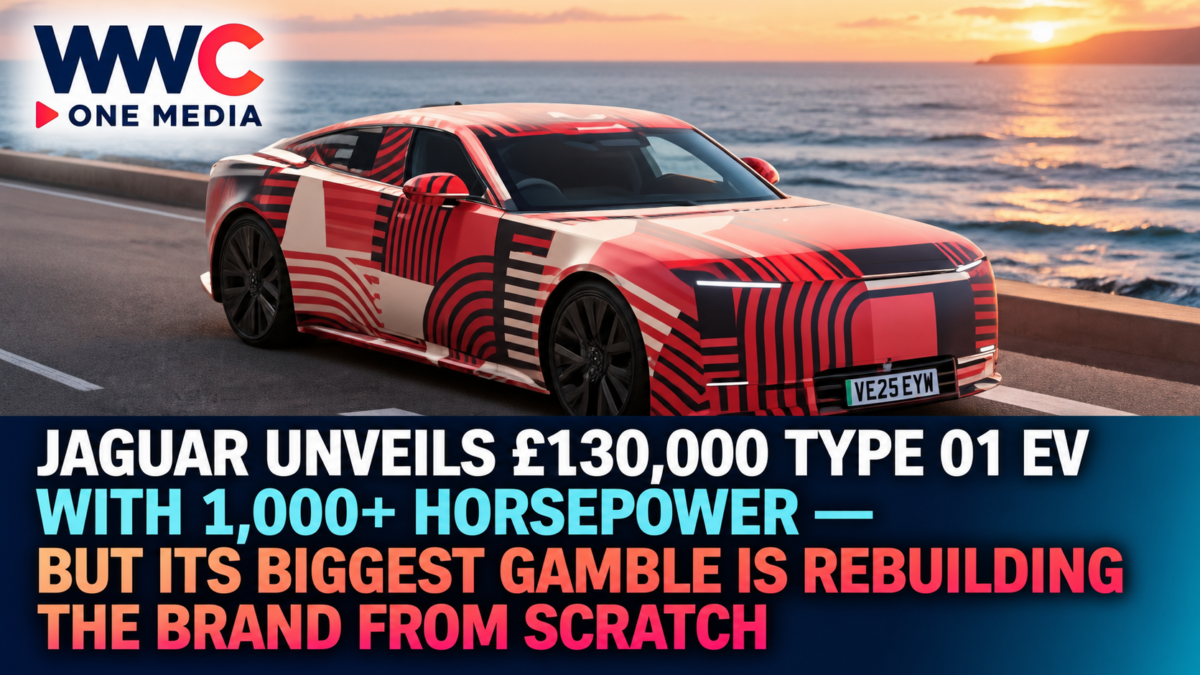
NEW YORK — Jaguar has finally revealed the car meant to prove its radical reinvention was more than a marketing stunt.
The British luxury marque unveiled the Type 01 in New York on October 6, marking the first production model of its controversial new electric era and one of the biggest strategic resets in the company’s 90-year history.
The four-door electric grand tourer is dramatically larger, faster and more expensive than the Jaguars most buyers remember.
Prices are expected to start at around £130,000, or roughly $170,000, placing the Type 01 firmly above the traditional premium market and much closer to Bentley, Aston Martin and top-end Mercedes-Benz territory.
It is also the most powerful production Jaguar ever built.
Independent technical reporting on the production car puts output at around 1,015 horsepower, with more than 1,000 lb-ft of torque from a tri-motor electric powertrain. Car and Driver reports a 0-to-60 mph time of about 3.1 seconds, while EPA-estimated range is around 400 miles.
But the real story is not the horsepower.
It is that Jaguar has effectively abandoned its old business model and is betting that a smaller number of much richer customers will pay substantially more for a car that looks nothing like the company’s recent products.
Type 01 Is the First Car of Jaguar’s “New Era”
Jaguar says the name itself is symbolic.
“Type” connects the new EV to famous models such as the C-Type, D-Type, E-Type and F-Type.
The “0” represents zero tailpipe emissions.
The “1” marks it as the first production Jaguar of a completely new generation.
That new generation is intentionally different.
The Type 01 has an extremely long bonnet despite being electric, a very low roofline, 23-inch wheels and a body stretching to roughly 5.2 metres.
It also has no conventional rear window, relying instead on camera-based rear visibility.
The car is so long that The Guardian noted it exceeds the dimensions of many standard UK parking spaces.
That is not an accident.
Jaguar is trying to make the vehicle visually impossible to confuse with the growing number of smooth, aerodynamic luxury EVs already on sale.
Jaguar Wants Fewer Customers — But Much Higher Margins
For years, Jaguar tried to compete directly with BMW, Mercedes-Benz and Audi.
That strategy failed to generate enough scale or profit.
Its sedans and SUVs faced powerful German rivals, while the shift toward electric vehicles created another expensive technology transition.
Jaguar’s answer is now to move upward.
Instead of selling large numbers of relatively mainstream luxury vehicles, the company wants to sell fewer cars at significantly higher prices.
The Type 01 is the clearest expression of that strategy.
Jaguar managing director Rawdon Glover has argued that luxury EVs risk becoming increasingly homogeneous and that the company must offer something visibly different rather than another anonymous premium electric sedan.
That makes the Type 01 both a car and a business-model test.
Jaguar is effectively asking whether rarity and design can compensate for reduced scale.
The Type 01 Is Built Around a Bespoke EV Platform
The car sits on Jaguar’s new Jaguar Electric Architecture, or JEA.
This is not an electrified version of an existing petrol platform.
It was developed specifically for the brand’s new generation of EVs.
The Type 01 reportedly uses a battery around 118 to 120 kWh, an 800-volt electrical system and high-speed charging capable of restoring a large portion of the battery in roughly 20 minutes under ideal conditions.
Jaguar says the dedicated architecture gives designers much greater freedom to create the dramatic proportions they wanted.
That is why the car has such an unusually long bonnet even though electric motors do not require the same space as a traditional combustion engine.
In other words, Jaguar is deliberately using EV technology to create an old-school grand-tourer silhouette rather than maximizing interior efficiency.
The Interior Is Just as Radical
Inside, the Type 01 keeps much of the architecture previewed by the Type 00 concept.
A dramatic central spine runs through the cabin, dividing it into four individual seating spaces.
Jaguar says the low seating position and narrow dashboard are intended to create a more immersive grand-touring environment.
Technology is designed to appear only when needed.
The production car reportedly includes a large digital display, camera-based rear-view systems, advanced connectivity and over-the-air software updates.
But Jaguar has deliberately avoided making the cabin look like a conventional tablet-filled EV interior.
That fits with its wider “Copy Nothing” philosophy.
Whether buyers find that distinctive or awkward will be one of the car’s biggest tests.
The 2024 Rebrand Created Enormous Backlash
The Type 01 arrives after one of the most controversial automotive rebrands in recent memory.
Jaguar’s 2024 “Copy Nothing” campaign deliberately moved away from traditional imagery of British performance cars.
The marketing featured brightly dressed models, abstract visuals and almost no actual cars.
Critics accused Jaguar of abandoning its heritage.
Elon Musk publicly mocked the campaign.
Political figures including Donald Trump and Nigel Farage also attacked the rebranding.
But Jaguar insisted the controversy was part of the point.
The company wanted people talking about the brand again.
The Type 01 is now where that strategy becomes much harder to defend with advertising alone.
Customers finally have a real car to judge.
Jaguar Actually Stopped Selling New Cars
The risk is even larger because Jaguar effectively paused its traditional model range before the Type 01 arrived.
The F-Pace, its final major existing model, was discontinued as the company prepared for the transition.
That created an extraordinary gap in which Jaguar had almost no meaningful new-car lineup while competitors continued selling vehicles.
The Type 01 is therefore not merely another launch.
It is the restart button.
Autocar described the car as the model that begins Jaguar’s rebirth after an approximately 18-month new-product hiatus.
That makes failure unusually dangerous.
Most carmakers can survive one disappointing model because they have other vehicles generating revenue.
Jaguar has placed much more of its identity on this one launch.
North America Is Crucial
Jaguar chose New York for the world premiere for a reason.
The company is placing heavy emphasis on affluent North American buyers.
The Guardian reports Jaguar is targeting younger, wealthier customers, especially technology-focused buyers in the United States who may not have considered the brand previously.
That is a notable change from Jaguar’s historical customer base.
The company is trying to attract people who might otherwise buy:
a Porsche Taycan,
Mercedes-AMG EV,
Lucid Air,
Bentley,
high-end Range Rover,
or even more exotic luxury vehicles.
The Type 01 therefore has to compete simultaneously on performance, prestige and novelty.
China Is a Much Harder Market
The strategy becomes more difficult in China.
Chinese manufacturers have become exceptionally strong in electric vehicles, including the premium segment.
Companies such as BYD and its luxury sub-brands increasingly offer high-performance EVs with sophisticated software and aggressive pricing.
Jaguar is therefore avoiding an immediate full-scale Chinese launch, according to current reporting, while prioritizing markets where luxury-brand heritage may carry more weight.
That makes the U.S. and Europe even more important.
If wealthy Western buyers reject the Type 01, Jaguar will have fewer obvious markets to compensate.
Jaguar Land Rover Is Already Cutting Costs
The launch also arrives during a difficult period for parent company JLR.
The company has been cutting thousands of jobs as part of a broader cost-reduction programme.
The Guardian reports JLR recently announced around 4,000 job cuts as it sought roughly £1.7 billion in savings.
The group has also had to manage the aftermath of a major cyberattack that disrupted operations and caused significant economic damage in Britain.
Against that backdrop, an expensive brand relaunch becomes even more financially significant.
Jaguar cannot spend indefinitely waiting for customers to embrace its new identity.
More Models Are Coming
The Type 01 is only the beginning.
Jaguar has indicated that additional vehicles based on the same new electric architecture will follow.
Industry reporting has pointed to a large luxury sedan and SUV as likely future additions.
That would give Jaguar a broader portfolio and reduce its dependence on one grand tourer.
But the first car matters enormously because it establishes:
pricing,
design language,
brand perception,
technology credibility,
and dealer confidence.
If the Type 01 succeeds, Jaguar can build around it.
If it fails, every later product becomes harder to sell.
Jaguar Is Trying to Avoid the Luxury-EV Trap
Luxury EVs have proved much more complicated than carmakers expected.
Mercedes-Benz has struggled with weaker-than-hoped demand for some EQ models.
Porsche has faced pressure around Taycan sales.
Lucid produces acclaimed cars but continues burning large amounts of capital.
Tesla’s Model S is no longer the market-defining luxury EV it once was.
And Chinese manufacturers are improving extremely quickly.
That means simply being electric is no longer enough.
Jaguar is trying to solve the problem by making design and exclusivity the product rather than emphasizing electrification alone.
The Type 01 is electric because Jaguar believes that is where the technology is going.
But its marketing is much more about luxury, performance and individuality.
Over 1,000 Horsepower Is Almost the Easy Part
The irony is that extreme EV performance is becoming relatively common.
Electric motors make enormous horsepower easier to achieve than with combustion engines.
Several premium EVs now produce acceleration figures once limited to supercars.
That means Type 01’s roughly 1,015 horsepower is impressive but not necessarily unique.
The harder challenge is emotional.
Can Jaguar make buyers care enough about the badge again to spend £130,000 or more?
Can it convince younger customers that Jaguar belongs beside Bentley and Aston Martin rather than below Mercedes and BMW?
And can it do that without alienating the enthusiasts who still associate the brand with the E-Type, XJ and roaring V8 sports cars?
The “Copy Nothing” Gamble Finally Has a Product
For nearly two years, Jaguar’s reinvention has largely been judged through advertising, concept cars and controversy.
Now there is finally something tangible.
The Type 01 has:
more than 1,000 horsepower,
around 400 miles of estimated range,
a radically styled four-seat cabin,
an ultra-long body,
and a price pushing Jaguar firmly into six-figure luxury territory.
It is deliberately impractical in places.
It is deliberately polarizing.
It is deliberately unlike the mainstream premium cars Jaguar spent years trying—and struggling—to compete against.
That may be exactly what the company needs.
Or it may prove that controversy attracts attention more easily than customers.
Jaguar has made the Type 01 impossible to ignore.
The real question is whether wealthy buyers will admire its audacity from a distance—or actually pay £130,000 to put one in their garage.