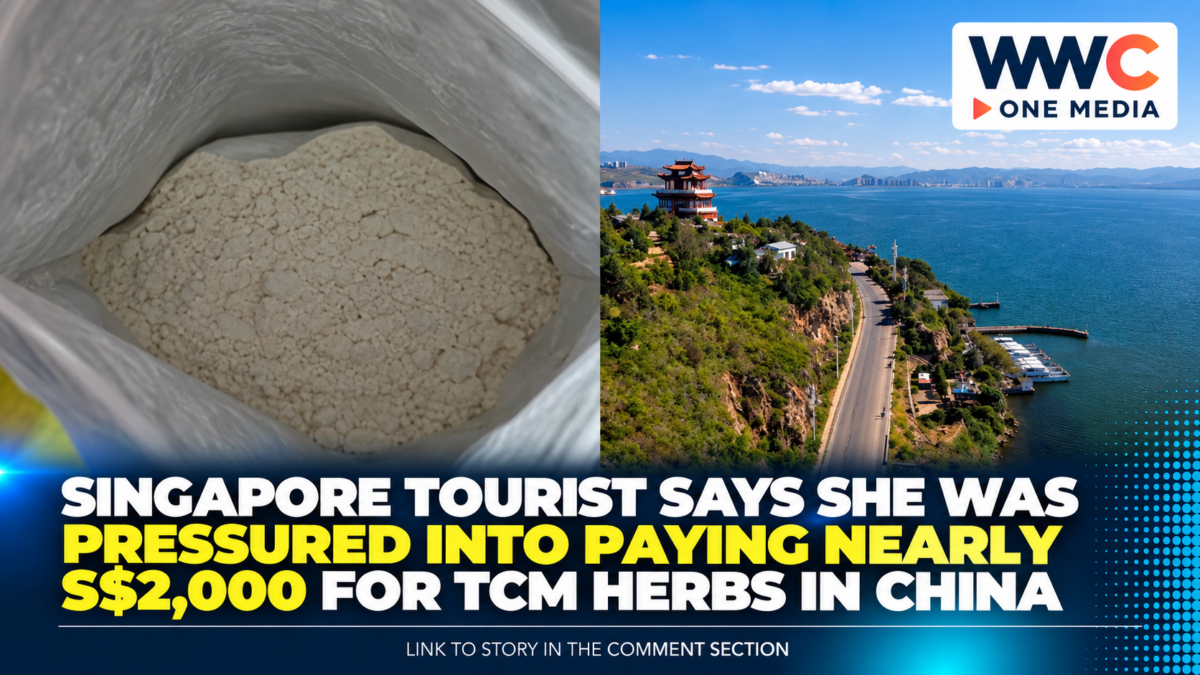
A 73-year-old Singaporean woman says she was pressured into paying nearly S$2,000 for powdered traditional Chinese medicinal herbs during a holiday in Yunnan, China, after a roadside vendor allegedly refused to let her back out of the purchase.
The woman, identified by Shin Min Daily News as Madam Li in translation, was travelling independently with her husband and four friends on a 26-day trip to Yunnan that began on Aug. 30, 2026.
The incident happened on the fifth day of their trip, when the group was making arrangements to travel to Xizhou Ancient Town, an attraction in Dali City.
Group was introduced to a cheap car service
According to reports, Madam Li and her companions were looking for a private car service when a woman approached them and offered her husband’s car charter services.
The price was considerably lower than other options, and the group eventually agreed to hire the service after negotiating.
During a lunch stop along the way, Madam Li said she passed a stall selling traditional Chinese medicinal herbs while walking to the washroom.
She said she had no intention of buying any medicinal products at the time.
However, a mother-and-daughter pair allegedly approached her and began promoting a powdered herbal product known as “Zangbei powder”.
The pair reportedly said they had suffered from persistent coughing but experienced improvement after consuming the product. They also described what they claimed were various medicinal benefits of the powder.
The price was initially stated to be 12 yuan per gram, but after negotiations, the price was reportedly reduced to eight yuan per gram.
Tourist says she was pressured into buying more
Madam Li said the situation changed when the mother and daughter pointed at her and indicated that she should take one bag of the product.
A seller then reportedly weighed the powder and told her she needed to pay about 10,000 yuan.
That amount was equivalent to roughly S$1,900.
Madam Li said she immediately objected because she did not want such a large quantity.
However, according to her account, the seller told her that the herbs had already been ground into powder and therefore could not be returned or refunded.
Feeling that she had little opportunity to refuse, she proceeded with the payment.
The situation was made more confusing by the exchange rate.
Madam Li said she misunderstood the amount involved and initially thought she was paying only about S$200 rather than close to S$2,000.
It was only after she returned to the car and spoke to her husband that she realised how much had actually been charged.
Her bank records showed a final payment of S$1,901.45.
Suspicion grew after hearing of similar incident
Madam Li said she became suspicious that she could have been the victim of a scam after taking a ride-hailing car in Tengchong, another city in Yunnan.
During the journey, she reportedly heard the driver discussing a similar incident involving tourists and herbal products.
The experience prompted her to reconsider what had happened at the lunch stop.
She later returned to Dali City on Sept. 14 and went to the local police station the following day to make a report.
Madam Li subsequently returned to the location with local police in an attempt to identify or locate the people involved.
However, the stall and the sellers could reportedly no longer be found.
Woman also reported incident in Singapore
After returning to Singapore, Madam Li made another police report regarding the incident.
She said she had not consumed the herbs and intended to send the powdered product to the Singapore Food Agency for testing.
The case highlights the difficulties tourists can face when making purchases while travelling, particularly when unfamiliar currencies, language barriers and pressure from sellers are involved.
Madam Li advised travellers to exercise caution when approached by street vendors and to avoid making rushed purchases without first understanding the price, quantity and nature of the product.
The incident is also a reminder that a product being described as a traditional or medicinal remedy does not automatically establish that it is safe, effective or appropriately regulated.
Singapore’s Health Sciences Authority has separately warned consumers about the safety and quality of traditional herbal remedies. It says some products marketed as herbal remedies can contain undeclared prescription medicines, including steroids, and that consumers should be cautious about products from unreliable sources.
For Chinese proprietary medicines sold in Singapore, the HSA regulates local dealers through licensing and product-listing requirements.
In this case, however, the allegations concern a purchase made in China, and there has been no independent confirmation that the powdered product itself was fraudulent, adulterated or medically ineffective.
The Singaporean tourist’s account centres on the circumstances surrounding the sale and the pressure she says she experienced to complete the purchase.
The reported disappearance of the vendor when she returned with local police also meant that she was unable to locate the seller at the same spot and seek an immediate resolution.
For travellers, the episode underscores the importance of confirming prices and quantities before agreeing to buy unfamiliar products, especially when purchases involve large sums of money or claims about health benefits.