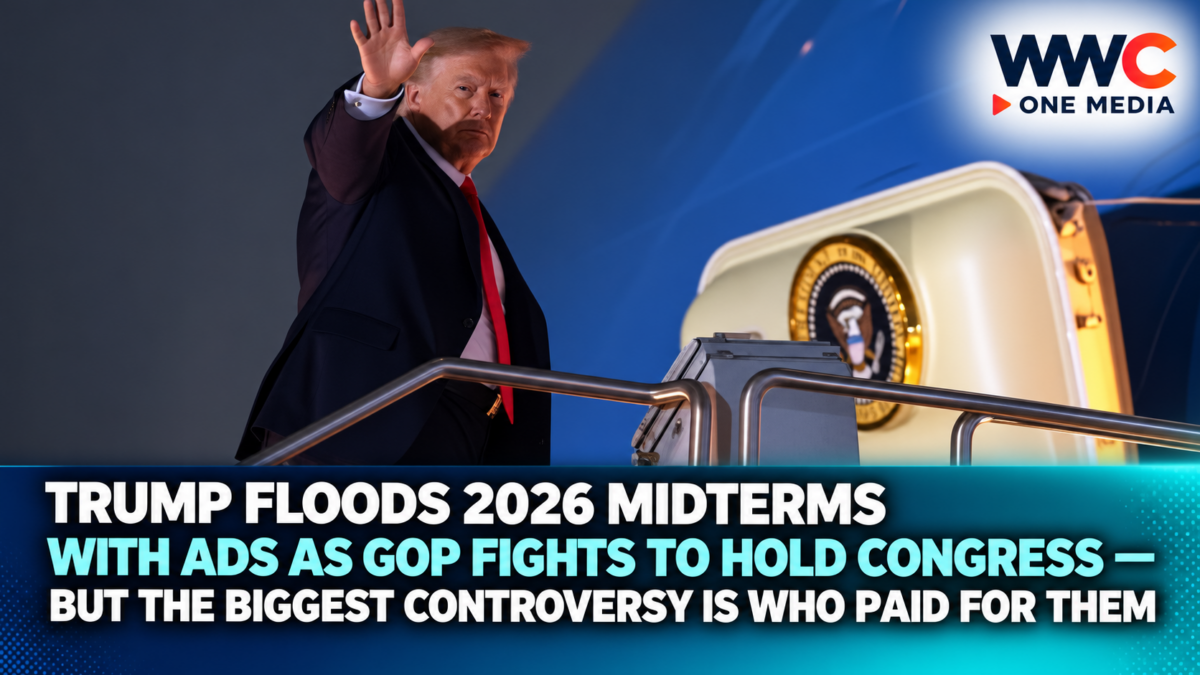
WASHINGTON — President Donald Trump and his political allies are pouring well over $100 million into the final weeks of the 2026 midterm elections as Republicans fight to protect control of Congress, but a separate taxpayer-funded advertising campaign has created an even bigger controversy over where political promotion ends and government propaganda begins.
Trump-aligned groups have committed more than $130 million in advertising across competitive House and Senate contests, according to AdImpact data reported by the Associated Press.
At the same time, the Trump administration authorized a separate $20 million federal advertising campaign featuring the president and promoting his record—money that came through the Department of Homeland Security and was originally tied to other congressionally funded purposes.
That distinction matters.
One pot of money comes from political organizations legally trying to elect Republicans.
The other came from taxpayers.
And it is the second that has triggered bipartisan criticism, legal complaints and demands for investigations.
Trump-aligned PACs are launching a late advertising blitz
Trump’s political network is entering the final month before the November 3 midterm elections with enormous financial firepower.
AdImpact says Trump-aligned groups are spending roughly $138 million across around 50 races, making the network one of the largest outside forces in the battle for Congress.
Two newer super PACs linked to MAGA Inc.—No Going Back PAC and Safety and Affordability PAC—have committed tens of millions of dollars to Senate and House contests, while MAGA Inc. itself retains hundreds of millions of dollars in reserves.
No Going Back has concentrated heavily on Senate races.
Safety and Affordability is targeting House contests.
The goal is straightforward:
protect vulnerable Republicans, expand the party’s Senate position and prevent Democrats from retaking the House.
Why Trump is spending so aggressively
The political environment has become more difficult for Republicans.
Historically, the president’s party often loses congressional seats during midterm elections.
Republicans also entered 2026 with only a narrow House majority, making even modest Democratic gains potentially decisive.
Trump is therefore treating the midterms as a referendum on his presidency.
He has launched a 32-day campaign blitz, visiting Republican-leaning states and battlegrounds to energize turnout and defend GOP candidates.
The stakes are personal as well as political.
Losing the House would give Democrats subpoena power and control of congressional investigations.
Trump remembers what happened during his first presidency, when Democrats won the House in 2018 and later impeached him twice.
The economy is becoming the biggest Republican problem
Republican ad spending is surging because voter dissatisfaction is also increasing.
Recent AP-NORC polling cited in campaign coverage shows weak public approval of Trump’s handling of the economy and the cost of living.
High fuel prices, food costs and broader affordability concerns are giving Democrats a potent message.
That is why many GOP ads are increasingly focused on:
inflation;
energy;
immigration;
crime;
and direct financial relief.
Trump himself has promised $5,000 payments to American adults if Republicans retain control of Congress, a proposal the AP estimated could cost about $1.2 trillion.
Republicans are betting that aggressive messaging can overcome dissatisfaction with current conditions.
Political ad spending is heading toward a record
The 2026 midterms are becoming extraordinarily expensive.
AdImpact projects approximately $11.6 billion in total political advertising spending during the cycle.
If that forecast holds, the midterms would surpass the previous $8.9-billion record from 2022 and even exceed the $11.2 billion spent during the 2024 presidential cycle.
That is remarkable because there is no presidential election this year.
The money is being concentrated on Senate, House, gubernatorial, state legislative and ballot-measure contests.
Republicans held a significant advantage in broadcast ad spending heading into October.
AdImpact found Republicans aired roughly $200 million more in congressional advertising than Democrats during September alone.
Trump himself dominates the advertising conversation
Even when Trump is not technically on the ballot, he is everywhere in political advertising.
AdImpact reviewed more than 6,000 broadcast creatives and found Trump appeared in more than 1.1 million broadcast airings during the cycle, representing roughly 36% of all political broadcast airings through the period measured.
In June alone, Trump appeared in about 40% of political broadcast ads.
That means the 2026 midterms are increasingly functioning like another Trump election.
Republicans use him to energize their base.
Democrats use him to mobilize opposition.
Trump has effectively become the central subject of the cycle even without his name on the ballot.
But the taxpayer-funded ads created a different problem
The most controversial advertising campaign did not come from MAGA Inc.
It came from the federal government.
The Department of Homeland Security received $20 million for a nationwide media campaign featuring Trump, after funds were shifted within the agency’s budget.
The advertisements praised Trump’s presidency, promoted themes similar to his political campaigns and carried a disclosure reading:
“Paid for by the U.S. Government.”
Some ads closely resembled material used during Trump’s 2024 presidential campaign.
That immediately raised questions about whether taxpayer money was being used for partisan political promotion weeks before a national election.
Critics say the ads may violate federal law
Democratic lawmakers and legal experts have questioned whether the campaign violates restrictions on government propaganda and partisan political activity.
Potential legal concerns include the Hatch Act, appropriations law and restrictions against unauthorized propaganda using public funds.
FactCheck.org reported that several legal experts disputed the White House’s argument that the advertisements were ordinary public-service announcements.
California Attorney General Rob Bonta filed complaints with the Government Accountability Office and the Office of Special Counsel seeking investigations.
Bonta said the ads appeared designed to help Trump’s political party ahead of the midterms and claimed at least $5.5 million had already been spent or committed by October 5.
Those are allegations, not findings of illegality.
No court or federal watchdog has yet issued a final ruling that the advertisements violated the law.
Republicans also criticized the taxpayer spending
The objections were not entirely partisan.
Several Republicans expressed discomfort with using federal money on ads praising Trump.
That matters because governments routinely run legitimate advertising campaigns.
Federal agencies advertise:
public-health programs;
military recruitment;
disaster preparation;
anti-drug messages;
tax information;
and immigration enforcement.
The legal and political question is whether these particular ads crossed the line from communicating government policy into promoting an individual politician or political party.
That line can be difficult to define.
The timing—just weeks before the midterms—made the issue especially sensitive.
The White House insists they were public-service announcements
The Trump administration rejected claims that the advertisements were campaign ads.
The White House argued that Trump was not personally running in the 2026 election and that the commercials did not explicitly tell viewers to vote Republican.
Officials described the spots as patriotic public-service messages highlighting administration policies.
That defense is legally significant.
Government officials are allowed to communicate policies and accomplishments.
The difficult question is whether the content and timing made these advertisements effectively partisan even without an explicit “vote Republican” message.
Critics say yes.
The administration initially said no.
Trump then reversed course
By October 5, the controversy had become large enough that Trump changed direction.
He announced that taxpayer money would no longer finance the ads.
Trump said he would instead pay for them personally or use money raised through MAGA Inc.
The decision does not resolve questions about the taxpayer money already spent.
Reuters reported that the federal campaign involved roughly $20 million in Homeland Security funding.
It also remains unclear whether previously spent government funds will be reimbursed.
But moving the future campaign onto political financing removes the clearest objection:
taxpayers being forced to fund the advertisements.
MAGA Inc. can easily afford them
Trump’s political operation is hardly short of cash.
MAGA Inc. has amassed roughly $400 million in reserves, according to current reporting.
That gives Trump enormous flexibility to fund advertisements without turning to the federal budget.
The political committee’s war chest is unusually large for a midterm election.
It allows Trump to intervene in races across the country.
And it gives Republican candidates access to outside financial support at a moment when some are facing unexpectedly competitive contests.
Republicans are spending even in states they expected to hold easily
One warning sign for the GOP is where some of the money is going.
Republicans have been forced to spend heavily in states and districts that once looked relatively safe.
In Iowa, for example, Senate Leadership Fund added another $20 million to help Republican Sen. Ashley Hinson in a surprisingly competitive race.
Republican-aligned groups are also pouring money into Ohio, Texas and Michigan.
Ohio’s Senate race alone had reached roughly $240 million in advertising spending by late September, according to a Washington Post analysis of AdImpact data.
Texas was also among the most expensive contests.
When parties begin spending heavily on supposedly safe seats, it usually indicates concern about the broader political environment.
Democrats are spending heavily too
Republicans do not have the field to themselves.
Democratic candidates, party committees and allied groups are pouring hundreds of millions of dollars into battleground contests.
The Financial Times reported that Republican political organizations had committed roughly $1 billion in advertising between September and Election Day, compared with around $730 million for Democrats.
Democrats are emphasizing:
affordability;
Trump’s economic record;
health care;
the Iran war;
and threats to democratic institutions.
Republicans are emphasizing:
immigration;
crime;
Trump’s policy achievements;
energy;
and opposition to Democratic economic policies.
The result is one of the most saturated political advertising environments Americans have ever experienced.
AI-generated political ads are becoming another issue
The 2026 election also has something previous midterms did not face at the same scale:
artificial intelligence.
Researchers working with the Wesleyan Media Project identified roughly $80 million in spending on nearly 170 political advertisements using AI during the 2026 cycle.
Many reportedly did not clearly disclose that AI was involved.
AI can be used innocuously for editing or graphics.
It can also generate realistic fake images, video and voices.
That creates another regulatory challenge layered on top of record political spending.
Voters are now being asked to distinguish not only between partisan claims but potentially between authentic and synthetic media.
The final month will be even more intense
Election Day is November 3, 2026.
That leaves campaigns only weeks to influence undecided voters and turn out supporters.
Advertising rates are climbing as campaigns compete for limited television and streaming inventory.
Late spenders often pay significantly more than campaigns that reserved advertising months ago.
Trump’s allies are therefore paying a premium to make this final push.
They apparently believe the stakes justify it.
Control of the House and Senate could determine the fate of Trump’s agenda for the final two years of his term.
Losing Congress could fundamentally change Trump’s presidency
If Republicans hold both chambers, Trump would have a much easier path for legislation, confirmations and congressional oversight aligned with his administration.
If Democrats win the House, the political environment changes immediately.
House committees could launch investigations.
Administration officials could face subpoenas.
Spending decisions could receive much greater scrutiny.
Democrats could block much of Trump’s domestic agenda.
If Democrats were also to gain the Senate, their leverage would become much greater.
This is why Trump is treating the midterms as far more than a routine congressional election.
The ad war is now about more than persuasion
The 2026 advertising battle reflects something larger.
Campaigns are no longer simply buying 30-second television commercials.
They are fighting across:
broadcast television;
streaming platforms;
social media;
connected TVs;
digital video;
radio;
and AI-generated content.
The amount of money involved has become staggering.
But the taxpayer-funded Trump ads added a fundamentally different question.
It is one thing for a politician’s super PAC to spend $100 million praising him.
It is another for the government itself to pay for ads that look political.
That is why the controversy became so damaging.
Trump’s reversal may end the funding dispute—but not the scrutiny
Trump has now said political money rather than federal money will finance the ads going forward.
That removes one part of the controversy.
It does not erase what already happened.
Government watchdogs may still examine:
where the $20 million came from;
whether Congress authorized the transfer;
what content was approved;
whether federal political-activity restrictions were violated;
and whether already spent money should be reimbursed.
The administration could ultimately be cleared.
Or investigators could conclude rules were broken.
For now, the legal question remains unresolved.
The bigger question is whether all that money can save Republicans
Trump and his allies clearly have a financial advantage.
MAGA Inc. has hundreds of millions of dollars.
Republican committees are outspending Democrats in many important races.
Trump himself is campaigning aggressively.
Yet money does not guarantee victory.
Voters are still dealing with high living costs.
The Iran conflict remains politically divisive.
Trump’s approval numbers are weak in several surveys.
And the president’s party historically struggles in midterm elections.
That makes the final question surprisingly simple.
Trump and his allies can buy enormous amounts of airtime.
What they cannot buy is certainty about how Americans will vote.
And after a controversy over $20 million in taxpayer-funded ads forced Trump to change course, the 2026 midterms may ultimately become a test not of who can spend the most—
but of whether hundreds of millions of dollars in advertising can overcome voter frustration with the president himself.