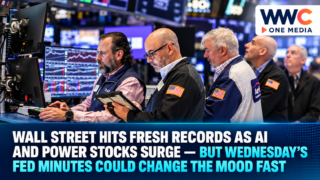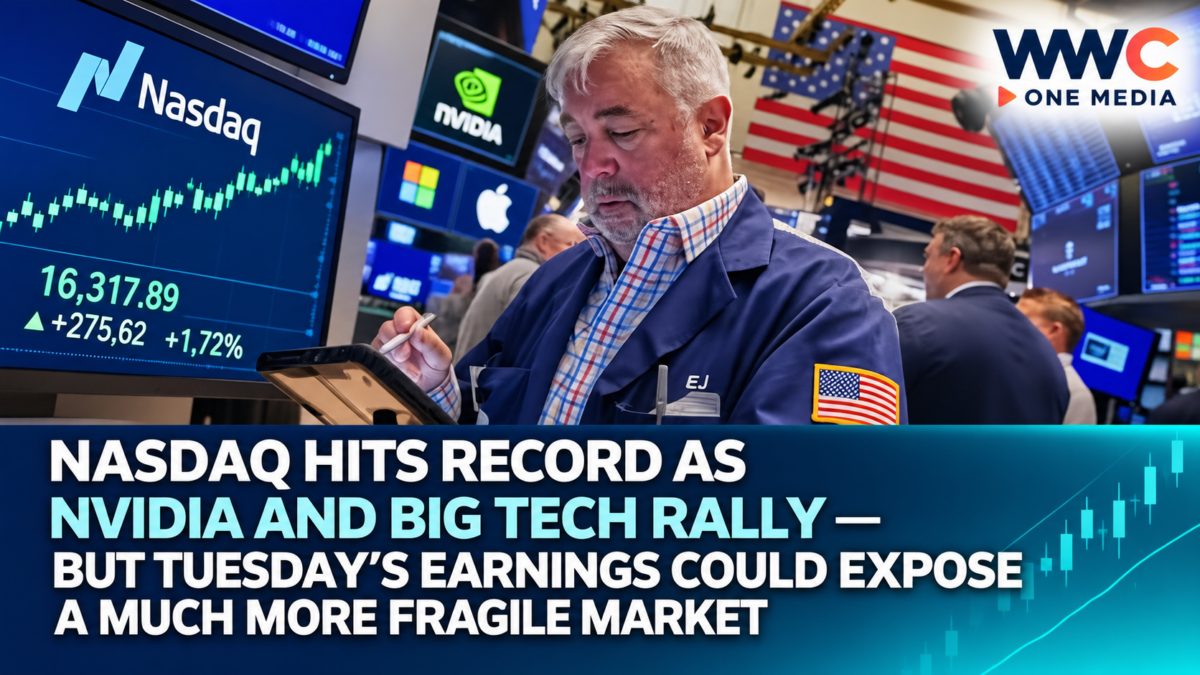
NEW YORK — Wall Street enters Tuesday with the Nasdaq at another record high and Nvidia pushing deeper into historic valuation territory, but beneath the celebration, investors are preparing for a critical test: whether corporate earnings can justify a market increasingly powered by artificial intelligence, megacap technology and falling expectations for another immediate Federal Reserve rate hike.
U.S. stocks ended Monday broadly higher.
The Nasdaq Composite climbed about 1.1% to a record close, while the S&P 500 rose 0.7% to 7,773.95, leaving it close to its own all-time high.
The Dow Jones Industrial Average added 0.2% to 51,267.90.
Ten of the S&P 500’s 11 sectors finished higher.
But technology remained the market’s biggest source of momentum.
Nvidia gained 2.1%, Microsoft advanced, Meta Platforms rallied and Tesla also moved higher, extending the dominance of companies tied to artificial intelligence and large-scale technology spending.
The immediate mood is bullish.
The harder question is whether earnings can keep supporting it.
Nvidia has become the symbol of Wall Street’s AI confidence
Nvidia remains at the center of the rally.
Shares climbed another 2.1% Monday, taking the company’s market value to approximately $5.76 trillion, according to Reuters.
That valuation would have seemed extraordinary only a few years ago.
Now investors are treating Nvidia as essential infrastructure for the global AI buildout.
Cloud companies, technology giants, governments and data-center operators continue spending heavily on graphics processors and related computing infrastructure.
That demand has pushed Nvidia far beyond its traditional semiconductor peers.
But the stock’s enormous weight inside major indexes also creates a risk.
When Nvidia rises, the S&P 500 and Nasdaq receive an outsized boost.
When it falls, the same concentration can work in reverse.
That means a market index can look healthy even when a large number of individual stocks are struggling.
The AI rally is spreading beyond Nvidia
Microsoft, Meta and other megacap technology companies also helped push the Nasdaq higher Monday.
Investors are effectively betting that enormous capital spending on AI will eventually translate into equally enormous revenue and productivity gains.
That expectation will be tested during Q3 earnings season.
Analysts surveyed by Goldman Sachs expect most S&P 500 companies to beat consensus earnings forecasts, although profit growth for the median company is expected to slow compared with the previous quarter.
AI monetization and productivity are expected to be among the dominant themes when companies report.
That creates a new standard.
It may no longer be enough for technology companies to say they are spending billions on AI.
Investors increasingly want evidence that the spending is generating measurable returns.
Weak jobs data gave stocks another boost
The market received additional support from Friday’s unexpectedly weak U.S. employment report.
September payroll growth came in at just 29,000 jobs, far below expectations of roughly 84,000.
The disappointing number sharply reduced expectations that the Federal Reserve will raise interest rates again at its October meeting.
Reuters said market pricing for an October rate increase fell from around 70% to 24% after the jobs data.
That helped technology stocks because growth companies are particularly sensitive to interest rates.
Lower rate expectations make the future earnings of high-growth companies more valuable in present-value terms.
It also reduces pressure on companies financing enormous AI infrastructure projects with debt.
But Treasury yields are still unusually high
The rate picture is not completely comfortable.
U.S. Treasury yields remain near multiyear highs despite the weaker jobs report.
The 10-year yield was recently around 5.3%, levels that would normally create substantial competition for stocks.
Investors can earn attractive yields in government bonds without assuming corporate equity risk.
That creates a much higher hurdle for expensive stocks.
If a company trades at an extreme valuation, investors need to believe its future growth will comfortably beat what they can earn in safer assets.
Technology stocks have so far passed that test.
But they may not forever.
Tuesday begins the first small wave of earnings
The full Q3 earnings season does not truly accelerate until major U.S. banks report next week.
But Tuesday provides an early look at several companies that can reveal important consumer and industrial trends.
Companies scheduled to report include:
Constellation Brands, RPM International, Lamb Weston, Apogee Enterprises, Neogen, Penguin Solutions and Worthington Steel.
The reports span alcohol, industrial coatings, food, construction products, technology infrastructure and manufacturing.
That gives investors a useful early snapshot of how different parts of the U.S. economy are handling inflation, high borrowing costs and changing consumer demand.
Constellation Brands could offer one of Tuesday’s biggest consumer signals
Among the most closely watched Tuesday reports is Constellation Brands.
The company owns brands including Corona, Modelo Especial and Pacifico in the United States.
Its results can provide clues about discretionary consumer spending and whether households are cutting back on higher-priced beverages.
Analysts currently expect Constellation to report after Tuesday’s closing bell.
The company has faced a difficult consumer environment in which inflation has pushed shoppers to become more selective.
That makes management’s outlook potentially more important than the quarter itself.
Investors will want to know whether demand is weakening, whether pricing can continue offsetting higher costs, and whether consumer pressure is spreading beyond lower-income households.
Lamb Weston can tell investors something about restaurant demand
Lamb Weston, one of the world’s largest suppliers of frozen potato products, is another important report.
Its french fries are sold through restaurants and food-service businesses around the world.
That makes its performance a less obvious but useful indicator of restaurant traffic.
If consumers eat out less frequently, suppliers such as Lamb Weston can feel the impact.
The company is expected to report before Tuesday’s market open.
Analysts are looking for roughly $1.65 billion to $1.66 billion in quarterly revenue, according to current earnings calendars.
What matters most will likely be volume, restaurant demand and management’s guidance.
RPM could provide an industrial read
RPM International, whose businesses include coatings, sealants and building products, will also report before the opening bell.
The company touches construction, maintenance and industrial activity, making its results useful for assessing whether businesses and property owners are still spending despite high financing costs.
Current estimates point to roughly $2.22 billion in revenue and earnings near $1.95 per share.
If RPM reports resilient demand, it could support the argument that the U.S. economy remains strong enough to withstand high interest rates.
A weaker outlook would reinforce concerns that restrictive monetary policy is finally biting.
Monday’s biggest stock move came from a takeover, not AI
While technology dominated the indexes, the most dramatic individual stock move Monday came from PTC.
Shares surged roughly 33% after Schneider Electric agreed to acquire the U.S. industrial software company in a transaction valued at about $22.6 billion.
PTC develops software used by manufacturers for product design, lifecycle management and industrial operations.
The deal highlights another major market trend:
large industrial companies are increasingly buying software assets to strengthen automation and digital manufacturing capabilities.
Schneider’s move also shows how valuable industrial software has become as factories attempt to automate more operations and integrate AI into engineering workflows.
But Schneider investors did not celebrate
The transaction produced dramatically different reactions on opposite sides of the Atlantic.
PTC surged.
Schneider Electric shares fell sharply.
European market coverage showed Schneider declining around 10% after announcing the deal, with investors concerned about the price and financing burden.
That contrast is common in large acquisitions.
The target company’s shareholders receive a premium.
The buyer’s shareholders must decide whether management paid too much.
Schneider reportedly committed substantial debt financing to support the acquisition, adding to concern about leverage.
The transaction therefore becomes another test of whether companies can justify paying enormous premiums for software assets tied to automation and digital transformation.
RXO jumped more than 20% on another major deal
Transportation and logistics stock RXO also surged Monday, gaining roughly 22% after C.H. Robinson announced a transaction valued at approximately $5.8 billion.
The deal demonstrates that merger activity is returning even in a high-rate environment.
That is important for Wall Street.
Rising interest rates normally make acquisitions more expensive because companies have to borrow at higher costs.
Yet large strategic transactions continue to appear.
If corporate confidence remains strong enough to sustain mergers and acquisitions, deal activity could become another source of market support heading into 2027.
Lower oil prices gave stocks another tailwind
Energy prices also helped Monday’s rally.
Brent crude fell to roughly $100.32 per barrel, while U.S. crude dropped to around $89.43.
The decline followed an increase in Middle East crude exports and commitments from the G7 to release additional energy reserves.
That was welcome news for investors.
High oil prices are dangerous for stocks because they create inflation.
Inflation can force the Federal Reserve to maintain higher interest rates.
High fuel costs also squeeze consumers and businesses.
So every meaningful decline in oil reduces one of the biggest threats hanging over the market.
But crude remains expensive by recent historical standards.
The energy shock has not disappeared.
Investors are caught between weaker jobs and strong earnings
The market’s current logic is unusual.
Weak employment data are being interpreted positively because they reduce the chance of another immediate interest-rate hike.
At the same time, investors still expect corporate profits to remain strong.
That combination is almost ideal for stocks:
slower growth, but not recession;
less inflation pressure, but still rising profits;
high interest rates, but potentially no immediate additional hike.
The problem is that this balance is fragile.
If the economy weakens too much, earnings will suffer.
If inflation remains too high, the Fed may need to raise rates again.
Wall Street therefore wants the economy to cool—but not collapse.
Earnings growth expectations are extremely high
This is another reason Tuesday’s early reports matter.
Reuters noted that U.S. corporate profits increased more than 50% in Q2, with analysts forecasting another increase of more than 35% for Q3.
Those are extraordinarily strong expectations.
They help explain why stocks can remain expensive even while bond yields sit at historically uncomfortable levels.
But strong expectations also create vulnerability.
When investors assume exceptional earnings growth, merely “good” results can disappoint.
Companies may need to both beat forecasts and raise guidance to generate meaningful share-price gains.
That standard becomes especially demanding for AI-related companies trading at premium valuations.
Wall Street is already talking about S&P 10,000
Investor optimism has reached the point where analysts are openly discussing whether the S&P 500 could eventually reach 10,000.
The index currently sits below 8,000.
Reuters reported that some strategists now believe 10,000 could be achievable before the end of the decade—or even earlier under an exceptionally bullish scenario.
The argument rests on:
strong corporate profit growth;
AI-driven productivity;
large fiscal spending;
and continued investor demand for U.S. equities.
But those forecasts should not be confused with certainty.
They are scenarios, not guarantees.
Another strategist thinks the S&P could crash to 5,000
In fact, one of Monday’s most striking forecasts moved in exactly the opposite direction.
Panmure Liberum said it expects the S&P 500 could fall to around 5,000 by the end of 2027, potentially more than 35% below current levels.
The firm argues the long bull market is becoming vulnerable to high valuations, interest rates and a possible economic slowdown.
The disagreement is enormous.
One camp sees 10,000.
Another sees 5,000.
That illustrates how unusually divided professional investors are.
Both sides are looking at the same market.
They simply disagree about whether strong profits and AI investment can continue overwhelming high interest rates and expensive valuations.
Market breadth remains a hidden concern
Monday’s rally was relatively broad, with 10 of 11 S&P sectors higher.
That is encouraging.
But longer-term market leadership remains heavily concentrated in technology.
Nvidia, Microsoft, Meta and a relatively small collection of AI-linked companies account for a disproportionate share of index performance.
That concentration can make the market look stronger than the average stock.
When megacaps rise 2% or 3%, they can drag entire indexes higher even if many smaller companies are flat or falling.
Investors therefore need to watch whether Q3 earnings broaden the rally.
If industrials, consumer companies, financial firms and small caps begin participating more consistently, the bull market becomes healthier.
If AI continues doing most of the work, the market becomes more dependent on a smaller group of extremely expensive companies.
Tuesday may look quiet—but it could set the tone
Tuesday’s earnings slate is relatively small.
There is no Nvidia, Microsoft or Apple report.
Major banks do not start reporting until next week.
But early earnings can still reveal the direction of several important trends:
Are consumers still spending?
Are restaurants weakening?
Are construction and industrial customers slowing?
Can companies keep passing higher costs to customers?
Are profit margins holding up?
Those answers will help determine whether Wall Street’s current optimism is justified.
The Fed remains the other major catalyst this week
Investors will also look ahead to Wednesday’s release of minutes from the Federal Reserve’s September meeting.
At that meeting, the Fed raised rates by 25 basis points to a range of 3.75% to 4%.
Since then, weaker employment data have changed expectations dramatically.
The minutes could show how worried policymakers remain about inflation and whether officials believe additional tightening will be necessary.
Any signal that the Fed is becoming more cautious could support technology shares.
A hawkish message could push Treasury yields higher again and pressure the most expensive parts of the market.
The Nasdaq record comes with a warning
A record high naturally attracts attention.
But record prices do not mean risk has disappeared.
Treasury yields remain high.
Oil is still around $100.
European political and debt worries are increasing.
The Middle East remains unstable.
AI valuations are enormous.
And the U.S. economy is producing much weaker job growth than investors expected.
The reason stocks continue rising is that investors believe corporate earnings will remain strong enough to overcome those risks.
That thesis is about to be tested.
The market’s biggest story is moving from AI hype to AI proof
For much of the past several years, investors rewarded companies simply for demonstrating exposure to artificial intelligence.
The next stage will be harder.
Companies must show how AI creates:
revenue;
lower costs;
higher productivity;
stronger margins;
or defensible competitive advantages.
If they do, current valuations may remain supportable.
If they cannot, the market could begin questioning why it is paying extraordinary prices for future earnings that have not yet arrived.
That is why Q3 earnings season matters so much.
Tuesday is only the opening act
Constellation Brands, RPM and Lamb Weston will not determine the fate of the entire stock market.
But their reports mark the beginning of the transition from speculation back to fundamentals.
Within weeks, nearly every major technology company, bank and industrial group will report.
Wall Street will finally see whether record stock prices are being supported by equally exceptional earnings.
For now, the Nasdaq is at an all-time high.
Nvidia is approaching a $6-trillion valuation.
Fed hike expectations have collapsed.
And investors are again discussing S&P 10,000.
The momentum is undeniably bullish.
But the next phase will depend less on what investors believe AI and the economy might eventually deliver—
and much more on what corporate America can actually prove in its earnings reports.