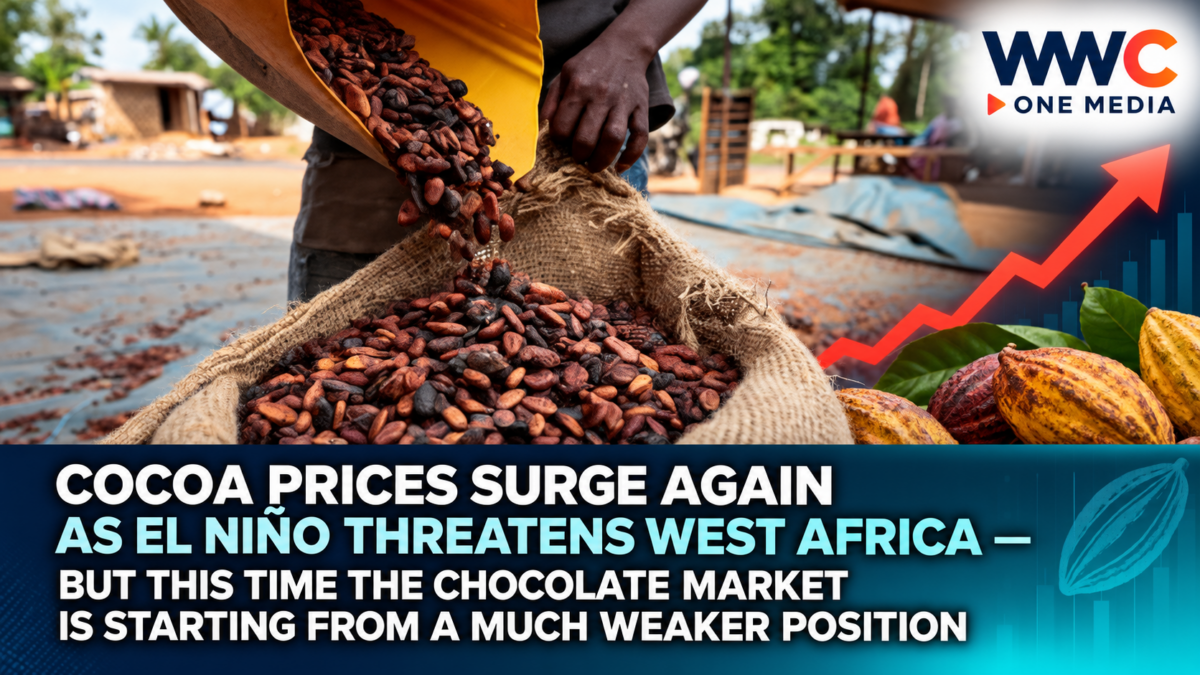
NEW YORK — Cocoa prices are climbing sharply again as traders brace for another possible weather shock in West Africa, reviving fears that chocolate makers could face a fresh supply squeeze just as consumers are beginning to recover from the historic cocoa inflation of the past two years.
New York cocoa futures closed at roughly $5,670 per metric ton on October 2, after rebounding as traders focused on increasingly unstable weather across Ivory Coast and the possibility of a powerful El Niño disrupting the next crop.
Prices then moved sharply higher again on October 5, with December New York cocoa futures rising more than 3% as excessive rainfall damaged roads and bridges in Ivory Coast and slowed bean deliveries to ports.
That is still dramatically below the extraordinary $12,565-per-ton level reached during the 2024 cocoa crisis.
But analysts are warning that comparing the two episodes solely by price could miss the larger danger.
The global cocoa industry is entering this new weather scare after years of depleted stocks, damaged farms, higher chocolate prices and consumers already reducing purchases.
Another poor West African harvest would therefore hit a market that has much less room for error.
Ivory Coast remains the center of the cocoa market
Any serious cocoa problem begins with West Africa.
Ivory Coast is the world’s largest producer and accounts for roughly 40% of global cocoa supply, while neighboring Ghana is another major producer.
Together, the two countries are critical to the global chocolate industry.
That concentration means weather problems in only a few West African growing regions can rapidly affect chocolate companies around the world.
Reuters reported in September that farmers across key Ivorian growing regions were already worried about below-average rainfall and uneven moisture, which was affecting small pods intended for future harvests.
Farmers said some young pods were falling from trees prematurely and warned that prolonged dryness could shorten the main crop.
But the weather picture has since become even more complicated.
Some areas are now experiencing heavy rains intense enough to damage infrastructure and slow cocoa transportation.
For cocoa trees, both extremes can be dangerous.
Too little rain stresses trees and reduces pod development.
Too much moisture can encourage fungal diseases such as black pod while making harvesting, drying and transporting beans more difficult.
El Niño could create the next major supply shock
The larger concern is what comes next.
Weather forecasters are increasingly focused on the strengthening El Niño pattern in the Pacific.
El Niño can alter rainfall patterns thousands of kilometers away, including in West Africa.
For cocoa-growing regions, it can bring hotter and drier conditions that reduce soil moisture and stress already vulnerable trees.
Goldman Sachs analysts cited in CNBC’s report warned that the developing growing season bears similarities to conditions preceding the 2023-24 cocoa crisis, when excessive rainfall was followed by unusually dry conditions.
Reuters reported earlier this year that Ivory Coast’s Coffee and Cocoa Council had already become cautious about forward-selling the 2026/27 crop because of El Niño concerns.
By June, Ivory Coast had sold roughly 1 million metric tons of its coming main crop through export contracts but slowed additional sales because officials were uncertain about future production.
That shows the weather risk is not simply being invented by futures traders.
The world’s largest cocoa producer itself has been preparing for uncertainty.
The industry technically returned to surplus—but only barely
The global cocoa market did receive some relief after the enormous shortages that drove prices to records in 2024.
The International Cocoa Organization estimates global production for the 2024/25 cocoa season rose 8.5% to about 4.733 million metric tons.
Global grindings—the amount of cocoa processed by manufacturers—fell 3.3% to about 4.649 million tons.
That left the market with a small estimated 37,000-ton surplus.
That is a dramatic improvement from the previous season’s huge deficit.
But 37,000 tons is tiny relative to a global market consuming more than four and a half million tons per year.
It provides only a thin cushion if West African output disappoints again.
End-of-season stocks increased to approximately 1.309 million tons, while the stocks-to-grindings ratio reached about 28.2%.
Those inventories are better than during the worst of the crisis—but hardly enormous.
This is one reason another weather disruption could move prices quickly.
This time, however, the futures market may behave differently
There is one crucial difference between today’s rally and the 2024 explosion.
The 2024 price spike was intensified not only by physical cocoa shortages but also by extreme financial-market stress.
As futures prices surged, traders and processors holding hedging positions faced enormous margin calls.
Some companies were forced to buy contracts or raise cash rapidly, creating a feedback loop that pushed futures prices even higher.
Goldman Sachs analysts cited in CNBC’s report believe the risk of another identical liquidity squeeze is lower today.
The market has already adjusted to extreme cocoa volatility.
Companies have changed hedging practices.
Speculative positioning is different.
And participants have had time to strengthen liquidity after the 2024 shock.
That does not mean cocoa cannot rise dramatically.
It means the mechanism pushing prices higher may be more fundamentally tied to actual supply.
The bigger problem is that demand has already been damaged
The 2024-25 cocoa shock forced chocolate manufacturers to raise prices sharply.
Consumers reacted.
Some bought less chocolate.
Others switched brands.
Manufacturers reduced product sizes.
Recipes were reformulated.
Promotions were scaled back.
The result was a major decline in demand.
Barry Callebaut, the world’s largest cocoa and chocolate supplier to food companies, said the global chocolate confectionery market declined 4.4% in its fiscal third quarter.
For the first nine months of its fiscal year, Barry Callebaut’s global chocolate volumes were down 2.3%.
That shows just how much high cocoa prices changed consumer behavior.
Chocolate did not become impossible to sell.
But the category stopped behaving like the reliably growing indulgence market companies had enjoyed for years.
There are finally signs demand is coming back
The encouraging part is that cocoa demand began showing signs of recovery earlier in 2026.
Barry Callebaut’s total sales volumes increased 5.7% in its third quarter, marking its first quarterly volume growth in more than two years.
Its Global Cocoa volumes surged 18%, partly because lower cocoa prices encouraged customers to restock.
Reuters reported that the strong rebound followed a major cocoa price correction earlier in the year.
Some manufacturers that had delayed purchases began returning to the market.
That creates an awkward timing problem.
Just as demand begins recovering, traders are again becoming worried about supply.
If both demand and weather risk rise simultaneously, cocoa prices could face renewed upward pressure.
Chocolate companies had started putting more cocoa back into products
The price decline earlier in 2026 also triggered another interesting shift.
Reuters reported in May that major chocolate makers were beginning to reverse some of the recipe changes introduced when cocoa was extremely expensive.
Hershey, for example, announced plans to restore more traditional cocoa-rich recipes for certain Hershey’s and Reese’s products.
Barry Callebaut said falling cocoa prices had made genuine chocolate less expensive relative to some substitute formulations.
This was one sign that the industry believed the worst cocoa inflation might finally be ending.
A new price spike would complicate that strategy.
Companies might again have to choose among:
higher retail prices;
smaller package sizes;
lower margins;
or reduced cocoa content.
Lindt is already feeling the pain
Premium chocolate maker Lindt & Sprüngli recently cut its 2026 sales outlook for the second time.
The Swiss company now expects organic sales growth of only 0% to 2%, down from its earlier forecast of 4% to 6%.
Lindt said cocoa prices had surged around 80% over six months, forcing the company to raise chocolate prices.
Those increases ultimately hurt demand.
CEO Adalbert Lechner said consumers were becoming increasingly price-sensitive, with premium products such as gift boxes and pralines particularly affected.
The company is responding by offering smaller, more affordable packages and controlling costs.
That illustrates the dilemma facing chocolate companies.
When cocoa becomes expensive, they can raise prices.
But consumers can eventually say no.
Nestlé is also absorbing higher cocoa costs
Nestlé is dealing with similar pressure.
The maker of KitKat and other confectionery products reported that its gross profit margin fell 20 basis points to 46.4% in the first half of 2026.
The company specifically blamed higher coffee and cocoa prices, along with tariffs and other costs.
Nestlé said pricing and cost savings offset much—but not all—of the increase.
Its Food & Snacks business still grew organically, supported by brands such as KitKat and Milo.
But cocoa illustrates how commodity inflation travels directly into multinational food companies’ income statements.
A sustained second rally could force another round of pricing decisions.
Chocolate makers cannot instantly replace cocoa
Unlike some commodities, cocoa is difficult to substitute without changing the product consumers expect.
A chocolate company can reduce the size of a bar.
It can alter ingredients.
It can increase fillings.
It can emphasize products with less cocoa.
But genuine chocolate fundamentally requires cocoa.
That limits manufacturers’ options when supply tightens.
They cannot suddenly replace West African cocoa with millions of tons from another region.
Cocoa trees require particular tropical conditions and take years to mature.
New supply cannot appear overnight simply because prices rise.
That structural lag makes the commodity especially vulnerable to prolonged shocks.
Cocoa trees themselves are becoming a long-term problem
The challenge is not only weather.
Many cocoa farms across Ivory Coast and Ghana rely on aging trees.
Older trees often become less productive and more vulnerable to diseases.
Farmers also face high fertilizer costs and difficulty financing farm rehabilitation.
Reuters reported that Ivorian exporters and industry participants were increasingly concerned that inadequate plantation maintenance and expensive fertilizer could hurt future production, potentially even more than El Niño itself.
This creates a vicious cycle.
High cocoa prices should theoretically benefit farmers.
But governments in major producing countries regulate farmgate prices through systems designed partly to stabilize farmer income.
That can mean producers do not always receive the full benefit of global futures spikes quickly enough to invest in new trees, fertilizer and disease control.
Climate risk is becoming structural rather than temporary
The cocoa crisis is also becoming part of a much wider food-supply problem.
Reuters reported this week that food companies are increasingly struggling to model the combined effects of climate change on agricultural supply chains.
Drought, flooding, wildfires, pests and changing rainfall patterns can interact in ways traditional crop models were not designed to predict.
Cocoa may be one of the clearest examples.
The industry depends heavily on a narrow tropical belt.
Production is geographically concentrated.
Trees take years to establish.
And many farmers operate on relatively small plots with limited financial resources.
That leaves the sector unusually exposed to persistent climate disruptions.
Ivory Coast also faces a traceability challenge
Weather is not the only supply-chain issue confronting West African cocoa.
Ivory Coast is rolling out a new digital traceability system as it prepares for the European Union’s anti-deforestation regulation.
Roughly 70% of Ivorian cocoa exports go to Europe, making compliance critical.
Reuters reported in September that some cooperatives and cocoa buyers were struggling to adapt to new electronic producer cards and tracking equipment.
If implementation problems continue, they could slow trade at the beginning of the 2026/27 season.
This is not fundamentally a cocoa shortage.
But at a time when markets are already nervous about physical availability, even administrative delays can amplify price volatility.
Europe is forcing greater transparency into cocoa supply chains
The regulatory shift has a broader purpose.
European rules increasingly require companies to demonstrate that cocoa was not produced on recently deforested land.
That could ultimately make the supply chain more transparent and sustainable.
But the transition is complicated.
Millions of cocoa farmers operate in remote rural areas.
Mapping farms, documenting ownership, digitizing payments and tracing beans through traders and exporters requires enormous infrastructure.
For companies purchasing cocoa, this adds another layer of cost.
The future price of chocolate therefore increasingly reflects not only cocoa beans themselves but also the expense of proving where those beans came from.
Halloween highlights how sensitive the timing is
The renewed cocoa rally comes only weeks before Halloween, one of the biggest chocolate-selling occasions in the United States.
But it is important not to assume today’s futures price immediately determines the price of Halloween candy already sitting in warehouses.
Major chocolate companies typically purchase and hedge cocoa months in advance.
Retail inventories for Halloween are largely planned well before October.
That means the current spike is more likely to affect future production costs and pricing decisions than candy already manufactured for this month’s holiday.
The bigger question is what happens if high cocoa prices persist into Christmas, Valentine’s Day and Easter production cycles.
Those are other major periods for global chocolate demand.
Consumers may be less willing to tolerate another price hike
Chocolate makers also face a different consumer than they did before the first cocoa crisis.
Shoppers have already absorbed years of food inflation.
In 2026, global food prices more broadly are climbing again.
The United Nations Food and Agriculture Organization said its Food Price Index reached a nearly four-year high in September, driven by higher cereal, sugar and vegetable-oil prices.
Chocolate is therefore competing for household spending against many other products whose prices are also rising.
That makes another large round of cocoa-driven price increases commercially dangerous.
Companies may have less ability to pass costs through without losing volume.
Farmers also suffer when prices become too volatile
Record cocoa prices sound like good news for producers.
In reality, extreme volatility creates serious problems for farmers too.
If prices surge temporarily, farmers may plant more cocoa.
But newly planted trees can take several years before producing meaningful crops.
If prices collapse before those trees mature, growers can be left with unattractive economics.
Extreme volatility also makes it difficult to plan:
fertilizer purchases;
farm expansion;
labor hiring;
and long-term tree replacement.
For the cocoa industry, stability may ultimately be more valuable than temporary records.
This is why the 2026 rally really is different
The 2024 crisis was defined by an extraordinary physical shortage combined with extreme futures-market stress.
The 2026 setup is more complicated.
Global supply technically returned to a small surplus.
Prices fell dramatically from the record.
Demand weakened.
Chocolate manufacturers adapted.
Consumers reduced purchases.
And then the weather risk returned.
The world therefore enters this new cocoa rally with:
more supply than during the worst of 2024—but still relatively low inventories;
weaker consumer demand—but signs of recovery;
less risk of a futures-market liquidity spiral—but significant physical crop uncertainty;
and an increasingly dangerous El Niño threat hanging over West Africa.
That combination could produce a very different kind of cocoa crisis.
A repeat of $12,000 cocoa is not inevitable
There is no guarantee that cocoa prices will return to their 2024 record.
Weather forecasts can change.
El Niño may prove less damaging than feared.
Ivory Coast and Ghana could produce stronger crops than expected.
Demand could weaken again if chocolate companies raise prices.
Those factors could keep the market balanced.
The ICCO’s most recent confirmed global statistics still show a small 2024/25 surplus rather than a deficit.
That is a meaningful difference from the extreme shortage that preceded the 2024 spike.
So claims that another historic cocoa crisis is already underway would be premature.
But the market has almost no appetite for another bad harvest
That is the bigger warning.
The global chocolate industry has spent two years adjusting to one of the most violent commodity shocks in its history.
Manufacturers raised prices.
Consumers bought less.
Recipes changed.
Margins came under pressure.
Demand only recently began showing signs of stabilization.
Now the world’s most important cocoa-growing region is again facing uncertain rainfall and a potentially powerful El Niño.
Cocoa at around $5,000 to $6,000 per ton is nowhere near the extraordinary 2024 peak.
But price alone does not tell the whole story.
The chocolate industry is starting this new weather scare with consumers already fatigued by high prices, manufacturers still rebuilding margins and cocoa inventories providing only a modest cushion.
That is why the next West African harvest could matter even more than today’s futures price.
If the crop holds, chocolate companies may finally get the stability they have been waiting for.
But if El Niño delivers another major supply shock, consumers could discover that the cocoa crisis they thought was ending was only taking a break.