NEW YORK — Wall Street has done it again.
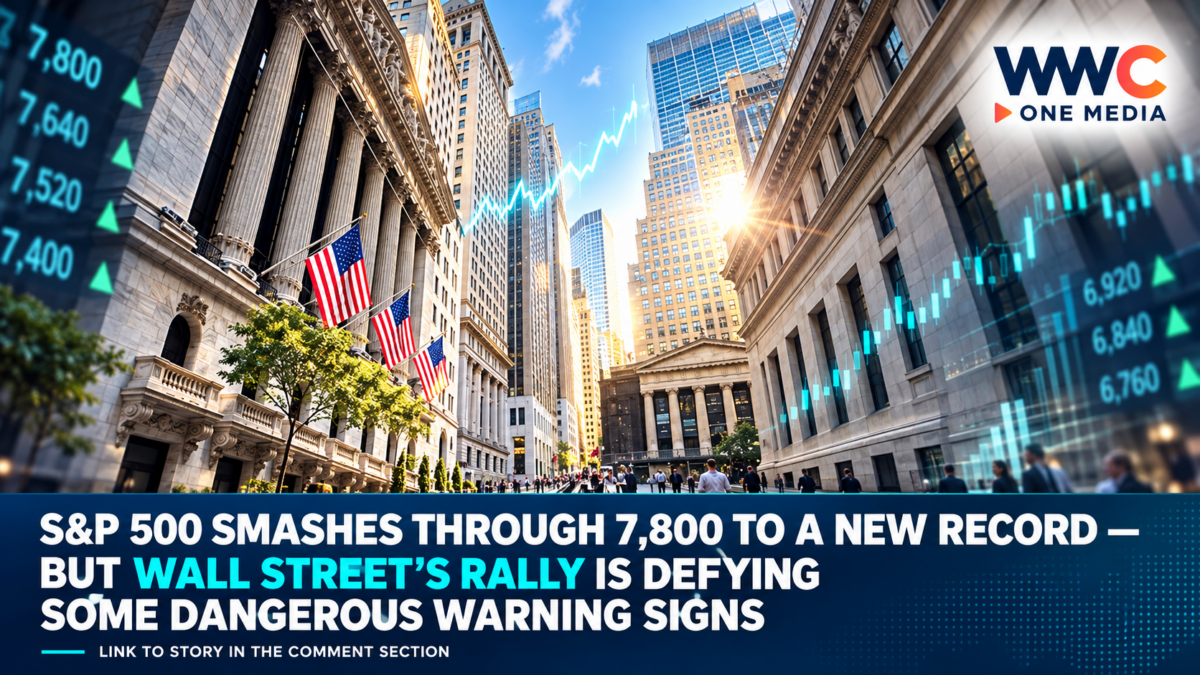
The **S&P 500 surged to a fresh all-time high on October 6, closing above 7,800 for the first time ever, after investors brushed aside an extraordinary list of threats ranging from $100-a-barrel oil and decades-high Treasury yields to renewed Federal Reserve rate increases and geopolitical turmoil.
The benchmark index gained roughly 0.6% to close at 7,818.93, while touching an intraday record of 7,844.52.
The Nasdaq Composite also closed at a record for a second consecutive session, rising about 0.4% to 27,599.79, while the Dow Jones Industrial Average climbed around 0.5% to 51,521.28.
But behind those spectacular headline numbers is a much more complicated market.
The S&P 500’s march to a new peak has increasingly been powered by artificial-intelligence stocks and America’s biggest technology companies, even as large parts of the broader market continue to struggle.
That raises one uncomfortable question:
How long can Wall Street continue setting records if fewer stocks are doing the heavy lifting?
The Market Survived Nearly Everything Thrown at It
The significance of the new S&P 500 record is not simply that stocks went higher.
It is what investors had to overcome to get there.
Since reaching its previous record in August, markets have faced sharply higher oil prices, soaring government borrowing costs, renewed inflation concerns and growing expectations that interest rates could remain higher for longer.
The Federal Reserve raised its benchmark interest rate in September for the first time in more than three years.
At the same time, the yield on the benchmark 10-year U.S. Treasury recently climbed above 5.3%, reaching levels not seen in decades.
Normally, that combination would be dangerous for stocks.
Higher bond yields make government debt more attractive compared with equities and increase borrowing costs throughout the economy.
Yet stocks kept climbing.
Then Came the Oil Shock
Energy prices created another major obstacle.
Oil surged earlier in 2026 as the Iran conflict disrupted flows through the Strait of Hormuz, one of the world’s most important energy transit routes.
Brent crude eventually climbed to around or above $100 a barrel, fueling fears that higher gasoline, transportation and manufacturing costs could push inflation higher again.
But by October 6, oil prices had stabilized, giving investors some relief.
Brent traded around $100.60 a barrel, while U.S. crude was near $89.44.
That stabilization mattered because another major oil spike could potentially force central banks to maintain tighter monetary policy for longer.
Instead, the combination of slightly lower bond yields and steadier oil helped investors return their attention to corporate earnings.
AI Is Still Wall Street’s Biggest Engine
The most powerful force behind the market remains artificial intelligence.
Technology and semiconductor shares helped lead the October 6 rally as investors continued betting that enormous spending on AI infrastructure will translate into years of profit growth.
Companies linked to data centers, chips, cloud computing and electricity generation have become some of the market’s biggest winners.
Nvidia has moved close to a staggering $6 trillion market valuation, according to Reuters, as demand for AI processors and infrastructure continues to reshape expectations for the technology sector.
Other AI-related companies also helped lift markets.
Marvell Technology and Advanced Micro Devices rose amid continuing expectations for strong AI-chip demand.
Constellation Energy jumped more than 12% after announcing a long-term electricity agreement with Google, highlighting another increasingly important theme: AI’s enormous appetite for power.
The AI boom is no longer just a semiconductor story.
It is spreading into utilities, power generation, data centers, networking equipment and infrastructure.
That has given Wall Street another reason to keep buying.
Corporate Profits Are Giving Bulls Another Argument
Investors are also looking toward what could be another powerful earnings season.
Reuters reported that analysts expect earnings for S&P 500 companies to rise roughly 30.6% year over year in the third quarter, with technology and energy among the strongest contributors.
That level of profit growth helps explain why investors have been willing to tolerate historically high bond yields.
If companies keep producing stronger-than-expected earnings, high valuations become easier to justify.
Recent corporate results have supported that argument.
Lamb Weston jumped after reporting results that beat expectations, while Option Care Health surged more than 32% after agreeing to a roughly $5.8 billion acquisition deal.
In other words, Wall Street is betting that corporate America can continue growing fast enough to outrun expensive money.
But the S&P 500 May Be Hiding a Much Weaker Market
This is where the rally becomes more concerning.
The S&P 500 is weighted by market capitalization.
That means the biggest companies — particularly huge technology stocks — have an outsized effect on the index.
If Nvidia, Microsoft, Apple and other mega-cap companies rise strongly, they can pull the S&P 500 higher even when hundreds of smaller stocks are falling.
MarketWatch reported that the median S&P 500 stock was roughly 17% below its 252-day peak, despite the headline index being near an all-time high.
That is an enormous divergence.
The equal-weight version of the S&P 500, where every company receives roughly the same influence, has also struggled compared with the traditional index.
Business Insider reported that the equal-weight index had fallen about 5% since mid-August, even while mega-cap technology shares kept the headline S&P 500 elevated.
So the record high does not necessarily mean the average U.S. stock is doing equally well.
Far from it.
Small Caps Are Sending Another Warning
The Russell 2000, which tracks smaller American companies, actually fell about 0.6% on October 6, even as the S&P 500, Dow and Nasdaq climbed.
That divergence matters.
Smaller companies are generally more sensitive to borrowing costs because they often depend more heavily on credit and have less access to cheap financing than America’s corporate giants.
For 2026 so far, the picture is still positive:
The S&P 500 is up about 14.2%.
The Nasdaq has risen roughly 18.7%.
The Dow is ahead approximately 7.2%.
And the Russell 2000 is up around 14%.
But the Russell’s weakness during the latest record-setting session shows that investors are still discriminating sharply between companies.
Consumers Don’t Feel Like They’re Living in a Record Market
There is another striking disconnect.
Wall Street may be celebrating, but many American households are not.
The Washington Post reported that consumer confidence has fallen to its lowest level in more than a decade even as the S&P 500 hits record highs.
Higher energy prices, expensive borrowing, slow wage growth and persistent cost-of-living concerns remain major problems for households that own little or no stock.
Wealthier households, particularly those with large retirement and investment portfolios, have benefited enormously from higher asset prices.
But Americans living paycheck to paycheck may see little benefit from a record S&P 500.
That creates an increasingly stark split between financial-market prosperity and household sentiment.
The Bond Market Still Has the Power to Break the Party
Perhaps the biggest threat remains Treasury yields.
The 10-year Treasury yield recently climbed above 5.3%, while the 30-year yield pushed above 5.6%, levels not seen for decades.
Higher yields can eventually force investors to reconsider how much they are willing to pay for stocks — particularly expensive growth companies whose valuations depend heavily on profits expected many years in the future.
For now, however, yields eased enough on October 6 to give equities room to rally.
Markets are also reducing expectations of another immediate Fed rate hike.
Reuters reported that futures pricing put the probability of another October increase at roughly 19%, after weaker employment data and easing energy pressures changed expectations.
If bond yields continue falling, stocks could receive another major boost.
If they start climbing again, the calculation could change quickly.
The S&P 500 Has Become a Test of How Much Risk Investors Will Ignore
The remarkable part of this rally is not that investors cannot see the risks.
They can.
Oil remains historically expensive.
Government borrowing costs are near multi-decade highs.
The Federal Reserve has already restarted rate increases.
Geopolitical risks remain elevated.
Inflation has not completely disappeared.
And the market’s leadership remains heavily concentrated among technology and AI-related companies.
Yet investors continue buying.
Reuters described the third quarter as extraordinary: Brent crude surged roughly 40%, diesel prices hit records and bond yields reached 20-year highs, yet global equities still managed to set records.
That resilience has encouraged investors to believe that every new threat can be absorbed.
But history suggests markets often appear strongest immediately before investors discover the risk they underestimated.
What Happens Next
Wall Street’s attention will now turn toward third-quarter corporate earnings.
If technology companies continue reporting explosive AI-related growth and major corporations maintain strong profits, the S&P 500 could potentially extend its record run.
But three things could quickly threaten the rally:
Another surge in Treasury yields.
A renewed jump in oil and inflation.
Or disappointing profits from the handful of mega-cap companies carrying much of the market.
Those risks are particularly important because valuations remain elevated and market leadership is still concentrated.
For now, investors have chosen optimism.
The S&P 500 has survived an oil shock, a bond-market selloff, renewed Fed tightening and geopolitical turmoil — and still managed to break through 7,800.
Wall Street has proved remarkably difficult to knock down.
The bigger question is whether this record represents the beginning of another powerful leg higher — or the moment when a market increasingly dependent on AI giants finally runs out of shocks it can ignore.