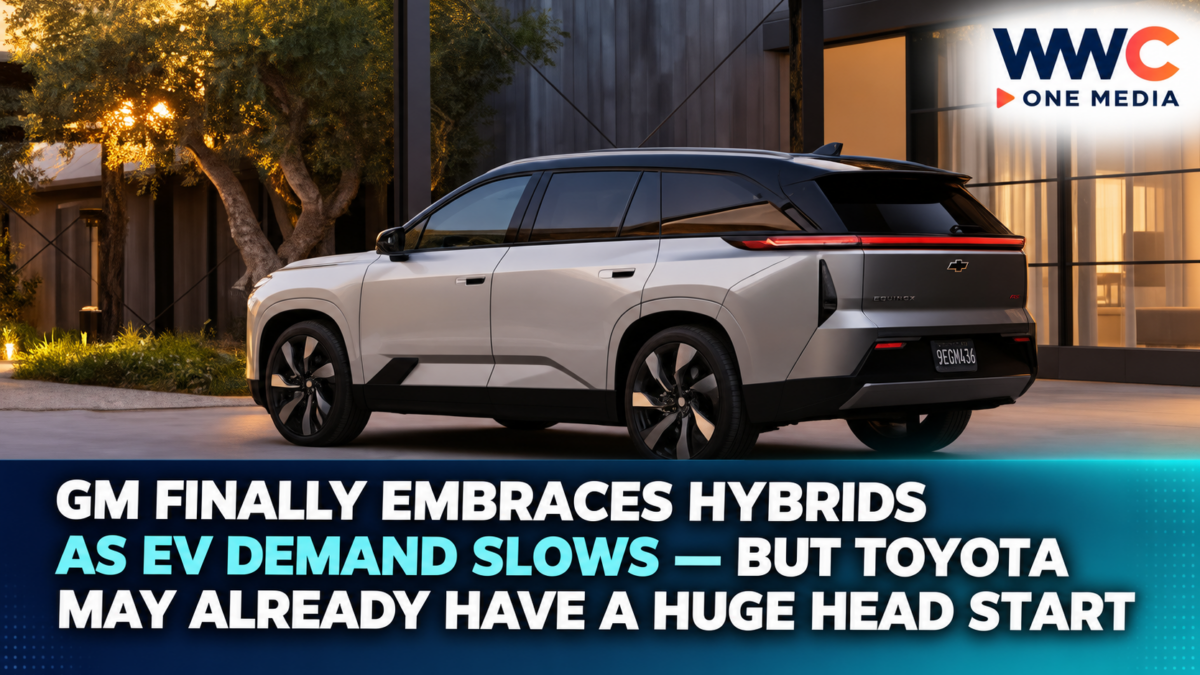
DETROIT — General Motors is finally preparing to bring more hybrid vehicles to American showrooms, marking a major strategic shift after spending much of the decade betting that U.S. buyers would move directly from gasoline-powered cars to fully electric vehicles.
GM Vice President of Propulsion Engineering Mike Anderson confirmed that hybrids are now firmly “part of the plan,” saying the Detroit automaker recognizes that customer preferences are changing.
“We’re not tone deaf to our customers,” Anderson told CNBC. “We know what they want and we want to give that to them as quickly as we can.”
GM has not yet disclosed which models will receive hybrid systems or exactly when they will reach dealerships.
But the reversal is significant.
For years, CEO Mary Barra positioned battery-electric vehicles as GM’s primary future technology.
Now, rapidly rising hybrid demand, weaker EV sales, expensive gasoline and aggressive competition from Toyota, Honda, Hyundai and Kia are forcing America’s biggest automaker to rethink the road between gasoline and full electrification.
Hybrids are suddenly one of the hottest parts of the U.S. car market
The shift in consumer behavior is difficult for GM to ignore.
According to Cox Automotive data cited in the CNBC report, conventional hybrids represented a record 16.3% of U.S. vehicle sales in the second quarter of 2026, up from 13% a year earlier.
Hybrid sales volume increased approximately 23% year over year.
Battery-electric vehicles, meanwhile, represented only about 5.8% of new-vehicle sales, down sharply from the 10.6% record reached in the third quarter of 2025 when buyers rushed to use expiring federal incentives.
That means ordinary hybrids are currently selling at almost three times the market share of fully electric vehicles.
For GM, that creates an obvious gap in its product portfolio.
GM largely skipped the hybrid boom
Toyota spent decades developing hybrids.
Honda built them into high-volume models such as the Accord and CR-V.
Ford sells hybrid versions of products including the Maverick and F-150.
Hyundai and Kia have rapidly expanded their own hybrid offerings.
GM, by contrast, currently has essentially one U.S. hybrid offering—the electrified Chevrolet Corvette E-Ray—after largely abandoning mainstream hybrids while concentrating investment on battery EVs.
Its most famous previous plug-in effort, the Chevrolet Volt, disappeared after the 2019 model year.
At the time, the assumption inside GM was that spending heavily on an intermediate technology could divert capital from the eventual destination: fully electric vehicles.
That strategy now looks increasingly costly.
Toyota is benefiting from the exact market GM missed
Toyota has become perhaps the clearest beneficiary of the hybrid boom.
The Japanese automaker is closing the U.S. sales gap with GM partly because it can offer hybrid versions across a broad range of cars and SUVs.
Toyota sold 633,223 vehicles in the third quarter of 2026, while GM remained No. 1 with 670,974.
GM’s total sales fell 5.5% year over year, while Toyota continued gaining ground.
The Corolla Hybrid alone posted a 36% sales increase, according to Reuters.
GM still holds the American sales crown.
But its year-to-date market share has slipped while Toyota’s has increased.
Cox Automotive estimated GM at roughly 16.7% U.S. share through the third quarter versus 15.6% for Toyota.
That is much closer than Detroit would like.
GM’s biggest rivals already control most hybrid sales
Toyota’s advantage extends far beyond one model.
Cox Automotive data show Toyota commands roughly 43% of the U.S. conventional hybrid market, while Honda holds more than 16%.
Ford, Hyundai and Kia round out much of the rest of the market.
In the second quarter alone, Kia added about 36,000 hybrid sales compared with the prior year.
Toyota added around 32,000.
Hyundai added approximately 30,000.
Honda gained another 13,000.
GM is essentially arriving at the party after its competitors have already built manufacturing capacity, supplier relationships and consumer familiarity.
That could make catching up difficult.
High gas prices have made fuel economy urgent again
GM’s change in direction is arriving at an especially important moment.
Fuel prices have surged in the United States because of disruption to global energy supplies from the Iran conflict and attacks on Russian refining infrastructure.
High gasoline prices are increasingly pushing American consumers toward smaller, more efficient cars and hybrids.
That has created an awkward situation for GM.
The company remains extraordinarily strong in pickups and large SUVs—some of the most profitable vehicles in the U.S. auto industry.
But customers suddenly care much more about fuel economy.
A hybrid powertrain can help automakers preserve the popularity and profitability of SUVs and trucks without forcing customers to adopt full battery-electric vehicles.
That is precisely the middle ground GM has lacked.
GM’s own sales numbers show the pressure
GM remained America’s largest automaker in the third quarter with 670,974 U.S. deliveries.
But sales fell roughly 6% from a year earlier.
The company said the decline partly reflected the smaller EV market and discontinued models.
GM remains extremely strong in:
- full-size pickups;
- full-size SUVs;
- fleet vehicles;
- and affordable small SUVs.
Its top-selling vehicles include the Chevrolet Silverado, GMC Sierra, Chevrolet Equinox, Chevrolet Traverse and Chevrolet Trax.
Those nameplates give GM an enormous installed customer base.
Putting hybrids into even a portion of that lineup could therefore produce substantial volume.
Silverado could become particularly important
The full-size pickup market may ultimately be one of the biggest opportunities.
Ford already sells an F-150 PowerBoost hybrid.
Ram is developing electrified truck options.
GM, meanwhile, has doubled down on gasoline and diesel engines for its next-generation Silverado and GMC Sierra.
The redesigned 2027 Silverado offers two new V8 engines, a TurboMax gasoline engine and a 3.0-liter Duramax diesel—but no hybrid at launch.
That is notable because GM’s own diesel strategy has become harder to sell as diesel prices soar.
Reuters reported that the upgraded diesel Silverado can achieve about 24 mpg and potentially more than 900 miles of highway range with its larger fuel tank, but elevated diesel prices can erase some of that operating-cost advantage.
A future Silverado hybrid could give GM another solution.
Outside analysts expect hybrids from Equinox to Silverado
GM itself has not confirmed future model names.
But AutoForecast Solutions expects GM’s first wave of new U.S. plug-in hybrids to arrive sometime between late 2027 and early 2028.
The forecasting firm expects the strategy could eventually span products ranging from the Chevrolet Equinox crossover to the Silverado pickup.
Some of the projected plug-in hybrids could offer around 70 miles of electric driving range, according to reporting summarizing CNBC’s interview.
That would make them unusually capable PHEVs.
A 70-mile electric range could allow many owners to complete daily commuting almost entirely on battery power while still having a gasoline engine available for long trips.
But these specifications remain forecasts—not official GM product announcements.
GM may use both its own technology and outside suppliers
Anderson said GM does not necessarily intend to develop every component internally.
The company is considering a mixture of in-house engineering and third-party technology, depending on vehicle segment, economics and strategic importance.
“We’re deliberate because, usually for strategic reasons, we need to control our own destiny,” Anderson said.
That approach could help GM move faster.
Building an entirely new hybrid ecosystem from scratch is expensive and time-consuming.
Using supplier technology in selected applications could shorten development time while GM reserves its own engineering for higher-volume or more strategically important vehicles.
GM already knows how to build plug-in hybrids—in China
The irony is that GM is not starting from zero.
Its Chinese joint ventures already sell sophisticated plug-in hybrid vehicles.
Buick’s Electra E7, launched in China this year, uses a 1.5-liter turbocharged engine combined with an electric motor.
GM says the model can travel more than 200 kilometers on battery power under China’s CLTC test cycle, with total driving range of around 1,630 kilometers when the gasoline engine is included.
GM China also sells vehicles across battery-electric, plug-in hybrid and extended-range electric configurations.
In fact, GM says every new product it launches in China in 2026 includes at least one new-energy vehicle option.
That raises an obvious question:
If GM already has sophisticated hybrid technology overseas, why has the U.S. rollout taken so long?
The answer lies partly in strategy and partly in product localization.
China moved faster because the market demanded it
China’s automotive market has evolved very differently from America’s.
Battery EVs, plug-in hybrids and extended-range vehicles together represent a huge share of Chinese sales.
Chinese automakers such as BYD, Geely and Li Auto have aggressively developed hybrid systems with long electric ranges.
GM therefore had little choice but to respond.
Its Buick Electra E7 attracted more than 30,000 orders during its presale period, illustrating the strength of Chinese demand for plug-in technology.
The U.S. market moved more slowly.
GM therefore put more of its American capital into battery EVs while retaining highly profitable gasoline pickups and SUVs.
Now American buyers are increasingly signaling they want something in between.
GM’s EV bet has become extremely expensive
This change is not happening in isolation.
GM has already spent heavily restructuring its EV plans.
Reuters reported in September that GM has taken approximately $10.9 billion in EV-related charges since mid-2025 while reducing capacity, changing factory plans and responding to weaker-than-expected electric demand.
The company has dramatically cut planned production of the Chevrolet Bolt EV.
Approximately 35,000 units are now expected, compared with earlier expectations of around 150,000, according to union estimates cited by Reuters.
The current Bolt production run is expected to end in early 2027.
This does not mean GM has abandoned EVs.
It means the company is recalibrating how quickly the market is likely to get there.
GM remains America’s No. 2 EV seller
Despite the slowdown, GM is not retreating completely from battery vehicles.
It was the No. 2 EV seller in the United States in the first half of 2026, behind Tesla, with products including:
Chevrolet Equinox EV;
Blazer EV;
Silverado EV;
GMC Sierra EV;
Cadillac Lyriq;
Optiq;
Vistiq;
and Escalade IQ.
GM says consumer EV adoption has simply been slower than anticipated.
Its latest climate-related disclosure explicitly states that its near-term profitability still depends heavily on gasoline-powered full-size SUVs and pickups, whose profits help finance battery and EV investment.
Hybrids could strengthen that bridge.
The federal policy landscape has changed too
There is another reason hybrids were not originally central to GM’s U.S. strategy.
During the Biden administration, increasingly strict emissions standards made full electrification more attractive over the long term.
GM announced in 2024 that it planned to bring plug-in hybrids back to the United States partly as a way to help satisfy those regulations.
But the Trump administration has since rolled back major fuel-economy requirements.
New standards reduce the projected 2031 fleetwide requirement from roughly 50.4 miles per gallon to about 34.9 mpg.
That theoretically gives GM less regulatory pressure to introduce hybrids.
Yet GM is proceeding anyway.
That reveals something important:
customer demand—not just government regulation—is now driving the hybrid decision.
Toyota’s long-term bet suddenly looks much smarter
Toyota spent years receiving criticism for moving too slowly into full EVs.
The Japanese automaker instead invested heavily in conventional hybrids and argued that limited battery resources could reduce more emissions if spread among millions of hybrid vehicles rather than concentrated in fewer expensive EVs.
That position was controversial.
But from a market standpoint, Toyota now looks remarkably well positioned.
The company already has hybrid versions of many of its highest-volume vehicles and can respond immediately when gasoline prices rise.
GM cannot.
That timing advantage is difficult to overcome quickly.
Honda and Hyundai are benefiting too
Toyota is not the only rival gaining share.
Reuters reported that Asian automakers are expected to capture more than half of U.S. auto sales, while the Detroit Three—GM, Ford and Stellantis—have fallen to around 36% combined.
Hyundai has become particularly aggressive with hybrid technology.
Its latest system can be adapted across multiple engine sizes and vehicle classes, allowing the automaker to deploy hybrids in everything from compact vehicles to large SUVs.
Honda has similarly expanded hybrid versions of major models.
These companies developed hybrid architectures before the current demand spike.
GM is now racing to build comparable flexibility.
Hybrids solve several consumer problems at once
The attraction is straightforward.
A conventional hybrid does not normally need to be plugged in.
It uses regenerative braking and a small battery to improve efficiency.
Customers can refuel at ordinary gas stations.
That eliminates several concerns associated with full EVs:
charging availability;
charging time;
apartment access;
long-distance range;
and cold-weather range loss.
A plug-in hybrid goes further.
It can operate on electricity for shorter daily journeys but still uses gasoline for longer trips.
For buyers interested in electrification but unwilling to depend completely on charging infrastructure, that can be a compelling compromise.
But hybrids bring their own disadvantages
There are trade-offs.
A hybrid vehicle carries both an internal-combustion engine and an electric propulsion system.
That can mean:
additional components;
greater engineering complexity;
higher production costs;
and more packaging challenges.
Plug-in hybrids also require relatively large batteries while still retaining an engine, exhaust system and fuel tank.
An owner who rarely plugs in a PHEV may get much less environmental benefit than the vehicle’s official ratings imply.
That is one reason GM previously questioned whether pouring money into hybrids made sense when the long-term goal remained all-electric vehicles.
Running three powertrain strategies is expensive
GM is now preparing to support:
gasoline and diesel vehicles;
hybrids and plug-in hybrids;
and fully electric vehicles.
That gives consumers more choice.
But it also creates enormous complexity.
Each technology needs engineering.
Suppliers.
Factory tooling.
Software.
Certification.
Dealer training.
Parts inventories.
And marketing.
The risk is that GM could spread billions of dollars across technologies without reaching ideal scale in any one of them.
That is why execution becomes critical.
GM says the destination is still electric
Anderson stressed that adding hybrids does not mean GM has abandoned its belief in an eventual all-electric future.
The change is about the route.
GM once effectively envisioned a transition that looked like:
Gasoline → EV
The market is increasingly telling automakers the transition may instead look like:
Gasoline → Hybrid → Plug-in Hybrid → EV
—and that different buyers may remain at different stages for years.
That is a much messier transition than automakers originally hoped.
The hybrid boom could last longer than GM expected
The key uncertainty is whether hybrid popularity is temporary.
One interpretation is that consumers are buying hybrids because gasoline prices are unusually high and EV incentives have weakened.
If fuel prices fall sharply and battery EVs become cheaper, hybrid demand could eventually fade.
The other possibility is that hybrids become a major long-term segment.
Cox Automotive data support the second possibility so far.
Hybrid market share has climbed steadily while battery EV adoption has stalled after the expiration of major federal incentives.
That gives GM strong reason to move quickly.
But “quickly” in the auto industry can mean years
This is GM’s biggest disadvantage.
Developing a new vehicle powertrain is not like updating an app.
Automakers must engineer the system.
Validate durability.
Test emissions.
Crash-test vehicles.
Secure suppliers.
Tool factories.
Train workers.
Obtain regulatory certification.
Then build sufficient inventory.
That is why analysts do not expect the first major wave of GM plug-in hybrids until late 2027 or early 2028.
By then Toyota, Honda, Hyundai and Kia will have had even more time to expand their own hybrid portfolios.
GM still has one enormous advantage: scale
Yet counting GM out would be a mistake.
The company remains the largest seller of vehicles in the U.S.
Its dealer network is enormous.
Chevrolet and GMC dominate highly profitable truck segments.
Its manufacturing footprint is extensive.
And GM has years of experience developing motors, batteries and power electronics through both its EV programs and Chinese operations.
If GM successfully packages hybrid technology into vehicles Americans already buy in huge numbers, adoption could be rapid.
A Silverado hybrid does not need to convince someone to buy a new kind of vehicle.
It only has to convince an existing Silverado customer to choose a different powertrain.
That is a much easier sales proposition.
The bigger battle is no longer EV versus gasoline
For much of the last decade, the U.S. auto industry framed its technological future as a binary contest.
Gas cars were the past.
Electric vehicles were the future.
Consumers have complicated that story.
Millions of buyers want better fuel economy without charging anxiety.
Others want an EV for daily driving but gasoline backup for long trips.
Some still want V8 pickups.
Others want fully electric SUVs.
GM is now acknowledging that all of those customers may coexist for much longer than expected.
And that has forced one of America’s biggest EV believers to make a significant course correction.
General Motors says hybrids are officially coming back.
The question is no longer whether GM sees the demand.
It does.
The bigger question is whether it can get enough hybrid vehicles into showrooms before Toyota, Honda, Hyundai and Kia turn their years-long head start into an even bigger share of the American market.