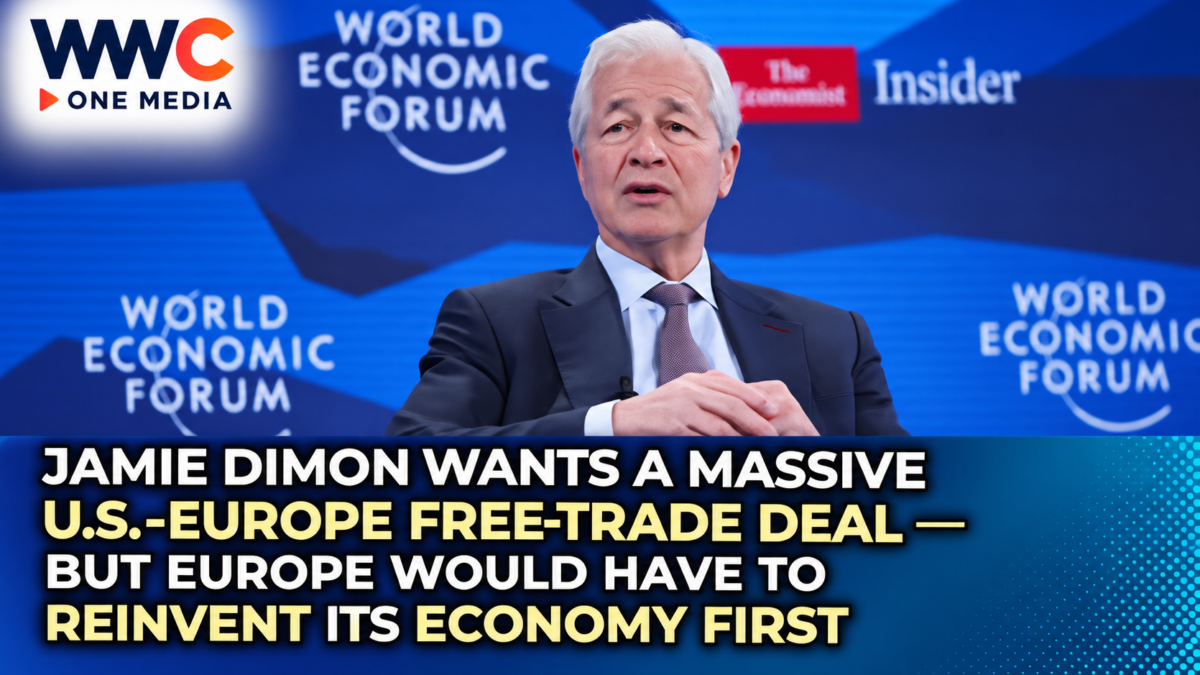
NEW YORK — JPMorgan Chase CEO Jamie Dimon is calling for one of the biggest resets in transatlantic economic policy in decades: a sweeping free-trade agreement linking the United States and Europe more closely together, potentially creating an economic bloc powerful enough to challenge China and shape global trade rules.
But Dimon’s proposal comes with a major condition.
Europe would first have to make deep reforms to its economy, financial system, energy strategy and military capabilities.
In an opinion article published in The Wall Street Journal, Dimon argued that Washington should offer Europe a major incentive: undertake reforms that strengthen economic competitiveness and security, and the United States would negotiate what he described as a broad economic and free-trade agreement.
Dimon believes the arrangement could eventually extend beyond Europe to other U.S.-aligned democracies including Canada, Mexico, Japan, South Korea, Australia and the Philippines.
His argument is much bigger than lowering tariffs.
It is a plan to reorganize the Western economic alliance.
Dimon Says the West Needs a New Economic Strategy
For decades, the United States and Europe built one of the world’s largest commercial relationships.
But that alliance is increasingly being tested by:
tariffs,
China’s industrial rise,
expensive energy,
defense spending,
technology competition,
and political tensions inside the Western alliance.
Dimon argues that simply managing each individual trade dispute is no longer enough.
Instead, he wants Washington and Europe to create a much deeper common economic system capable of competing against increasingly powerful state-backed economies.
He described such an agreement as both an economic and geopolitical game changer.
The Catch: Europe Has to Change First
Dimon’s proposal is not a blank check for Europe.
He argues that Europe suffers from structural weaknesses that could eventually make it unable to finance both its social programs and military commitments.
One of his biggest concerns is energy.
Europe imports a large portion of the energy it consumes.
That makes its industries vulnerable whenever global oil and gas prices rise.
The region also faces:
fragmented financial markets,
high regulatory burdens,
slower technology investment,
weaker productivity growth,
and increasing competition from Chinese manufacturers.
Dimon’s message is essentially this:
America should offer Europe freer trade—but Europe must become much more competitive in return.
Europe’s Capital Markets Are One of the Biggest Problems
One of Dimon’s central concerns is Europe’s fragmented financial system.
The European Union has a single currency across much of the bloc.
But it still does not have a truly unified capital market comparable with the United States.
EU officials themselves acknowledge the problem.
European finance ministers and central-bank officials recently said European banks need greater scale and much deeper capital markets if the region is going to compete with U.S. financial institutions.
The difference matters.
American companies can raise enormous amounts of capital from:
stock markets,
corporate bonds,
venture capital,
private equity,
and institutional investors.
European companies often face more fragmented rules and smaller national financial markets.
That makes it harder to finance high-growth companies.
U.S. Banks Are Spending Much More on Technology
European officials have also warned that U.S. banks significantly outspend their European rivals on technology.
That gap matters even more as artificial intelligence transforms banking.
AI requires enormous spending on:
cloud computing,
chips,
cybersecurity,
software,
and data infrastructure.
If European financial companies cannot invest at similar scale, they risk falling further behind.
That is why both Dimon and European policymakers are increasingly pushing for deeper financial integration.
Europe Still Has Not Completed Its Banking Union
The European Union has discussed banking and capital-market integration for years.
Progress has been slow.
National governments often resist cross-border bank mergers because they want to protect domestic financial champions.
A recent example is Germany’s resistance to UniCredit’s efforts involving Commerzbank.
EU officials say political interference in bank mergers remains one of the main obstacles preventing European financial institutions from becoming large enough to compete globally.
Dimon sees that fragmentation as a strategic weakness.
JPMorgan itself demonstrates the opposite model.
One American bank can operate at enormous scale across the entire U.S. market.
Europe has dozens of national banking markets operating under different political pressures.
AI Could Make the Gap Even Wider
The competitiveness problem extends beyond banking.
An IMF analysis recently warned that Europe could receive substantial productivity benefits from AI—but only if the region accelerates adoption and improves infrastructure.
The IMF estimates AI could raise European productivity by roughly 1% over five years.
But it also warned that Europe remains heavily reliant on AI technologies developed in the United States and China.
Around 60% of workers in advanced European economies are in occupations that could be significantly affected by AI, according to the IMF.
That gives Europe a strong incentive to build its own technology ecosystem.
Energy Could Be Europe’s Biggest Competitive Weakness
Europe’s dependence on imported energy has become even more visible during recent geopolitical crises.
Middle East tensions have pushed oil prices sharply higher.
European economies are generally more exposed than the United States because America produces enormous volumes of oil and natural gas domestically.
Europe imports much more of its energy.
That vulnerability hits manufacturers especially hard.
Industries such as:
chemicals,
steel,
glass,
fertilizer,
and heavy manufacturing
need huge amounts of electricity and gas.
When energy becomes expensive, European factories can quickly become less competitive than plants in the United States or China.
Germany Has Already Learned That Lesson
Germany provides perhaps the clearest example.
For decades, its industrial model relied heavily on relatively cheap Russian gas.
Russia’s invasion of Ukraine disrupted that model.
German industry subsequently faced much higher energy costs.
Companies in chemicals, metals and manufacturing began reconsidering where future factories should be located.
That crisis demonstrated exactly the kind of vulnerability Dimon wants Europe to fix.
Energy security is now economic policy.
And increasingly, it is national-security policy too.
Defense Is the Other Half of Dimon’s Proposal
Dimon is not simply asking Europe to reform its economy.
He wants it to strengthen its military capability as well.
Europe has dramatically increased defense spending since Russia invaded Ukraine.
But its defense industry remains fragmented.
Different countries operate different weapons systems.
Procurement is often national rather than European.
Production capacity can be slow.
Dimon argues that this makes Europe too dependent on the United States for security.
His proposed trade deal is therefore designed as an incentive:
Europe strengthens its economic and military capabilities.
America offers deeper access to its market.
The alliance becomes economically stronger and strategically more independent.
Trump Has Been Making a Very Different Trade Argument
Dimon’s proposal arrives during an unusual period in American trade policy.
President Donald Trump has relied heavily on tariffs as both an economic and geopolitical tool.
The current U.S. tariff framework applies additional duties to imports from dozens of economies.
European Union products are generally subject to a combined tariff rate of around 10% under the latest Section 301 framework, depending on the product and existing most-favored-nation duty.
That is almost the opposite direction from the broad free-trade system Dimon is proposing.
Trump uses tariffs as leverage.
Dimon is proposing market access as leverage.
Both approaches seek concessions.
They simply use opposite incentives.
The Existing U.S.-EU Agreement Is Much More Limited
Washington and Brussels already have a trade framework.
Under their 2025 agreement, the United States capped many tariffs on European products at around 15%, including categories such as automobiles, pharmaceuticals, semiconductors and lumber under specified conditions.
The EU subsequently suspended its planned retaliatory tariffs against American goods as part of efforts to stabilize transatlantic trade.
That agreement reduced the risk of a full trade war.
But it is nowhere close to the sweeping zero-barrier economic relationship Dimon is describing.
His plan would go significantly further.
Dimon Wants Something Closer to an Economic Alliance
The ambition appears closer to building an economic counterpart to NATO.
Participating democracies could gradually reduce:
tariffs,
regulatory barriers,
financial-market restrictions,
investment barriers,
and other obstacles to cross-border business.
The result could be an enormous integrated market spanning:
North America,
Europe,
Japan,
South Korea,
Australia,
and potentially other democratic partners.
Collectively, those economies would represent an extraordinary share of global wealth and consumer demand.
That scale is central to Dimon’s argument.
China Is the Unspoken Center of the Plan
China appears throughout the logic of Dimon’s proposal.
Chinese companies have become increasingly competitive in:
electric vehicles,
batteries,
solar equipment,
telecommunications,
industrial machinery,
and advanced manufacturing.
China also uses large-scale government support to accelerate strategic industries.
Western governments argue that some of those practices create unfair competition.
China rejects that characterization and says Western countries are increasingly turning toward protectionism.
Beijing recently warned it would retaliate if the EU adopts new trade mechanisms targeting Chinese products or companies.
That escalating tension helps explain Dimon’s urgency.
Europe Is Already Considering Tougher Trade Defenses
Germany and France are discussing stronger European trade tools capable of responding to what they consider unfair foreign trade practices.
That could include measures resembling U.S. Section 301 investigations.
But Europe faces a strategic dilemma.
It wants to defend its companies against subsidized Chinese competition.
At the same time, China is one of Europe’s largest trading partners.
Aggressive tariffs could therefore trigger retaliation.
Dimon’s proposed Western economic bloc could give Europe greater leverage by linking its economy more deeply with the United States and other major democracies.
But Europe May Not Want to Choose Between Washington and Beijing
That is one of the biggest obstacles.
European governments generally support their alliance with the United States.
But many also want to maintain significant commercial ties with China.
German automakers sell millions of vehicles there.
European luxury brands depend on Chinese consumers.
Industrial companies rely on Chinese supply chains.
So Europe may resist any trade pact that appears designed primarily as an anti-China alliance.
Dimon’s proposal would need to be structured carefully.
Free Trade Could Also Be Politically Difficult in America
The obstacle is not only Europe.
American politics has moved increasingly toward protectionism.
Both Republicans and Democrats have become skeptical of free-trade agreements after decades of factory closures and offshoring.
A massive new trade pact could face opposition from:
manufacturing unions,
domestic producers,
economic nationalists,
and lawmakers representing industries worried about European competition.
Even if the agreement produced broader economic gains, individual sectors could lose.
Those concentrated losses often create powerful political resistance.
Trump Himself Could Be the Biggest Question
Dimon framed his proposal using language familiar from Trump, describing the possibility of a large and attractive agreement.
But Trump’s own trade strategy has emphasized tariffs rather than eliminating them.
His administration has also repeatedly argued that America’s trading partners have benefited unfairly from access to the U.S. market.
That raises an obvious question:
Would Trump actually support the kind of enormous free-trade deal Dimon wants?
There is currently no indication that the administration has adopted Dimon’s proposal.
It remains an argument—not government policy.
The West Could Gain Enormous Scale
Economically, however, the logic is powerful.
The United States and European Union already conduct enormous amounts of trade.
Adding Canada, Mexico, Japan, South Korea, Australia and other allies would create an economic network covering many of the world’s wealthiest markets.
It would also connect much of the Western world’s:
capital,
technology,
defense production,
energy,
manufacturing,
and consumer spending.
Dimon believes that scale could allow democratic economies to write global rules rather than simply reacting to China.
The Philippines Was Specifically Included
For Asia, one noteworthy part of Dimon’s argument is his explicit mention of the Philippines among friendly democracies that could eventually participate in the broader framework.
The Philippines has become strategically more important as U.S.-China competition intensifies in the Indo-Pacific.
Its location near major shipping routes and the South China Sea makes it militarily significant.
A future economic framework connecting the Philippines more deeply with the U.S., Europe, Japan, South Korea and Australia could potentially accelerate:
foreign investment,
supply-chain relocation,
semiconductor assembly,
manufacturing,
and infrastructure development.
But that remains hypothetical.
Dimon proposed the possibility; no such negotiations have begun.
Supply Chains Could Be the Biggest Opportunity
The pandemic and geopolitical tensions have already pushed companies toward “friend-shoring.”
Instead of depending on one country for critical goods, companies are diversifying production across politically aligned markets.
A large Western trade bloc could accelerate that trend.
Manufacturers could build supply chains across:
the United States,
Mexico,
Europe,
Japan,
South Korea,
Australia,
and Southeast Asian allies.
That could reduce dependence on China for strategic products.
It could also create enormous investment opportunities.
Semiconductors Would Be a Major Target
Chips are likely to become one of the most important sectors.
Advanced semiconductors are essential for:
AI,
weapons,
cars,
telecommunications,
and industrial equipment.
The United States designs many advanced chips.
Europe owns important semiconductor manufacturing equipment.
Japan produces critical materials and machinery.
South Korea manufactures memory.
Taiwan remains central to advanced chip fabrication.
A coordinated democratic supply chain could become one of the world’s most powerful technology ecosystems.
That is exactly the kind of strategic economic integration Dimon appears to envision.
Europe’s Manufacturing Recovery Offers Some Hope
There are signs Europe is already improving.
Eurozone manufacturing activity expanded at its fastest pace in more than four years in September.
The S&P Global manufacturing PMI rose to 52.9, with output reaching a 55-month high.
Demand for investment goods was particularly strong.
AI and defense spending helped support industrial activity.
Germany also showed solid manufacturing growth.
That suggests Europe is not simply trapped in permanent industrial decline.
But the recovery remains fragile.
Inflation and Energy Remain Threats
Europe’s recovery comes with a major complication.
Inflationary pressures are increasing again.
Rising energy costs have pushed input prices higher, increasing expectations that the European Central Bank may need to maintain tighter monetary policy.
Higher interest rates raise the cost of:
business investment,
mortgages,
government debt,
and infrastructure.
That is another reason Dimon wants structural reforms.
Europe cannot rely forever on cheap borrowing or government subsidies to improve competitiveness.
It needs stronger private investment.
Deeper Capital Markets Could Unlock Trillions
Europe has enormous household savings.
But much of that money sits in bank deposits rather than being channeled into equity markets and high-growth companies.
A deeper capital-markets union could direct more European savings toward:
startups,
infrastructure,
technology,
defense,
and energy projects.
That is one reason both Brussels and Wall Street executives keep returning to the same reform.
The problem is not necessarily that Europe lacks money.
It is that the financial system does not deploy capital as efficiently as the United States.
The Trade Deal Could Become the Carrot
That is where Dimon’s proposal becomes strategically interesting.
Europe has discussed these reforms for years.
Progress has been slow because national governments resist surrendering control.
A massive U.S. free-trade offer could provide the incentive necessary to overcome that resistance.
In effect:
reform Europe, and America opens the market.
That is much more politically attractive than simply lecturing European governments to change.
But the Agreement Would Take Years
Even if leaders embraced the idea tomorrow, negotiations would be extraordinarily complex.
Agriculture alone could become a major obstacle.
Europe and America have different standards for:
food,
chemicals,
technology,
privacy,
financial regulation,
and environmental policy.
Governments would also have to decide how to handle:
subsidies,
government procurement,
digital taxes,
carbon rules,
and national-security screening.
Previous U.S.-EU trade negotiations have struggled over exactly these issues.
So Dimon’s plan should be viewed as a strategic vision, not a near-term deal.
Why Dimon Is Raising the Issue Now
The timing reflects growing anxiety among global business leaders.
The international economic system is becoming more fragmented.
The U.S. and China are restricting strategic technologies.
Europe is considering stronger protection against Chinese imports.
Tariffs are increasing.
Energy routes are being disrupted by wars.
Companies are reorganizing supply chains.
In that environment, Dimon believes America needs stronger economic allies—not simply more tariffs.
His Message to Washington Is Also Clear
The argument is not simply that Europe needs America.
America also benefits from a stronger Europe.
A richer Europe buys more American products.
A better-armed Europe reduces pressure on U.S. defense spending.
A more technologically competitive Europe strengthens Western supply chains.
A deeper European capital market creates more investment opportunities.
And a politically stable Europe gives Washington a stronger partner against authoritarian powers.
That makes Dimon’s idea fundamentally different from zero-sum trade politics.
He is arguing that making allies stronger can make America stronger too.
The Biggest Question Is Whether Politics Will Allow It
Economically, the proposal has logic.
Geopolitically, it has ambition.
Politically, it may be extraordinarily difficult.
Europe would have to surrender some national control.
America would have to reduce tariffs.
Industries on both sides would demand protection.
China would likely see the agreement as an attempt to contain its economic influence.
And Trump would have to embrace a major free-trade pact despite making tariffs central to his economic strategy.
That is why Dimon’s proposal is so interesting.
It asks Washington and Europe to reverse years of growing economic nationalism and replace it with a much larger alliance.
If they succeed, the result could become one of the most powerful economic blocs in history.
If they fail, the West could continue fragmenting just as China becomes more competitive.
And that is the real choice behind Dimon’s proposal:
America and Europe can keep fighting over individual tariffs—or try to build an economic alliance large enough to write the next generation of global trade rules themselves.