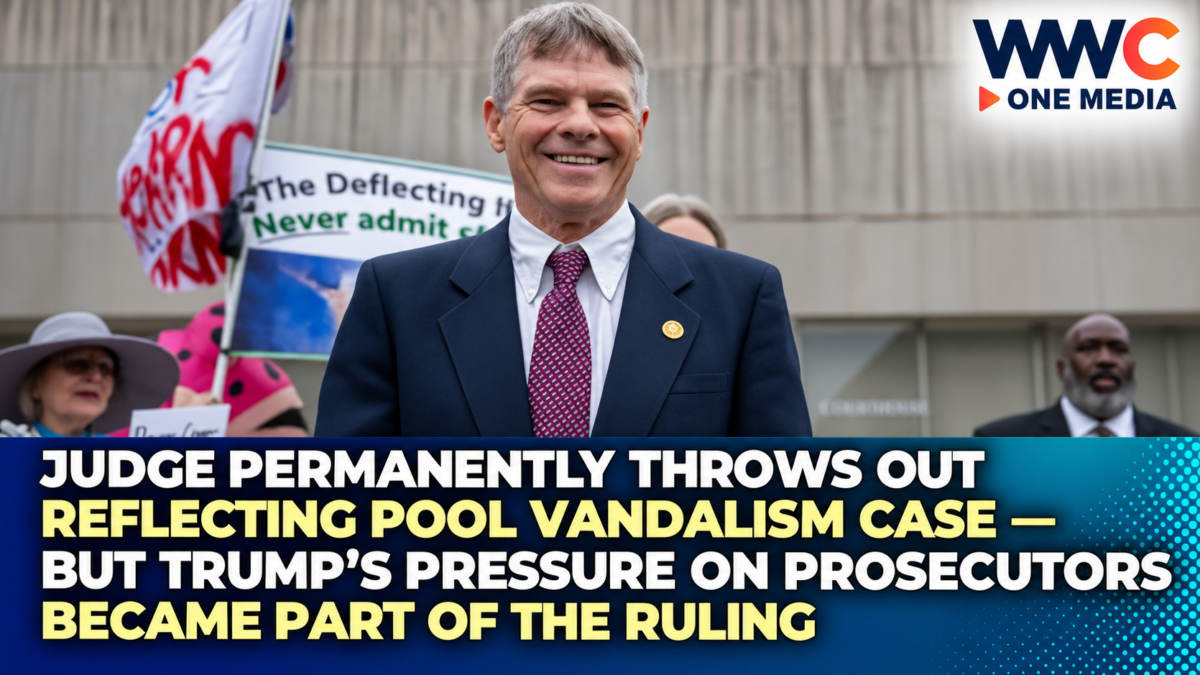
WASHINGTON — A judge has permanently dismissed the felony vandalism case against former U.S. Olympic canoeist David Hearn, closing the door on prosecutors ever reviving the same charge after government lawyers acknowledged that the damage blamed on him was actually caused by a faulty renovation of the Lincoln Memorial Reflecting Pool.
D.C. Superior Court Judge Todd Edelman dismissed Hearn’s case with prejudice on October 1, an unusually strong step that prevents the U.S. Attorney’s Office from refiling the same prosecution later.
The ruling goes much further than simply ending a minor property-damage dispute.
Edelman said the case presented exceptional circumstances because prosecutors had already concluded it lacked merit, while President Donald Trump had publicly criticized them and pressured them to change course.
That turned a dispute over peeling material in one of Washington’s most famous landmarks into a broader controversy over political pressure, prosecutorial independence and how quickly the government can turn a public accusation into a felony case.
Hearn Faced Up to 10 Years in Prison
Hearn, 67, is a three-time U.S. Olympic canoeist from Bethesda, Maryland.
He competed at the 1992, 1996 and 2000 Summer Olympics, earning his best Olympic finish—ninth place—at the Atlanta Games in 1996.
His legal trouble began after an incident at the Lincoln Memorial Reflecting Pool on June 19, 2026.
Hearn said he was riding his bicycle when he noticed that part of the newly installed blue coating inside the pool had begun peeling away.
He reached down and briefly touched a loose piece that was still attached to the basin.
When a park worker told him to let go, Hearn said he complied.
Federal prosecutors nevertheless charged him with felony destruction of property.
The offense carried a possible sentence of up to 10 years in prison.
That made what might have looked like a minor encounter with a peeling pool liner an extremely serious criminal case.
Trump Had Already Declared It Vandalism
The Reflecting Pool had recently undergone renovation as part of preparations surrounding the United States’ America 250 celebrations.
Shortly after the refurbished surface began deteriorating, Trump publicly blamed vandals.
He claimed the new waterproof coating had been deliberately cut or slashed and pushed officials to prosecute people believed responsible.
Hearn quickly became one of the most prominent defendants.
But prosecutors eventually discovered that the evidence did not support the theory Trump had publicly promoted.
The Government Learned the Liner Was Already Failing
The Justice Department reversed course in late July.
Federal prosecutors said newly produced Interior Department documents showed the Reflecting Pool damage resulted from a flawed or “botched” installation by the contractor, combined with pressure to finish the project rapidly before America 250 events.
The Washington Post separately analyzed the deteriorating pool and concluded that the peeling was most likely caused by application problems during the renovation rather than deliberate destruction.
That evidence undermined the central premise of the prosecution.
The government had treated the peeling material as proof of vandalism.
The later evidence indicated the material was already coming loose.
DOJ Asked to Drop the Case
U.S. Attorney Jeanine Pirro’s office moved to dismiss the felony charge.
The government initially sought dismissal without prejudice.
That wording was crucial.
A dismissal without prejudice would end the current prosecution while allowing prosecutors to bring the case back if they later claimed to discover new evidence.
Hearn’s lawyers objected.
They wanted the dismissal made permanent.
Their concern was not purely theoretical.
Trump had publicly attacked the decision to drop the case.
Trump Said Pirro ‘Choked’
After Pirro’s office abandoned the prosecution, Trump criticized his own U.S. attorney.
He said Pirro had “choked” and “folded like an umbrella,” according to court reporting and AP.
Trump continued asserting that vandals had damaged the Reflecting Pool even after prosecutors said Interior Department evidence pointed instead to construction defects.
That political pressure became central to Hearn’s argument for permanent dismissal.
His lawyers said keeping the door open to future charges could expose him to renewed prosecution based not on evidence but on pressure from the president.
Judge Edelman ultimately agreed that risk was serious enough to matter.
The Judge Said the Possibility of New Evidence Was ‘Fanciful’
Edelman sharply rejected the government’s request to preserve the possibility of another prosecution.
He said the theoretical prospect that prosecutors might someday discover evidence capable of supporting a new case appeared “fanciful.”
The judge also said prosecutors had effectively “shot first and asked questions later” by pursuing Hearn through what he described as an exceptionally rapid indictment process.
His ruling emphasized that prosecutors ordinarily receive substantial discretion over whether to bring or dismiss cases.
But he concluded that this situation was exceptional.
The government had already found the case meritless.
The president had publicly pressured prosecutors to reverse course.
And Hearn faced the possibility of remaining indefinitely vulnerable to a future prosecution unsupported by meaningful evidence.
Judge: Hearn Needed Protection From Possible Harassment
Edelman said the court had an obligation to protect Hearn from the uncertainty created by leaving the case technically revivable.
The judge cited the possibility that Hearn could otherwise face what objectively would amount to harassment through a meritless politically motivated prosecution.
That language is significant.
Judges generally avoid unnecessarily inserting themselves into disputes between presidents and prosecutors.
But Edelman explicitly discussed the White House pressure surrounding the case.
He noted that the prosecutors themselves had deemed the case without merit while Trump repeatedly criticized them for doing so.
The court therefore treated political pressure not merely as background noise, but as one factor supporting the need for permanent dismissal.
What ‘With Prejudice’ Actually Means
The legal phrase can sound technical.
Its practical meaning is straightforward.
Dismissed without prejudice: prosecutors may potentially bring the same case again.
Dismissed with prejudice: prosecutors cannot revive that same prosecution.
Hearn received the second—and much stronger—form of dismissal.
That gives him legal certainty that the government cannot simply reconsider later and recharge him with the same vandalism case.
His attorneys called the decision a victory for the rule of law and argued that their client should never have been prosecuted in the first place.
Other Reflecting Pool Cases Were Dropped Too
Hearn was not the only person accused in connection with the pool.
The Justice Department also dropped misdemeanor cases against three other defendants accused of damaging the Reflecting Pool.
That further weakened the broader vandalism theory.
Rather than uncovering evidence of a coordinated effort to destroy the renovated surface, investigators found evidence pointing toward failures in the renovation itself.
The Renovation Had Been Rushed
Government filings blamed part of the failure on the effort to complete the project quickly before major America 250 events.
Prosecutors said the installation had been flawed and rushed.
That matters because Trump had portrayed the deteriorating surface as proof of vandalism.
The Interior Department’s own documentation ultimately suggested something considerably more mundane:
a construction project had gone wrong.
Pieces of the new coating began separating.
People noticed them.
And at least one person who touched the already-peeling material ended up facing a felony indictment.
The Pool Itself Became an Embarrassment
The renovation was supposed to improve the appearance of one of Washington’s most photographed landmarks.
Instead, portions of the new blue coating began peeling and floating in the water.
Algae problems also appeared after the work.
The Reflecting Pool was later drained while officials addressed the deterioration.
That left the administration facing two problems at once:
the renovation itself had failed,
and one of the prosecutions launched over the supposed vandalism was collapsing.
Prosecutors Said the Evidence Changed
It is important to distinguish between political criticism and the formal explanation from prosecutors.
Pirro’s office said it moved to dismiss after receiving additional records from the Interior Department that changed the factual picture.
Those documents showed that Hearn was not responsible for the damage prosecutors originally attributed to him.
Prosecutors therefore did what the justice system is supposed to allow:
they reconsidered the case when new evidence undermined it.
The controversy arose because Trump then publicly attacked that decision and called for continued prosecution.
That Put Pirro in an Unusual Position
Pirro is a Trump appointee and former Fox News personality.
She serves as the top federal prosecutor in Washington.
Ordinarily, a politically appointed U.S. attorney is still expected to exercise independent prosecutorial judgment based on evidence and law.
The Hearn controversy demonstrated how difficult that separation can become when the president publicly comments on an individual criminal case.
Pirro’s office said the evidence no longer supported the prosecution.
Trump openly disagreed.
Edelman’s ruling effectively ensured that disagreement cannot now result in Hearn being prosecuted again on the same case.
The Case Became Part of a Larger Pattern of Legal Setbacks
The Reflecting Pool prosecution is also part of a series of high-profile cases brought during Trump’s second term that have encountered problems in court.
Reuters reported in September that several politically prominent prosecutions had collapsed because of insufficient evidence, procedural problems or other legal defects.
Those cases have intensified debate over whether federal prosecutors are being pushed toward politically useful cases before investigators have assembled evidence strong enough to sustain them.
The administration disputes allegations that the Justice Department is being improperly politicized.
But Hearn’s case provides critics with an unusually concrete example because prosecutors themselves ultimately said the central factual accusation was wrong.
The Judge Focused on Evidence, Not Politics Alone
It would also be misleading to say Edelman dismissed the case solely because Trump commented on it.
The evidentiary problem came first.
The Interior Department documents undermined the vandalism theory.
Prosecutors acknowledged the weakness.
They chose to abandon the felony charge.
Political pressure became important because the government still wanted the ability to prosecute Hearn again later despite having no meaningful evidence pointing toward such a future case.
That is why dismissal with prejudice became relevant.
The Grand Jury Process Also Faced Questions
Hearn’s attorneys had questioned how prosecutors presented the case to the grand jury that indicted him.
According to defense filings reported by The Washington Post, prosecutors initially received testimony suggesting damage attributable to Hearn was uncertain.
A witness was later recalled, and prosecutors elicited testimony putting the alleged damage above the threshold supporting the felony charge.
Hearn’s lawyers argued that the process raised questions about whether the grand jury received a fair and accurate picture.
Because the judge ultimately permanently dismissed the prosecution, those disputes may never need to be fully litigated.
But they added to concerns about how aggressively the original case was pursued.
A Felony Prosecution Over a Loose Piece of Liner
The contrast at the center of the case is striking.
The government charged a 67-year-old former Olympian with a felony punishable by as much as 10 years in prison.
The alleged act was touching or tugging at material that evidence later showed had already begun separating because of installation failures.
That discrepancy explains why the case attracted national attention.
It raised a simple question:
How did investigators move from a deteriorating pool liner to a felony indictment before fully determining why the liner was deteriorating?
Trump’s Comments Made the Stakes Higher
Presidents routinely criticize crime and call for stronger enforcement.
Publicly demanding action against a specific defendant is more sensitive.
Federal prosecutors are supposed to make charging decisions based on evidence and applicable law.
Defense lawyers therefore argue that direct presidential pressure can create both actual and perceived threats to prosecutorial independence.
Edelman’s ruling does not create a broad new rule banning presidential comments about prosecutions.
But it does show that those comments can become legally relevant when a judge evaluates whether a defendant faces a credible risk of unjust future prosecution.
The Decision Is a Significant Win for Hearn
For Hearn, the ruling brings practical finality.
He does not have to wonder whether the government might revive the charge six months or a year from now.
His lawyers said the decision allows him to move forward with his life after a prosecution they described as unjust.
Hearn previously said being publicly portrayed as a vandal had been personally painful.
He argued that the experience demonstrated how quickly anyone can become caught in government accusations that later prove unsupported.
But the Political Questions Will Last Longer Than the Case
The criminal case is effectively over.
The arguments it created are not.
The Reflecting Pool controversy now leaves several uncomfortable questions behind:
Why was Hearn indicted before prosecutors had fully established what caused the damage?
Why did crucial Interior Department evidence emerge only later?
Why did the president continue insisting on vandalism after prosecutors concluded the evidence showed otherwise?
And how much weight should courts give presidential pressure when deciding whether someone needs protection from a future prosecution?
Those questions move the story well beyond a damaged landmark.
The Biggest Damage May Be Institutional
The Reflecting Pool can be repaired.
The larger concern is confidence in the process.
Criminal prosecution carries enormous power.
A felony indictment can damage a person’s reputation, employment and finances even when the government later drops the case.
That is why prosecutors are expected to investigate carefully before charging.
Hearn’s case demonstrated what can happen when that sequence appears reversed.
The judge’s description was unusually memorable:
the government effectively charged first and investigated the underlying facts later.
Trump Wanted the Case Kept Alive — The Judge Closed It Permanently
That ultimately is what makes the October 1 ruling consequential.
Prosecutors had already conceded the vandalism theory did not hold up.
The unresolved question was whether the government should retain the power to revisit the case.
Edelman said no.
He concluded that the chance of legitimate new evidence emerging was minimal, while the danger of renewed political pressure was sufficiently serious to justify permanently closing the door.
For David Hearn, that means the prosecution is finished.
For Washington, however, the case leaves behind a much larger debate:
What happens when a president publicly demands prosecution, but the evidence points in the opposite direction?
In this case, the court supplied its answer.
The government does not get unlimited chances to prosecute someone after its own evidence shows the accusation was wrong.