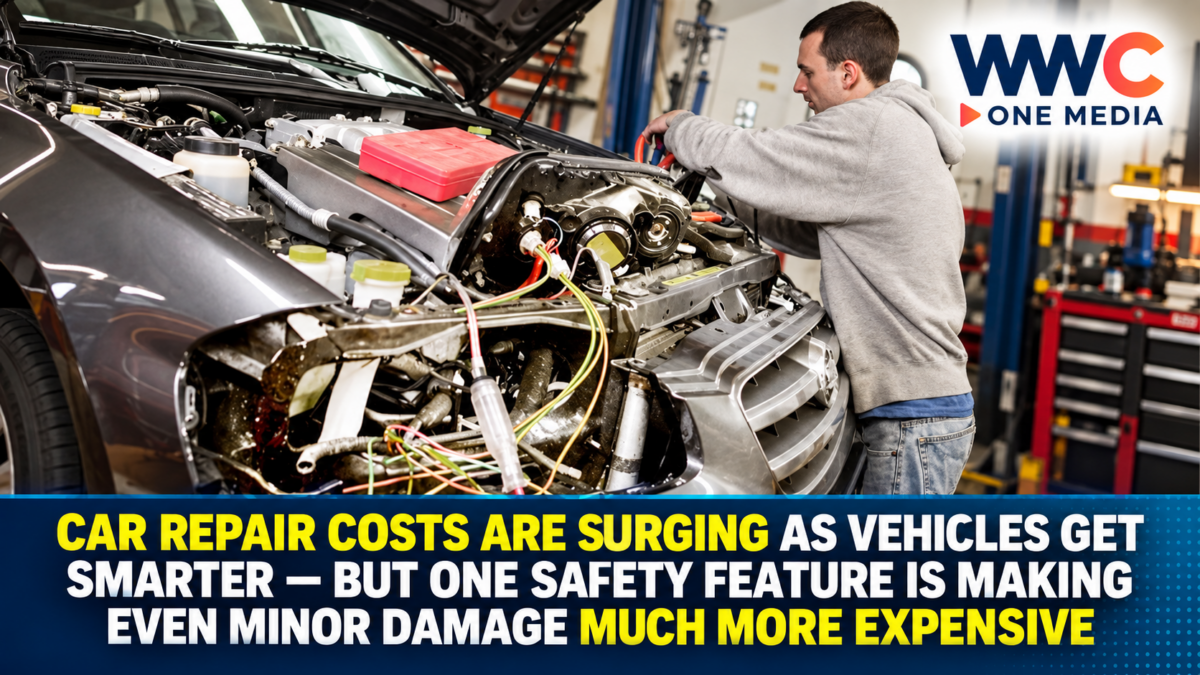
NEW YORK — Modern cars are becoming safer, smarter and more technologically advanced — but those upgrades are creating an expensive new problem for drivers: even relatively minor repairs can now require specialized computers, cameras, radar sensors and calibration equipment that dramatically increase the final bill.
U.S. motor-vehicle maintenance and repair prices were 5.2% higher in August 2026 than a year earlier, according to the Bureau of Labor Statistics, significantly outpacing several other transportation-related categories.
The longer-term increase is even more striking.
BLS data show the motor-vehicle maintenance and repair index stood at 297.884 in August 2019 and reached 465.136 by August 2026 — an increase of roughly 56% in seven years.
That means drivers are paying substantially more not only because labor and parts have become more expensive, but because the vehicles themselves have become far more complicated to diagnose and repair.
A Cracked Windshield Is No Longer Just a Cracked Windshield
A decade ago, replacing a windshield was largely a glass job.
On many new vehicles today, it can also be a computer and sensor job.
Modern cars commonly place cameras behind the windshield to support advanced driver-assistance systems, or ADAS, including:
automatic emergency braking,
lane-keeping assistance,
adaptive cruise control,
traffic-sign recognition,
and collision warnings.
If the windshield is replaced or the camera position changes, those systems may need to be recalibrated before the vehicle can safely return to the road.
That recalibration requires precision equipment and trained technicians.
AAA says automakers increasingly recommend diagnostic scans before and after collision repairs to verify that electronic safety systems are functioning properly.
So a repair that once required little more than replacing broken glass can now involve software, sensors and computerized testing.
ADAS Can Add Nearly 38% to a Collision Repair Bill
AAA quantified the cost in a detailed study of modern vehicles.
It found that repairing and calibrating advanced driver-assistance systems can add as much as 37.6% to the total cost of a collision repair.
Even minor damage to front radar or distance sensors can add as much as $1,540 to the repair bill.
In AAA’s testing of several 2023-model vehicles, ADAS components involved in a minor rear collision accounted for approximately 41% of the total repair estimate.
ADAS-related costs connected with windshield replacement represented about 25% of the overall windshield repair bill.
That helps explain why a relatively small accident can produce a surprisingly large insurance claim.
The bumper may show only cosmetic damage.
But behind it may be radar equipment costing hundreds or thousands of dollars.
Repair Shops Are Having to Buy Expensive Equipment Too
Consumers are not the only ones absorbing higher costs.
Independent repair shops have to make major investments simply to work on newer vehicles.
CNBC’s reporting highlighted one shop that paid approximately $28,000 for an ADAS calibration machine and another $12,000 for the required computer.
A complete calibration setup can reportedly reach $90,000, depending on the equipment and vehicle brands the shop services.
Then there are additional target boards used to calibrate specific cameras and sensors.
Some of those targets can cost hundreds or thousands of dollars each.
That creates a financial dilemma for smaller repair businesses.
They can invest heavily in new technology.
They can outsource calibration work.
Or they can stop servicing certain vehicles altogether.
Whichever option they choose, someone ultimately pays.
And increasingly, that someone is the vehicle owner or insurance company.
Calibration Is Becoming Much More Common
CCC Intelligent Solutions, whose software is widely used in the collision-repair and insurance industries, says calibration procedures are appearing in a rapidly growing share of repairs.
In 2025, 28.3% of repairable collision estimates included calibration work, up from 21.8% the year before.
That represents roughly a 30% increase in the number of repair estimates containing a calibration procedure.
The trend is likely to continue.
Automatic emergency braking, lane-departure systems and blind-spot monitoring are moving from premium options into mainstream vehicles.
That means the average family car increasingly contains technology that once existed mainly in luxury models.
Safety improves.
Repair complexity rises with it.
Newer Cars Are Much More Expensive to Repair
CCC found another major difference between new and old vehicles.
The average total cost of repair for vehicles six years old or newer was $5,721.
That was $2,039, or 55.4%, more than the average repair cost for vehicles seven years or older.
That gap shows how dramatically electronics and advanced safety systems affect repair economics.
Newer vehicles may protect occupants better during accidents.
But the technology built into bumpers, windshields, mirrors and body panels makes damage much more expensive to correct.
The result is a strange tradeoff:
cars are becoming better at preventing accidents while becoming more expensive when accidents still happen.
Even Mirrors Have Become Technology Centers
Side mirrors provide another example.
They used to contain little more than glass and an electric adjustment motor.
Today they may include:
blind-spot sensors,
cameras,
heating elements,
turn signals,
memory systems,
and power-folding mechanisms.
AAA found that when ADAS components in a side mirror were damaged, the camera alone represented roughly 71% of the related repair cost in its testing.
So what appears to be a simple broken mirror can become a four-figure repair.
The same pattern applies to bumpers.
The plastic panel may be inexpensive.
The radar sensor mounted behind it may not be.
Repair Bills Are Already Reaching Four Figures
A separate 2026 analysis by vehicle-service-contract provider Empire Auto Protect tracked 102 common repairs and found a median repair cost of approximately $725.
More than half of the repairs examined could exceed $1,000, while 15 could surpass $3,000.
Among the most expensive:
Hybrid battery replacement — $2,000 to $8,000
Diesel particulate filter replacement — $2,000 to $8,000
Engine replacement — $3,000 to $7,500
Transmission repair or replacement — $1,800 to $6,500 or more
CNBC Select separately cited the same roughly $725 median repair bill while warning consumers that basic vehicle repairs have become increasingly expensive.
Labor Costs Are Rising Too
Technology is only one part of the story.
Repair shops are also facing higher wages, higher rent, expensive diagnostic subscriptions and shortages of skilled technicians.
Empire Auto Protect says labor rates in some major U.S. metropolitan areas now exceed $200 per hour.
And advanced vehicles require increasingly specialized skills.
Technicians now need to understand mechanical systems, electrical systems, computers, networking and software.
That changes the labor market.
A modern collision technician is increasingly part mechanic and part electronics specialist.
Shops therefore need to pay more to recruit and retain people capable of working safely on these systems.
Those costs are reflected in repair bills.
Software Subscriptions Are Becoming Part of Auto Repair
Modern repair shops also increasingly pay for access to manufacturer software and technical data.
Some vehicles require proprietary diagnostic tools or subscription-based software before technicians can reset modules, program components or verify that repairs were completed correctly.
That has helped turn the right-to-repair debate into an increasingly important issue.
Independent repair businesses argue they need affordable access to the same vehicle data and tools available to manufacturer-authorized dealerships.
Without that access, consumers could have fewer choices — and potentially higher prices.
The more software-defined cars become, the more important that debate becomes.
Electric Vehicles Add Another Layer of Complexity
EVs present their own repair challenges.
Earlier CCC research found battery-electric vehicles required nearly four additional labor hours per collision repair compared with internal-combustion vehicles, while labor costs were about 30% higher.
EVs often have fewer moving mechanical components.
But collision work can involve specialized battery procedures, high-voltage safety requirements and manufacturer-specific repair methods.
Hybrids can be even more complex because they combine traditional engines with high-voltage electric systems.
The result is another paradox.
Electric vehicles may require less routine maintenance in areas such as oil changes.
But major repairs can become highly specialized and expensive.
Higher Repair Bills Feed Into Insurance Costs
Rising repair severity does not stop at the body shop.
Insurers ultimately pay much of the cost after collisions.
When the average claim becomes more expensive, insurers may respond by raising premiums.
CCC reported that 23.1% of auto claims were declared total losses, a record high in its 2026 Crash Course report.
That can happen when repair costs approach or exceed the value of the vehicle.
Higher parts prices and complex repairs therefore can push insurers toward declaring cars totaled even when damage does not look catastrophic.
For consumers, the consequences can appear in two places:
the repair bill after an accident,
and the insurance premium paid every month.
Sometimes Technology Makes a Car Too Expensive to Fix
This is becoming especially important for older vehicles.
A five- or six-year-old car may still contain expensive cameras, radar sensors and electronic modules.
But its market value has declined considerably.
If an accident damages enough of those systems, repairs can quickly approach the car’s resale value.
That makes replacement more economically attractive than repair.
The situation helps explain the record total-loss rate reported by CCC.
And it creates another affordability problem.
Drivers may lose a functioning vehicle because repairing advanced electronics no longer makes financial sense.
They then have to enter a new- or used-car market where prices remain elevated.
Parts Prices Are Still Adding Pressure
CCC’s 2026 report found parts remained one of the largest contributors to rising collision costs.
Some components — including grilles, liftgates, quarter panels and rear lamps — recorded price increases above general inflation during portions of 2025.
That makes sense when considering how many modern parts contain embedded technology.
A grille may hide radar equipment.
A headlight can contain adaptive LEDs and control modules.
A bumper can contain parking sensors.
A liftgate may include cameras, powered hinges and electronic controls.
Increasingly, car parts are no longer simply physical components.
They are electronic systems.
Tariffs and Supply Chains Could Add More Pressure
Repair shops are also operating in a difficult manufacturing environment.
U.S. factory surveys in September showed sharply rising input costs as manufacturers dealt with tariffs, high energy prices and renewed supply-chain pressure.
The Institute for Supply Management’s manufacturing-price index jumped to 77.9 in September from 71.1 in August, indicating rapidly rising input costs.
Those pressures can eventually feed into replacement parts.
Imported electronics, metals, plastics and vehicle components remain exposed to global supply disruptions and trade-policy changes.
That means repair inflation could remain elevated even if some labor pressures ease.
Safety Technology Is Working — But It Isn’t Free
There is an important distinction.
ADAS systems exist for a reason.
Automatic emergency braking can prevent crashes.
Blind-spot monitoring can reduce lane-change accidents.
Lane-departure warnings can alert distracted or fatigued drivers.
The technology can save lives and reduce collisions.
AAA is not recommending that drivers avoid these features.
Its research instead highlights the hidden ownership cost.
When sensors are damaged or disturbed, proper calibration is necessary to ensure they continue working correctly.
Skipping calibration to save money can create its own safety risk.
So the higher cost is often unavoidable.
The Future Car May Be Cheaper to Crash — Eventually
Automakers and suppliers are aware of the problem.
As ADAS technology becomes standardized, calibration equipment may become cheaper.
Technicians may become more efficient.
Parts could become easier to replace.
Remote diagnostics could reduce labor time.
And insurers may develop better ways to determine exactly when calibration is necessary.
But those benefits have not yet overcome the increasing complexity of the vehicle fleet.
CCC says calibration procedures are still becoming more common, not less.
For now, the industry is still climbing the technology-cost curve.
The $500 Fender Bender Is Disappearing
For consumers, perhaps the simplest takeaway is this:
visible damage no longer tells you what a repair will cost.
A damaged bumper can hide radar.
A cracked windshield can disrupt cameras.
A broken mirror can disable blind-spot monitoring.
Even after the physical damage is repaired, computers may still need scanning, programming and calibration before the vehicle is considered safe.
That is why repair bills are rising faster than many drivers expect.
Cars have become remarkably good at sensing the world around them.
But every additional sensor is another component that may need replacement, programming or calibration after an accident.
And as the technology spreads into millions of mainstream vehicles, the biggest surprise for drivers may no longer be how advanced their cars have become.
It may be discovering how much all that technology costs when something goes wrong.