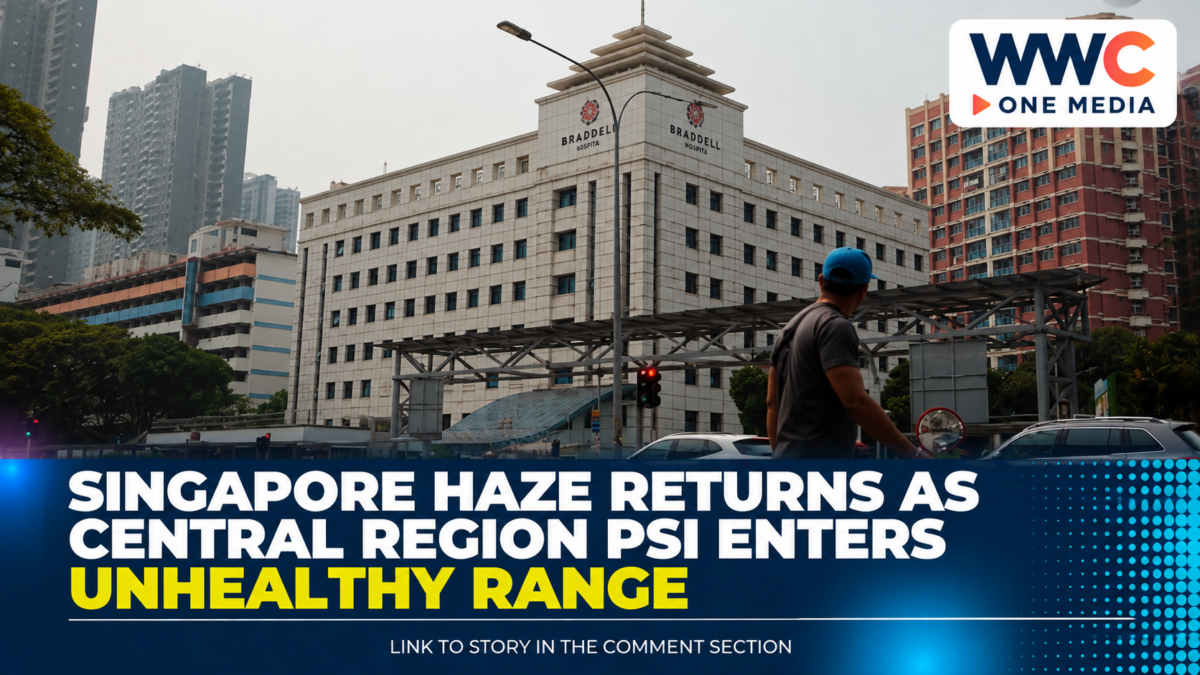
Singapore’s air quality deteriorated on Saturday, Oct. 3, with the 24-hour Pollutant Standards Index (PSI) in the central region returning to the unhealthy range after several days of improvement.
At 11am, the PSI ranged from 76 to 102 across Singapore, with the central region recording the highest reading at 102. The eastern and western regions followed at 94 and 91 respectively, while the northern and southern regions remained below the unhealthy threshold.
Under Singapore’s air-quality scale, a 24-hour PSI reading of 101 to 200 is classified as unhealthy, while readings from 51 to 100 are considered moderate.
The deterioration came after air quality had improved at the start of October. By late Sept. 30, all five regions had returned to the moderate range, and conditions remained generally moderate on Oct. 1 and Oct. 2.
The National Environment Agency (NEA) had warned that the improvement could be temporary. Its Oct. 2 haze update said moderate to dense smoke plumes from southern Sumatra were drifting toward Singapore, while smoke haze from fires in Kalimantan was also being observed.
Dry conditions were expected to continue across Singapore and parts of the surrounding region, while prevailing southeasterly or southerly winds could transport additional smoke haze toward the island. The NEA had forecast Singapore’s 24-hour PSI to remain within the moderate to low-unhealthy range.
Fine-particle pollution was also elevated in several areas on Saturday. At 11am, one-hour PM2.5 readings were 66 in the east, 63 in the central region and 57 in the west, placing those areas in the elevated band.
The one-hour PM2.5 reading is used as a guide for immediate outdoor activities, while the 24-hour PSI is used to assess air quality and plan activities for the following day. The NEA advises residents to check both measures when deciding whether to engage in outdoor exercise or other strenuous activities.
When the PSI reaches the unhealthy range, healthy people are advised to reduce prolonged or strenuous outdoor physical activity. Elderly people, children, pregnant women and those with chronic heart or lung conditions are advised to take additional precautions.
The latest deterioration follows a more severe haze episode earlier in the week. On Sept. 29, all five regions briefly entered the unhealthy range, with the central region reaching 164, the highest PSI recorded during this haze season at that point.
The latest conditions remain linked to transboundary smoke haze from fires in parts of Indonesia. The NEA’s haze monitoring system reported clusters of hotspots in southern Sumatra and Kalimantan, with moderate to dense smoke observed across parts of the region.
With dry weather expected to persist in parts of the southern ASEAN region, authorities continue to monitor the movement of smoke and changing wind conditions. Residents are being advised to follow the latest PSI and PM2.5 readings, particularly before undertaking prolonged or strenuous outdoor activities.