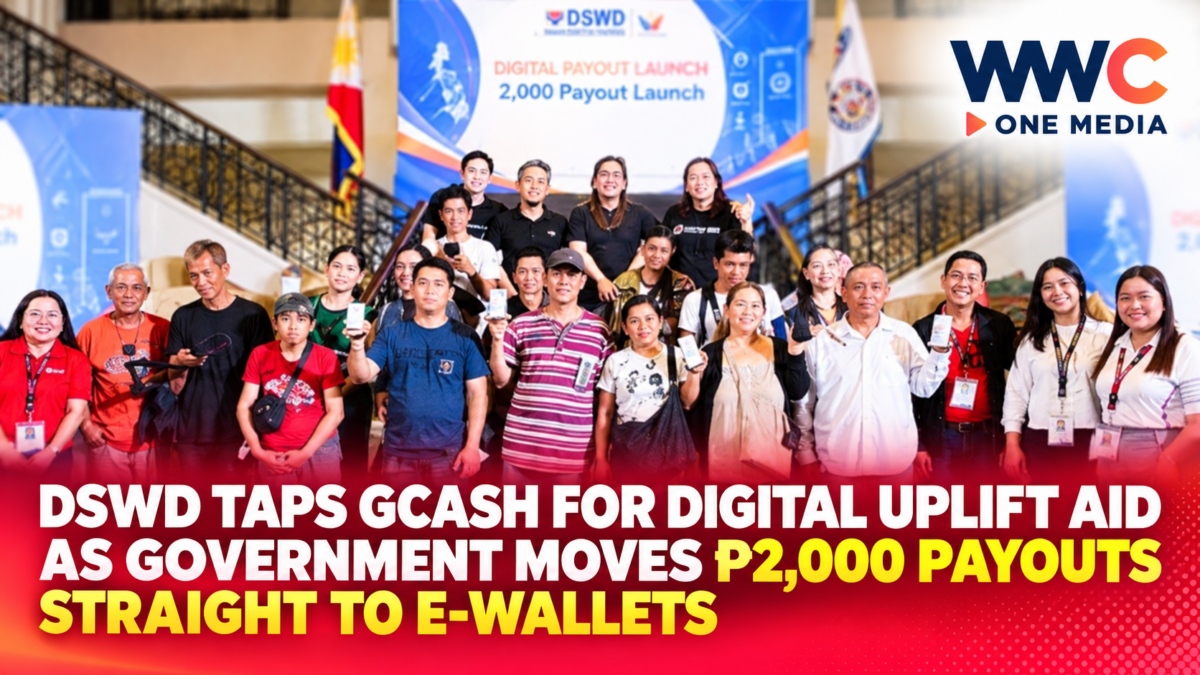
MANILA, Philippines — Millions of vulnerable Filipino households could increasingly receive government cash assistance without lining up at payout centers as the Department of Social Welfare and Development expands digital distribution of its UPLIFT assistance through GCash.
The DSWD has tapped GCash to support digital payouts under the government’s Unified Package for Livelihoods, Industry, Food and Transport or UPLIFT Program, allowing eligible beneficiaries to receive succeeding ₱2,000 assistance payments directly into their mobile wallets.
The shift represents more than a change in how government aid is released.
It is part of a broader effort to move large-scale social protection programs away from physical cash distribution and toward digital payments that could reduce travel costs, waiting time and logistical expenses for beneficiaries.
But with millions of Filipinos depending on the program, the bigger test will be whether digital payouts can remain accessible to households that may have limited internet access, smartphones or experience using financial apps.
FIRST GCASH DIGITAL UPLIFT PAYOUT LAUNCHED IN BACOLOD
The DSWD formally rolled out its digital UPLIFT payout in Bacolod City on September 22.
During the launch, Group 2 beneficiaries received their second-tranche assistance directly through registered GCash accounts. DSWD said the pilot demonstrated how beneficiaries could receive future payments without repeatedly traveling to physical distribution sites.
Social Welfare Secretary Rex Gatchalian said digital payments could significantly reduce the transportation costs and time beneficiaries spend collecting their assistance.
Instead of lining up at a payout venue, eligible recipients could receive the money directly through an account they already use.
The DSWD plans to continue shifting succeeding releases toward digital channels through December.
₱2,000 CAN NOW GO STRAIGHT TO A GCASH WALLET
Under the arrangement, beneficiaries who choose GCash may receive future UPLIFT assistance through the company’s Fund Disbursement Service.
GCash is also participating in UPLIFT caravans to help beneficiaries who do not yet have digital wallets create and register accounts.
GCash Vice President and Head of B2B Sales Cleo Celeste Santos said the partnership is intended to make government assistance easier and more convenient to access while giving beneficiaries greater choice in how they manage their funds.
The move also means recipients can potentially use their assistance immediately for digital payments, transfers and other transactions instead of first withdrawing the full amount in cash.
BUT THE 7.5 MILLION BENEFICIARIES ARE NOT ALL IN THE SAME CATEGORY
One important detail is often lost in the headline number.
The UPLIFT program targets approximately 7.5 million poor, near-poor and low-income households, but beneficiaries are divided into three groups with different payout mechanisms.
GROUP 1: 3.5 MILLION 4Ps AND WALANG GUTOM HOUSEHOLDS
This category consists of around 3.5 million households enrolled in the Pantawid Pamilyang Pilipino Program and Walang Gutom Program.
Eligible 4Ps households were provided a one-time ₱2,000 UPLIFT top-up, generally through existing LandBank or digital accounts.
Walang Gutom beneficiaries follow their program’s scheduled distribution arrangements.
GROUP 2: 2.5 MILLION POOR AND NEAR-POOR HOUSEHOLDS
This is the group most directly affected by the new digital payout rollout.
The 2.5 million households identified through the Philippine Statistics Authority’s 2024 Community-Based Monitoring System are entitled to ₱2,000 monthly from July through December 2026.
Their first payments were generally conducted manually so DSWD could verify beneficiaries and enroll payment details.
Beginning with succeeding releases, the government has been shifting them toward e-wallets and basic bank accounts.
GROUP 3: 1.5 MILLION LOW-INCOME SSS MEMBERS
Another 1.5 million beneficiaries are low-income workers identified through the Social Security System.
Qualified SSS members receive assistance through registered disbursement accounts, subject to the program’s eligibility requirements.
The differences matter because the often-cited 7.5-million figure does not mean every beneficiary automatically receives ₱2,000 every month for six months.
WHY UPLIFT WAS CREATED
The expanded UPLIFT assistance was launched as the government tried to cushion vulnerable Filipinos from higher fuel prices and rising living costs triggered partly by continuing geopolitical tensions and disruptions in global energy markets.
President Ferdinand Marcos Jr. announced the expanded assistance in July, saying rising fuel and commodity prices were putting additional pressure on low-income families.
The government has said around 7.5 million households are expected to benefit from the broader program.
DSWD Secretary Gatchalian previously warned that without additional support, around 1.2 million Filipinos could fall into poverty as higher living costs squeeze already vulnerable households.
That makes UPLIFT partly a poverty-prevention program rather than simply another emergency cash payout.
GOVERNMENT SET ASIDE BILLIONS FOR THE PROGRAM
The government announced approximately ₱12.375 billion in funding for the expanded UPLIFT initiative when it launched the program in July.
Funding was sourced from available government savings under applicable national budget circulars, according to Malacañang.
By August 17, DSWD said more than 5.39 million households had already received initial UPLIFT assistance.
Total disbursements at that point had reached more than ₱10.791 billion, with roughly 73% of intended beneficiaries having received their initial assistance.
Earlier, as of August 8, the agency reported that ₱9.42 billion had already been distributed to 4.71 million beneficiaries.
The rapid rise in payouts illustrates the enormous logistical challenge involved in moving billions of pesos to millions of households within a relatively short period.
WHY GOVERNMENT STARTED WITH CASH
Digital payments may appear simpler, but DSWD deliberately used manual distribution for many initial payouts.
The reason was verification.
The agency needed to confirm that beneficiaries were genuine and eligible before repeatedly sending money to an account.
DSWD has used a similar approach in other cash-aid programs, where first-tranche payments are handled physically before subsequent releases shift to digital channels.
For UPLIFT Group 2, DSWD instructed beneficiaries to prepare account information and the eGov PH application to make succeeding digital payments easier.
This verification stage is designed to reduce risks such as duplicate claims, incorrect accounts or assistance being sent to ineligible recipients.
GCASH IS NOT THE ONLY DIGITAL PAYMENT CHANNEL
While the latest partnership highlights GCash, it is not the only financial channel being used by the government.
Earlier UPLIFT releases for eligible 4Ps households included payments through:
LandBank cash cards
GCash
and
Maya, depending on the beneficiary’s region and registered payout channel.
Other beneficiaries can also register appropriate bank accounts.
That matters from a financial-inclusion standpoint because government assistance cannot depend entirely on a single private digital platform.
Giving beneficiaries several payment options can also reduce the risk of disruptions if one system encounters technical problems.
DIGITAL PAYOUTS COULD SAVE BENEFICIARIES MORE THAN TIME
For families living far from city centers, collecting government assistance can carry hidden costs.
A beneficiary may need to spend money on transportation, meals or childcare simply to reach a payout site.
A worker may also lose income by taking time away from a job.
Those costs can eat into a ₱2,000 cash grant.
DSWD specifically cited reduced travel time and transportation expenses as major reasons for shifting UPLIFT payments online.
If a beneficiary receives ₱2,000 directly through an e-wallet, more of that amount could potentially remain available for food, utilities, transport and other household expenses.
DIGITAL AID ALSO PUSHES FINANCIAL INCLUSION
The partnership is part of a much broader shift in Philippine social protection.
For millions of low-income Filipinos, receiving government assistance through a digital wallet can become their first regular interaction with a formal financial platform.
Once verified, an e-wallet can potentially be used for:
Bill payments
Money transfers
Mobile load
Merchant purchases
and other financial transactions.
That could help more Filipinos move from a primarily cash-based economy into formal digital finance.
But financial inclusion is only meaningful if users understand how to protect their accounts.
SCAMS BECOME ANOTHER RISK
Moving government assistance into e-wallets also creates new vulnerabilities.
Beneficiaries may become targets of phishing messages, fake registration links, impersonators or criminals attempting to steal one-time passwords and account credentials.
That means digitalization must be accompanied by strong beneficiary education.
Users should never be asked to surrender passwords, MPINs or one-time authentication codes in exchange for receiving government assistance.
Official eligibility remains determined by the government—not by unsolicited text messages, social-media accounts or individuals promising to enroll beneficiaries for a fee.
This becomes increasingly important as millions of pesos begin moving through digital channels every month.
THE PROGRAM IS ALREADY REACHING COMMUNITIES NATIONWIDE
The UPLIFT rollout has spread rapidly across the country.
In Negros Occidental, more than 8,300 beneficiaries had received over ₱16.6 million by late July during the early stages of the program.
In Cagayan de Oro, 6,854 residents were included in the initial local distribution.
Western Visayas also began simultaneous payouts across several provinces, with beneficiaries saying they planned to use the assistance for food and other household necessities.
The scale illustrates why digital distribution could become attractive to government agencies.
Physically distributing cash to millions of households every month requires enormous manpower, security and administrative resources.
THE BIGGER STORY: GOVERNMENT CASH AID IS GOING DIGITAL
The DSWD–GCash partnership could have implications far beyond UPLIFT.
DSWD assisted more than 4.2 million people under its Assistance to Individuals in Crisis Situation program during the first half of 2026 alone, releasing over ₱27.9 billion in aid for needs ranging from medical and burial expenses to education and emergency support.
If digital disbursement proves reliable for UPLIFT, similar systems could increasingly be used across other large government social-protection programs.
For government, the attraction is clear: faster distribution, less physical handling of cash and potentially lower administrative costs.
For beneficiaries, the promise is even simpler.
Instead of spending hours traveling and lining up to receive aid, the money could arrive directly on a phone.
But the real test will not be whether DSWD can send ₱2,000 into millions of digital wallets.
It will be whether the government can ensure that the right beneficiary receives the right amount, securely, without being excluded by technology or losing part of the assistance to scams and transaction costs.
If that can be achieved, UPLIFT may become more than an emergency cash program.
It could become another major step toward making Philippine government assistance digital by default.