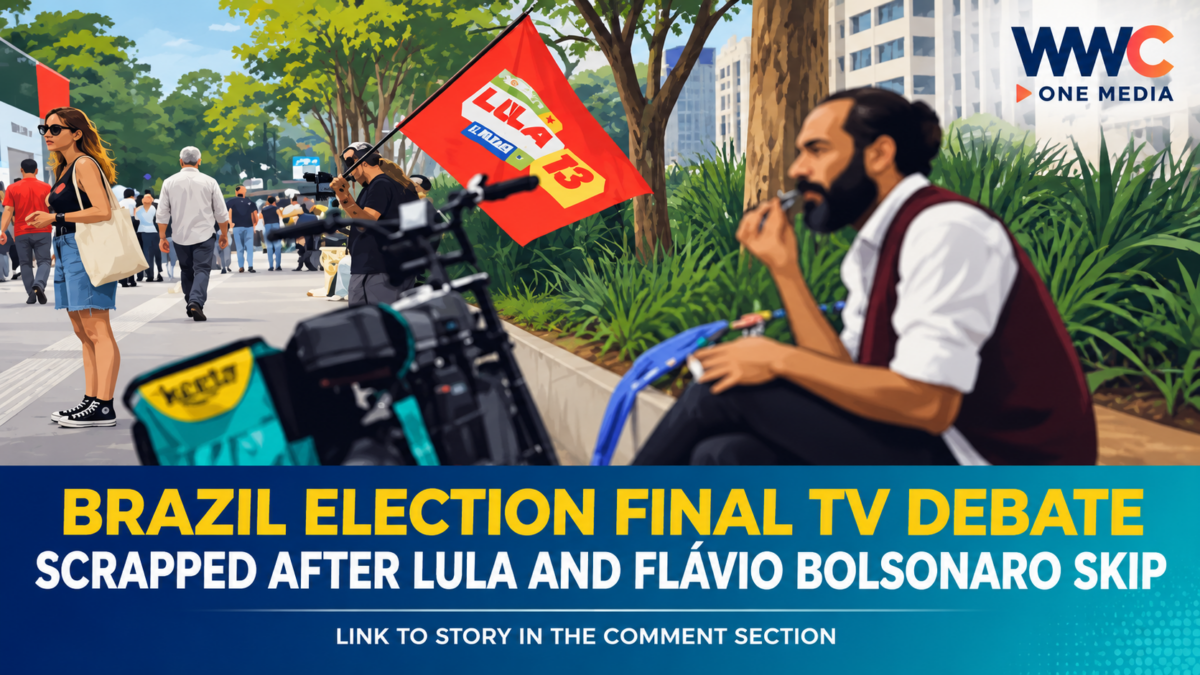
Brazil’s final televised presidential debate before the first-round election was canceled after President Luiz Inácio Lula da Silva and Senator Flávio Bolsonaro, two of the leading candidates, declined to participate in the scheduled TV Globo event.
The debate had been planned as the last major televised confrontation before Brazilians vote on Sunday, October 4. Its cancellation means the two leading candidates will not face each other in a first-round television debate, while other presidential contenders had been prepared to take part.
Lula had already announced that he would not attend the debate. Instead, he was scheduled to appear in an interview on the Flow Podcast around the same time as the TV Globo event.
Flávio Bolsonaro initially planned to participate but withdrew only hours before the debate was scheduled to begin. The senator, who is the son of former president Jair Bolsonaro, said he wanted to debate Lula directly and cited what he described as restrictions imposed by Brazil’s electoral authorities.
The cancellation was also affected by two court decisions issued shortly before the event. One ruling from Brazil’s Superior Electoral Court prevented TV Globo from displaying an empty podium reserved for Lula, while another decision from the Supreme Federal Court required the broadcaster to allow opposition candidate Renan Santos to participate.
TV Globo said the rulings created legal uncertainty around the format of the debate and contributed to the decision to cancel the program. The event had been expected to feature several candidates even without Lula, but Flávio Bolsonaro’s subsequent withdrawal left the broadcaster without the two candidates who had been expected to draw the greatest attention.
Other candidates expected to participate included Augusto Cury, Ronaldo Caiado, Romeu Zema and Renan Santos. Their participation reflected the broader field competing in the first round, even though the two most prominent candidates would not be on stage.
The cancellation is notable because Brazil has a long tradition of televised presidential debates, particularly during the final stages of election campaigns. According to reporting on Brazil’s electoral history, this is the first time in two decades that the leading candidates have both avoided a direct televised confrontation during the first round.
Lula has skipped several debates during the 2026 campaign. His decision not to attend the final TV Globo debate followed his stated preference for other campaign appearances and interviews. Flávio Bolsonaro, meanwhile, had said that his main objective was to confront Lula directly rather than participate in a debate without the incumbent.
The two campaigns instead pursued separate online appearances around the time the debate was scheduled. Lula appeared on a podcast, while Bolsonaro addressed supporters through social media, giving both candidates alternative platforms to communicate with voters without sharing the same stage.
The canceled debate also comes amid a closely contested presidential campaign. A Datafolha survey released October 1 measured Lula at 42% and Flávio Bolsonaro at 38% for the first round. In a simulated runoff scenario, the same poll measured Lula at 48% and Bolsonaro at 45%. These figures are a snapshot of voter preferences at the time of the survey and do not determine the election result.
With the first-round vote approaching, the cancellation leaves voters without a final televised forum in which the leading candidates could directly respond to each other’s arguments and policy positions. A potential second-round campaign, if required, could provide additional opportunities for direct debates before the scheduled October 25 runoff.
The development adds another unusual chapter to Brazil’s 2026 presidential campaign, where several debates have been affected by candidate withdrawals and disputes over participation rules. The TV Globo cancellation highlights the continuing role of electoral courts and broadcasters in determining how televised campaign events are conducted as voting day approaches.