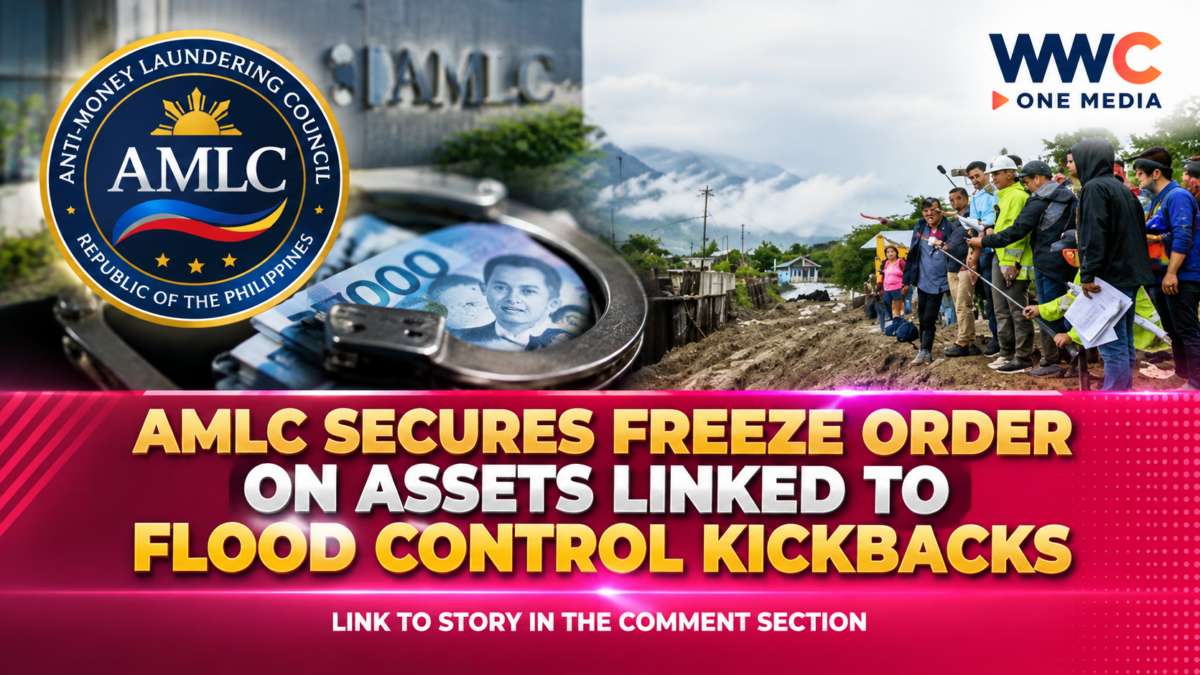
The Anti-Money Laundering Council (AMLC) has secured another court-issued freeze order covering financial assets linked to a prominent lawmaker, a corporation, and several individuals and entities allegedly connected to anomalies in flood control projects and a broader government budget kickback scheme.
The Court of Appeals issued the resolution on September 21, 2026, after finding probable cause that the assets covered by the application were related to plunder under Republic Act No. 7080. The freeze order temporarily restricts the movement or disposal of the covered assets while authorities continue investigating their alleged links to unlawful activity.
The AMLC did not publicly identify the lawmaker, corporation or other individuals and entities covered by the order. The council said its financial investigation found that some of those involved had no apparent operating revenues sufficient to explain the scale of their investments.
Investigators also traced the movement of funds through several layers of financial transactions. These allegedly involved individual intermediaries, corporations, bank accounts, a money service business and a virtual asset platform, creating additional steps between the funds and their alleged source.
According to the AMLC, the transactions were traced to funds allegedly associated with corruption and plunder cases involving the lawmaker. The council said the use of multiple recipients and financial channels made the funds more difficult to trace and increased their transactional distance from their alleged source.
The freeze order covers a substantial number of financial assets. These include 86 bank accounts, four investment accounts, one insurance policy and 25 virtual asset wallets, bringing the total number of accounts and wallets covered by the order to more than 100.
The inclusion of virtual asset wallets highlights the growing role of digital financial channels in investigations involving suspected illicit funds. The AMLC said money in the case passed through virtual asset service providers and multiple wallets, adding layers that could make it harder for investigators to immediately establish the origin and destination of funds.
The development comes as authorities continue examining alleged irregularities surrounding government flood control projects and accusations that public funds may have been diverted through kickback arrangements. Earlier investigations have also prompted authorities to examine financial records and assets connected to individuals and businesses under scrutiny.
Under the Philippines’ anti-money laundering framework, freeze orders are among the mechanisms used to preserve assets when there is probable cause that accounts or property are connected to unlawful activities. The law also provides procedures for affected parties to challenge or seek the lifting of a freeze order.
The AMLC said it will continue coordinating with government agencies, financial institutions and other partners to identify, trace, restrain and recover suspected illicit assets. The council also emphasized the need to prevent both traditional banking systems and emerging financial technologies from being misused for corruption, money laundering and other unlawful activities.
The latest freeze order does not by itself establish criminal liability. The finding of probable cause cited by the Court of Appeals concerns the connection of the covered assets to alleged unlawful activity, while the underlying allegations and any potential criminal cases remain subject to further investigation and legal proceedings.