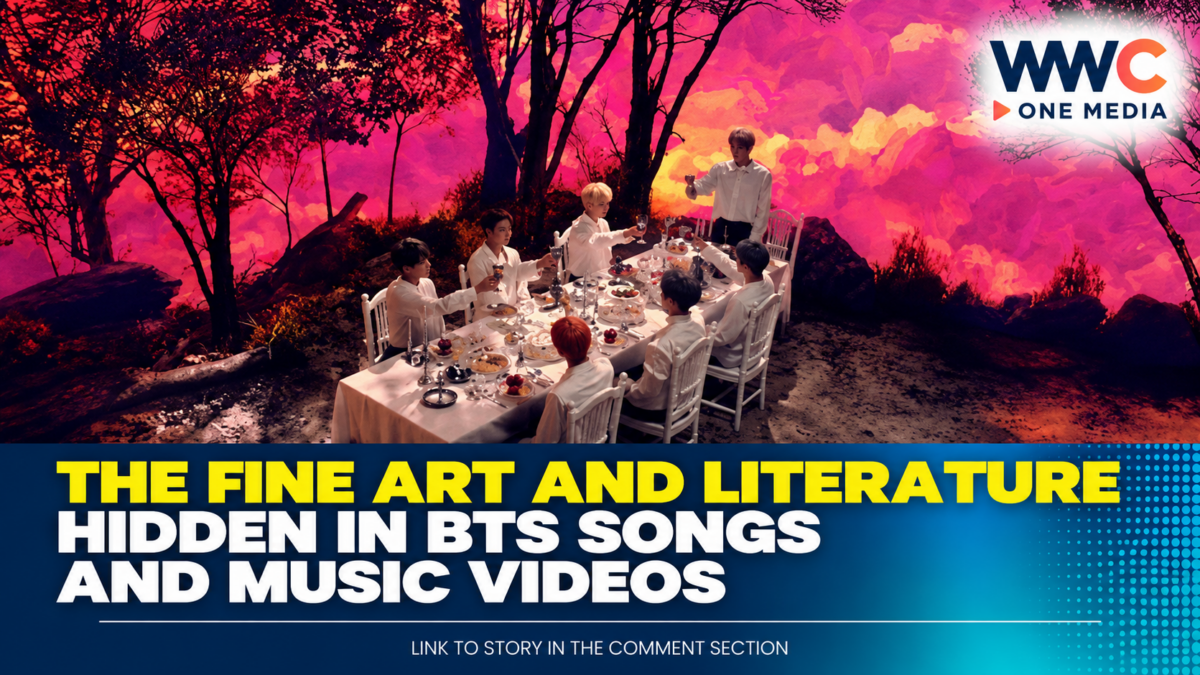
BTS have built much of their music around more than catchy melodies and powerful performances, weaving references to literature, paintings, philosophy and psychology into their songs and music videos.
One of the clearest examples is “Blood Sweat & Tears,” whose visual world draws heavily from Hermann Hesse’s novel “Demian.” The coming-of-age story explores themes of temptation, identity, morality and the struggle between opposing forces, ideas that also run through BTS’ “Wings” era. The music video contains numerous classical artworks and religious imagery, turning the song into a visual exploration of beauty, desire and conflict.
The same music video features references to several major works of European art, including paintings associated with Pieter Bruegel the Elder and Herbert James Draper. The imagery surrounding angels, demons, temptation and falling reinforces the themes explored throughout the “Wings” album.
“Spring Day” takes a different literary route. The music video contains a reference to Ursula K. Le Guin’s short story “The Ones Who Walk Away from Omelas,” a story about a seemingly perfect city whose happiness depends on the suffering of an isolated child.
BTS’ song transforms that literary idea into a story about separation, loss, memory and the hope of eventually meeting again. The reference has become one of the many details fans have examined while interpreting the imagery and symbolism surrounding the song.
“Butterfly” also contains a direct literary connection through Haruki Murakami’s “Kafka on the Shore.” The song’s lyrics refer to the novel and explore uncertainty over whether an experience is real or a dream, echoing the book’s themes of identity, reality and the mysterious connections between different worlds.
Another Murakami connection appears in “Sea,” a hidden track from “Love Yourself: Her.” The song has been associated with “1Q84,” another Murakami novel that explores questions surrounding reality, parallel worlds and uncertainty.
BTS also drew from literature for “Magic Shop.” The song was inspired by James R. Doty’s memoir “Into the Magic Shop,” which centers on the relationship between the mind, the heart and the possibility of changing one’s circumstances.
The group’s “Map of the Soul” era brought psychology into the picture. “Map of the Soul: Persona” takes its conceptual foundation from Jungian psychology and Murray Stein’s “Jung’s Map of the Soul: An Introduction,” with ideas such as the persona, ego and shadow appearing throughout the project.
BTS’ relationship with visual art is particularly visible through RM, who has frequently spoken about his interest in museums and artists. He has highlighted works by artists including J.M.W. Turner, Lee Ufan and Kim Whanki, while the group has also collaborated with Google Arts & Culture to showcase artworks connected to each member.
Jin has also pointed to art within BTS’ music-video universe. In the group’s Google Arts & Culture project, he highlighted Pieter Bruegel the Elder’s “The Fall of the Rebel Angels,” noting its connection to the struggle between good and evil and its appearance in one of BTS’ music videos.
These references have helped give BTS’ discography an unusually layered quality. A song can work as a pop track on its own while its accompanying visuals open another level of interpretation through paintings, novels, mythology and psychological ideas.
For listeners willing to look deeper, BTS’ music becomes more than a collection of songs. Their references create connections between contemporary K-pop and centuries of literature, fine art and philosophy, giving fans another way to explore the stories behind the music.