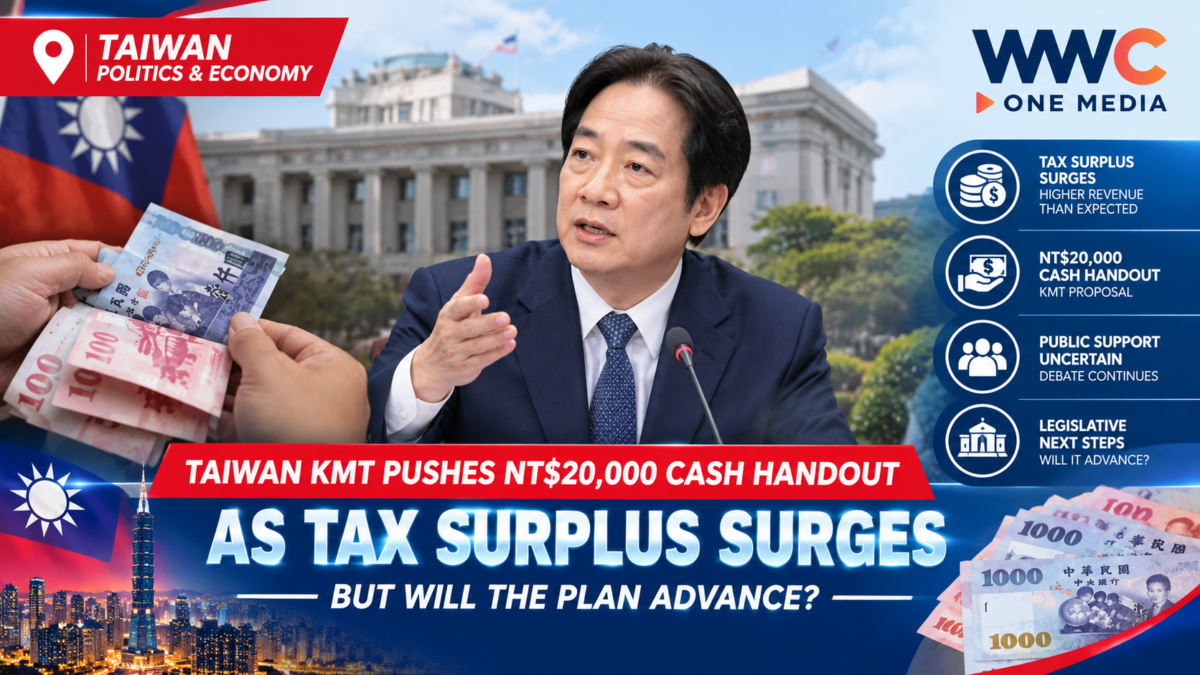
TAIPEI — Taiwan’s main opposition Kuomintang (KMT) is proposing a NT$20,000 cash payment for every citizen, arguing that stronger-than-expected tax collections should be shared with the public.
The proposal, announced as Taiwan’s new legislative session opened, would double the NT$10,000 universal cash payment that President Lai Ching-te’s government has proposed for 2027.
But the proposal is already facing questions over its financing, legislative authority and how surplus government revenue should be used.
KMT Says Tax Surplus Could Fund NT$20,000
KMT Legislative Caucus Convener Fu Kun-chi said surplus tax revenue could exceed NT$1 trillion this year amid strong growth in Taiwan’s technology sector.
He pointed to last year’s surplus of NT$528.3 billion, saying about 40%, or roughly NT$230 billion, was returned to the public through NT$10,000 cash payments.
Using a similar proportion of a projected surplus above NT$1 trillion, Fu argued that more than NT$400 billion could be available for a NT$20,000 payment. He also said the proposal could be implemented without additional government borrowing.
Those figures are KMT estimates and proposals, rather than an enacted government payment program.
Government Already Has a NT$10,000 Plan
The KMT proposal comes after President Lai announced plans for a NT$10,000 universal cash payment in 2027, with NT$2,357 billion included in the proposed central government budget for the measure.
The government’s plan is tied to its stated condition of maintaining balanced revenue and expenditure without additional net borrowing. The actual timing of any payment depends on legislative consideration and approval of the budget.
The KMT wants the larger NT$20,000 payment to be made this year, rather than waiting for the government’s planned 2027 distribution.
Opposition Parties Differ on How Surplus Money Should Be Used
The KMT is not the only opposition voice weighing in.
The Taiwan People’s Party (TPP) has called for a broader plan for surplus tax revenue rather than automatically directing a fixed share toward cash payments.
TPP legislative caucus chief executive Hung Yu-hsiang said surplus funds should also be considered for debt repayment, social welfare programs, benefits for elderly farmers and school lunches.
That means opposition parties do not have a single position on how the projected surplus should be allocated.
DPP Raises Legislative and Fiscal Questions
The ruling Democratic Progressive Party (DPP) has challenged the proposal on procedural and fiscal grounds.
DPP legislative caucus chief executive Chuang Jui-hsiung said measures that increase government spending need to identify their funding sources and comply with Taiwan’s budget rules. He also pointed to constitutional restrictions concerning legislative proposals that increase spending in relation to an Executive Yuan budget.
The DPP has also argued that government finances need to account for other spending priorities, including national defense, social welfare and economic development.
The Debate Goes Beyond a Cash Payment
At the center of the dispute is a larger question: How should Taiwan use unexpectedly strong tax revenue?
The KMT argues that citizens should receive a larger direct share of the economic gains, particularly as Taiwan’s technology sector benefits from strong global demand.
Other lawmakers have emphasized debt reduction, social programs and broader government spending needs.
Meanwhile, the government’s existing 2027 budget proposal already includes a NT$10,000 payment.
What Happens Next?
The NT$20,000 proposal is now part of the political and legislative debate rather than an approved benefit.
For the payment to become reality, lawmakers would need to address its legal framework, financing and relationship to the government’s existing budget proposal.
For Taiwanese households, the difference is significant: NT$10,000 is already part of the government’s proposed 2027 budget, while the KMT is pushing for NT$20,000 and wants it distributed sooner.
The next stage of the legislative process will determine whether the opposition’s proposal can move beyond a political proposal and into an actual government program.
WWC ONE MEDIA G,A