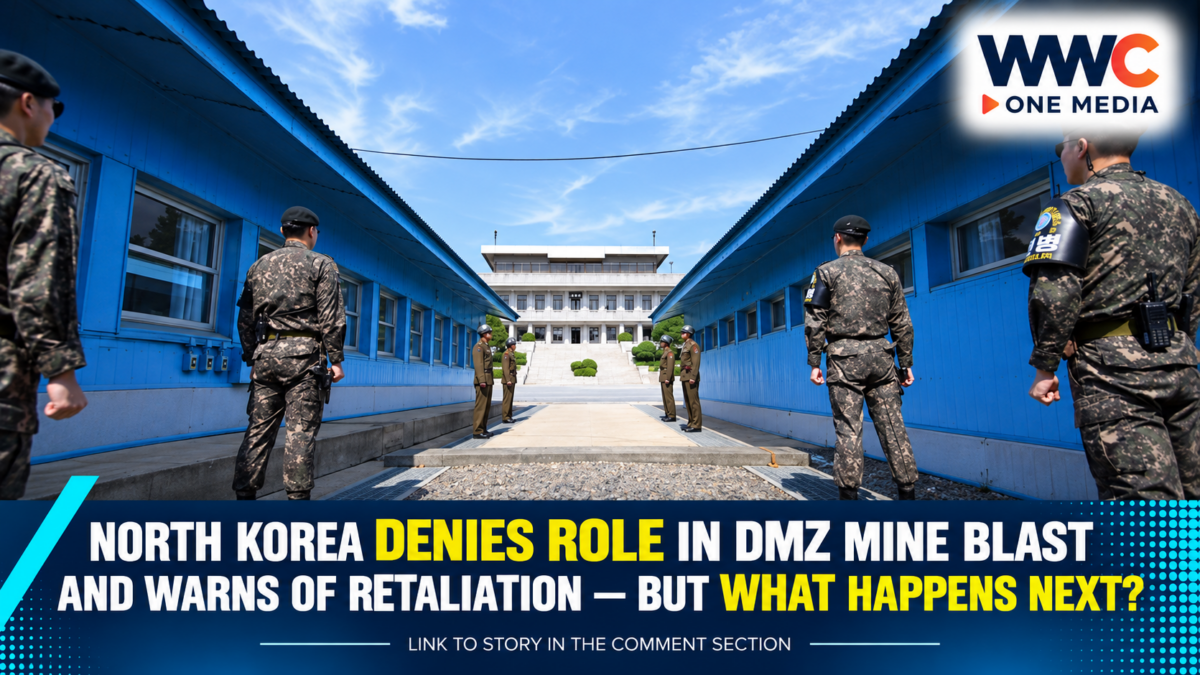
SEOUL — Tensions on the Korean Peninsula are rising again after North Korea rejected South Korea’s preliminary finding that North Korean land mines likely caused explosions inside the Demilitarized Zone (DMZ), while warning that Seoul could face retaliation if its troops open fire.
Kim Yo Jong, the sister of North Korean leader Kim Jong Un and a senior official in Pyongyang, dismissed Seoul’s assessment as fabricated and accused South Korea of using the incident to justify military and political actions against the North.
Her warning came one day after South Korea’s defense minister described the suspected mine incident as a clear violation of the 1953 Korean Armistice Agreement, while saying Seoul would take corresponding measures if North Korean responsibility is confirmed.
Pyongyang Rejects Seoul’s Findings
The dispute centers on explosions that injured three South Korean soldiers on September 21 inside the DMZ, south of the Military Demarcation Line.
South Korea’s military has said there is a very high likelihood that North Korean mines caused the blasts. A joint investigation involving South Korean military officials and the U.N. Command found evidence supporting that assessment.
Investigators also recovered a North Korean resin antipersonnel mine near the explosion site during an inspection on September 29.
North Korea, however, has rejected the attribution.
Kim Yo Jong characterized Seoul’s claims as an attempt to shift responsibility onto Pyongyang and warned that North Korea would respond if South Korean forces took military action against its troops.
Seoul Says the Investigation Is Still Critical
South Korea has not announced a specific military response.
President Lee Jae Myung ordered the military to work with the U.N. Command to establish the facts and said necessary measures would follow the investigation.
The government has been weighing its response while continuing its broader effort to reduce tensions and maintain channels for engagement with North Korea.
Defense Minister Kang Shin-chul has separately said that if the investigation ultimately confirms that North Korean forces planted the mines, Seoul would take corresponding measures.
Why the DMZ Dispute Matters
The DMZ is governed by the armistice that halted active fighting in the 1950-53 Korean War. The latest incident has therefore raised questions not only about responsibility for the explosions but also about compliance with the armistice framework.
The precise circumstances remain important. The blasts occurred in an area that South Korean troops had rarely entered for decades, and officials have noted that determining whether the mines were deliberately intended to target South Korean personnel is a separate question from identifying where the mines originated.
That distinction could affect how Seoul interprets the incident and what response it considers appropriate.
A New Flashpoint for Inter-Korean Relations
The mine dispute arrives at an already sensitive moment.
South Korea has been pursuing efforts to reduce military tensions and revive dialogue, while North Korea has maintained a hard-line position toward Seoul.
Now, competing claims over the DMZ explosion are adding another layer of uncertainty.
Pyongyang says it did not cause the blast. Seoul’s preliminary investigation points strongly toward North Korean mines, and investigators have recovered a mine identified as North Korean near the site.
The final findings and the response that follows could therefore become a significant test for inter-Korean relations.
For now, the central question remains unresolved: Will further investigation settle the dispute, or will the conflicting claims create another dangerous source of tension along the Korean border?
WWC ONE MEDIA G,A