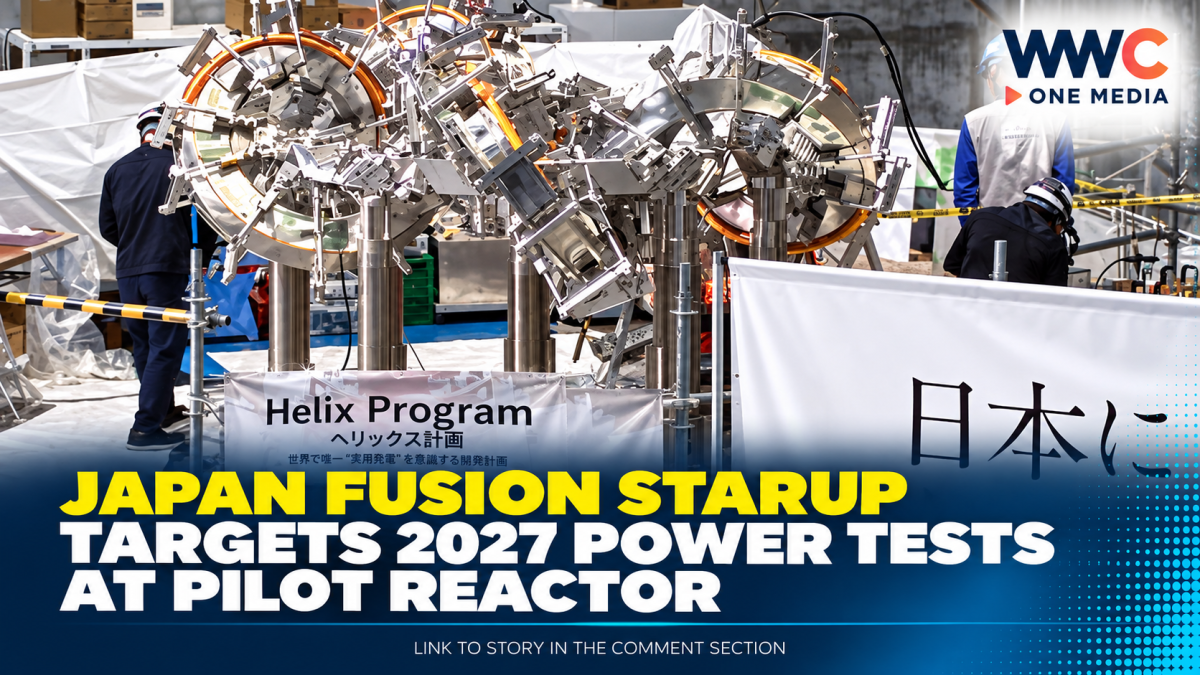
Japanese fusion-energy startup Helical Fusion plans to begin preliminary power-on tests at its demonstration reactor in 2027, marking another step in the country’s push to develop commercially viable fusion power.
The company is developing Helix HARUKA, described as Japan’s first integrated pilot reactor using a helical approach to fusion. The facility is designed to test whether fusion reactions can be maintained in a stable and continuous manner.
Nuclear fusion generates energy by combining atomic nuclei at extremely high temperatures, replicating the basic process that powers the sun. The technology has long been viewed as a potential source of large amounts of low-carbon electricity with relatively little long-lived radioactive waste compared with conventional fission reactors. However, researchers have spent decades working toward a commercially viable fusion power plant.
Helical Fusion said it achieved a significant technical milestone in 2025 by successfully testing a high-temperature superconducting coil. The company said the test reproduced the magnetic environment required inside a fusion device and demonstrated stable current flow under superconducting conditions.
Construction of the first spiral coil for HARUKA began earlier this year at the National Institute for Fusion Science facility in Toki, central Japan, and is now largely complete.
If the initial testing progresses successfully, the company plans to install a second coil and other major components, including a liquid-metal wall blanket. Full power-on testing of the completed integrated facility is expected around 2030.
Helical Fusion plans to eventually follow HARUKA with a larger reactor called HELIX KANATA. The proposed facility is designed to produce a net 50 megawatts of power while demonstrating stable, continuous electricity generation.
The company expects to begin full-scale investment in HELIX KANATA during the 2030s and is targeting a commercial fusion power plant as early as the 2040s.
Helical Fusion is the private-sector successor to helical fusion technology developed by the National Institute for Fusion Science. Its approach differs from the tokamak design used by major international fusion projects such as Japan and Europe’s JT-60SA.
The road to commercial fusion remains challenging. Helical Fusion chief executive Takaya Taguchi said the company must overcome not only technical hurdles but also questions involving cost, safety and construction speed before commercial operations can begin.
Japan is also increasing government support for fusion research and development. Fusion energy has been designated as one of the country’s strategic sectors, with public and private investment of 3.1 trillion yen, or about US$19.7 billion, planned through fiscal 2040.
The 2027 tests will therefore serve as an important early step for Helical Fusion, but they will not by themselves represent commercial fusion electricity. The company will still need to demonstrate reliable operation, complete additional reactor systems and address the economic and regulatory challenges involved in building a commercial power plant.