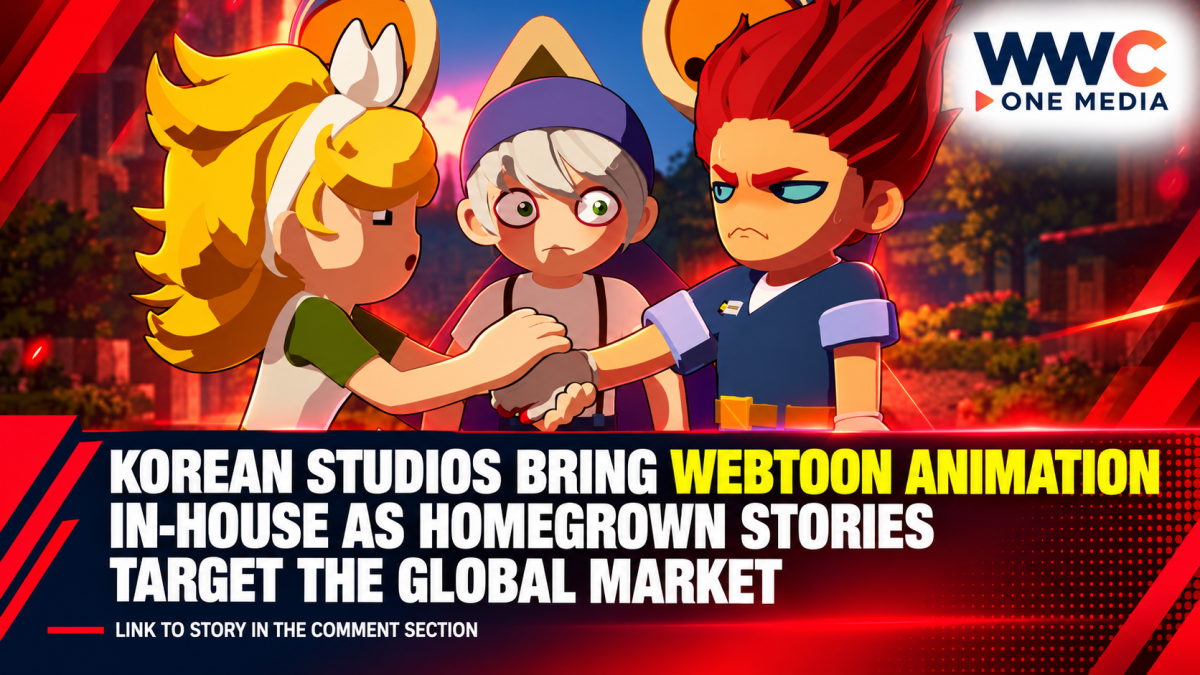
South Korea’s animation industry is entering a new phase as local studios increasingly take control of producing animated films based on the country’s hugely popular webtoons.
For years, Korean webtoon adaptations often relied on overseas production partners, particularly Japan, where animation infrastructure and expertise are deeply established. The success of titles such as Solo Leveling demonstrated the global commercial potential of Korean intellectual property while also highlighting the importance of international collaboration.
Now, Korean studios are increasingly developing the capability to bring those stories to the screen themselves.
One of the clearest examples is “Guardians of the Video Game,” an animated feature based on Gasfard’s Naver Webtoon. The film is being produced entirely by Seoul-based Locus and is scheduled to open in Korean theaters on October 14.
Locus is also developing additional webtoon-based projects, including Barkhan and Denma, signaling a broader push to establish a domestic pipeline for animated intellectual property.
Another major example is “Your Letter,” based on Cho Hyeon-ah’s webtoon and produced by Studio N. The film has already been presold to 166 countries, underscoring the international market potential of Korean-originated animated stories. Its hand-drawn visuals and emotional storytelling have also drawn critical attention overseas.
The expansion comes as Korea’s animation industry confronts a difficult domestic market. While Korean webtoons have built enormous audiences around the world, locally produced animated films remain relatively niche compared with major Japanese imports.
Leafie, A Hen into the Wild remains the top-performing Korean animated film domestically, with about 2.2 million admissions since its 2011 release. By comparison, Japanese animated blockbusters such as Suzume and Demon Slayer: Kimetsu no Yaiba — The Movie: The Infinity Castle have surpassed 5 million admissions in Korean theaters.
Industry officials therefore see domestic production not necessarily as a replacement for international partnerships, but as another option for Korean studios with the right intellectual property and production capabilities.
Kim Yun-ji, president of the Korea Creative Content Agency, has argued that the industry needs to move beyond its traditional focus on children’s animation and develop more content aimed at adults. She has also called for stronger connections between animation, webtoons and merchandise to create additional revenue streams.
That strategy could give Korean studios greater control over their intellectual property while allowing successful webtoon stories to move more easily across films, streaming, merchandise and other forms of entertainment.
The bigger question now is whether Korea can turn its world-leading webtoon ecosystem into a sustainable domestic animation powerhouse — without giving up the international partnerships that helped its stories reach global audiences in the first place.
The shift is already underway, and the next generation of Korean webtoon adaptations could determine just how far that transformation goes.
WWC ONE MEDIA G,A