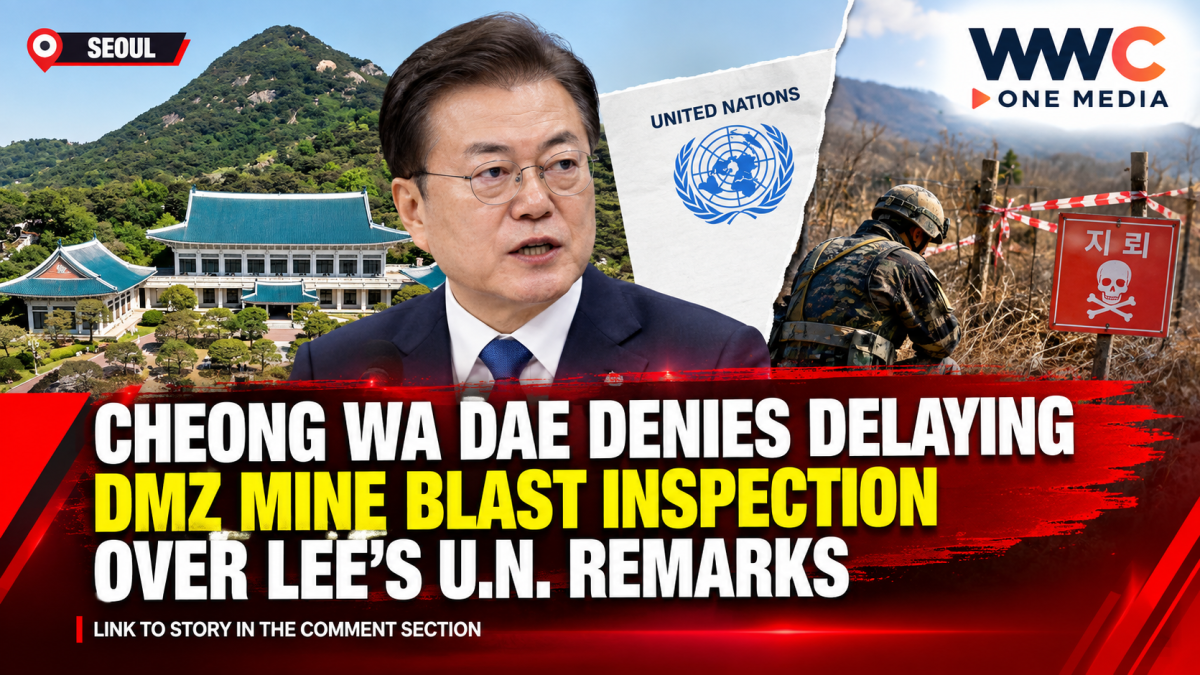
SEOUL — South Korea’s presidential office has rejected allegations that the timing of a military inspection of a recent DMZ mine-blast site was influenced by President Lee Jae Myung’s remarks on easing sanctions against North Korea.
Cheong Wa Dae said Tuesday that the inspection schedule was determined solely on military grounds, following consultations between the Joint Chiefs of Staff and the United Nations Command.
“The military’s on-site inspection regarding the mine accident has nothing to do with the president’s U.N. speech,” a presidential official said, according to Yonhap.
Opposition Questions Timing of Investigation
The dispute began after the blast injured three South Korean soldiers inside the Demilitarized Zone on Sept. 21.
The main opposition People Power Party accused the government of delaying the inspection because confirming that North Korean forces had planted the mines could complicate Lee’s diplomatic message advocating dialogue and sanctions relief.
Cheong Wa Dae has rejected that allegation, saying the timing reflected operational and military considerations rather than political concerns. Earlier, the presidential office also said the hazardous nature of the site required investigators to approach cautiously.
Military Says North Korean Mines Were Highly Likely
The controversy intensified after the South Korean military announced preliminary findings Monday.
Investigators said evidence recovered from the site — including the blast crater, flame patterns, injuries and material recovered from the explosion — strongly pointed toward North Korean antipersonnel mines.
The military concluded that North Korean mines were highly likely to have caused the blast, while emphasizing that a final investigation would still be conducted.
The United Nations Command, which participated in the investigation, has said it has no further comment while the case remains under investigation.
Why Lee’s U.N. Remarks Became Part of the Debate
The investigation has drawn political attention because it coincided with Lee’s diplomatic push for renewed engagement with North Korea.
Ahead of his attendance at the U.N. General Assembly, Lee told The New York Times that there could be value in trading sanctions relief for limits on further development of North Korea’s nuclear weapons and intercontinental ballistic missile capabilities.
The opposition subsequently questioned whether the timing of the DMZ investigation could affect that diplomatic position. Cheong Wa Dae has denied any connection between the two issues.
Final Findings Still Matter
The military has said the preliminary evidence points strongly toward North Korean mines, but the final investigation is expected to provide a fuller determination.
If the final findings confirm that the mines were planted by North Korean forces, the military has said it would consider appropriate measures and hold Pyongyang accountable.
For now, the political dispute centers on the timing and handling of the investigation, while the factual question of responsibility remains tied to the completion of the joint probe.
The next major development will therefore be the final investigation into what caused the blast and who placed the mines at the site.
WWC ONE MEDIA G,A