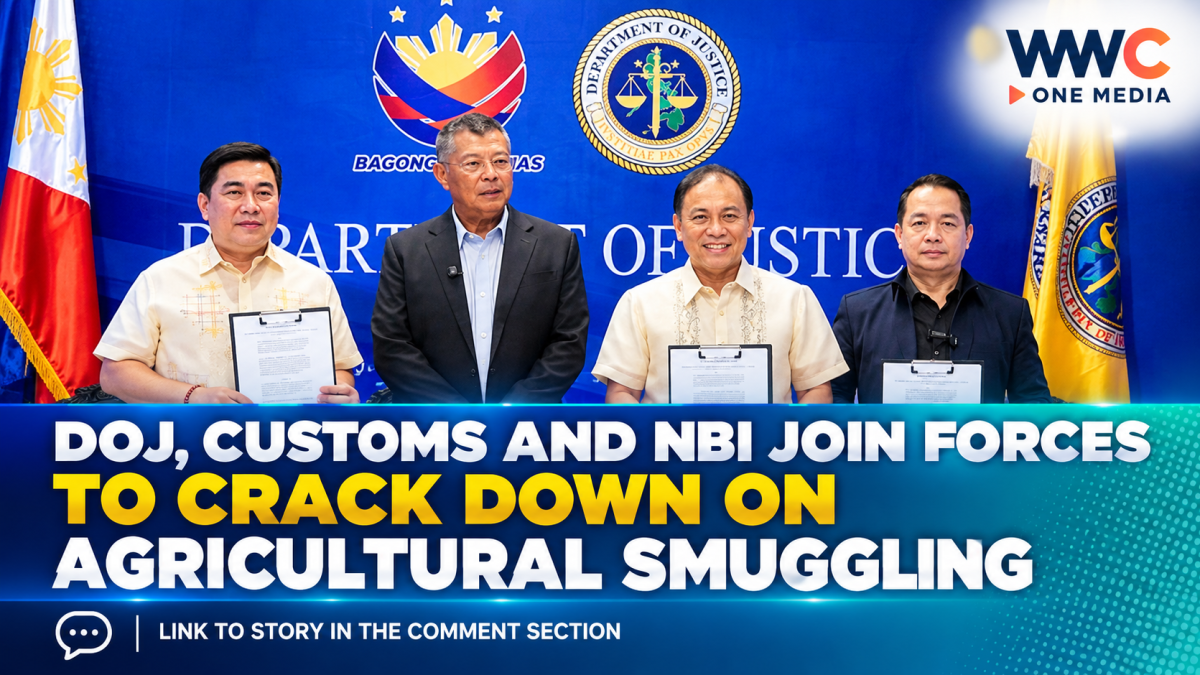
The Department of Justice, Bureau of Customs and National Bureau of Investigation have strengthened their cooperation against agricultural smuggling, hoarding, profiteering and cartelization under a new government agreement.
The three agencies signed a tripartite memorandum of agreement on September 28 to improve the investigation and prosecution of activities classified as agricultural economic sabotage under Republic Act No. 12022, or the Anti-Agricultural Economic Sabotage Act.
The agreement calls for closer information and intelligence sharing, criminal investigation support, evidence evaluation, case development, referrals, preliminary investigations and prosecution. A technical working group will also be created to establish coordination guidelines and information-sharing procedures.
Justice Secretary Fredderick Vida said the agencies would work toward faster exchanges of information so that findings by one agency could immediately support action by the others. The partnership is also intended to close enforcement gaps that could be exploited by individuals involved in agricultural smuggling and related activities.
The Bureau of Customs said it has already endorsed 15 complaints involving 20 respondents to the Justice Department for alleged violations of the Anti-Agricultural Economic Sabotage Act. Since 2025, it has also filed 30 agriculture-related cases under the Customs Modernization and Tariff Act involving 127 respondents.
The intensified campaign comes as authorities continue targeting illicit agricultural shipments and other schemes that can disrupt legitimate trade and the domestic food supply. Earlier in September, Customs filed six criminal complaints over shipments allegedly misdeclared as chicken products that were found to contain thousands of sacks of onions and boxes of carrots without the required import clearances.
Ombudsman Jesus Crispin Remulla, who witnessed the agreement signing, said government officials who are found to have enabled or protected agricultural economic sabotage could also face investigation.
The agencies said the coordinated approach is aimed at strengthening enforcement while protecting farmers and fisherfolk, legitimate businesses, food security and consumers.