Megawide Construction Corp. has evolved from a construction company into a broader engineering and infrastructure platform, expanding its activities into transport terminals, property development, social infrastructure and other projects aimed at supporting the Philippines’ long-term development.
The company’s transformation has been driven by an effort to move beyond traditional construction contracting and build more diversified and recurring sources of business. Its current portfolio spans general construction, precast and construction solutions, property development, transport infrastructure and social infrastructure.
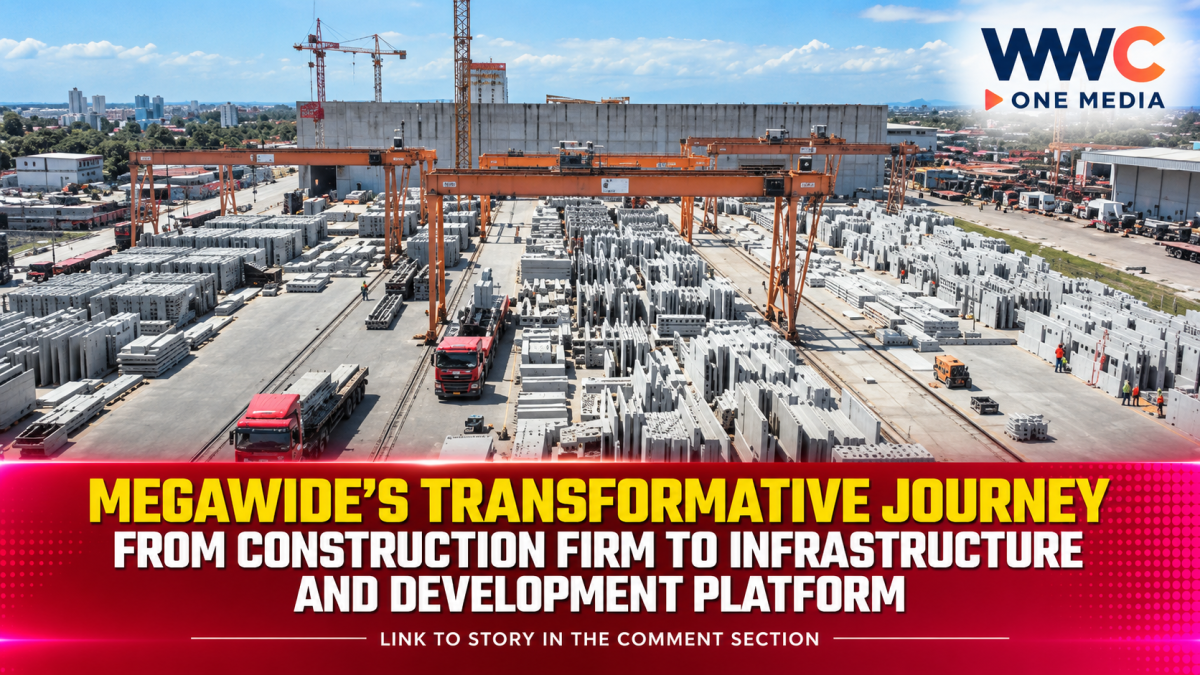
Megawide’s construction roots remain central to the business. Its integrated engineering, procurement and construction capabilities are supported by its precast and construction-solutions operations, allowing the company to participate in large infrastructure and building projects while supplying components through its own manufacturing platform.
As the company has expanded, however, it has increasingly moved toward projects where it can participate beyond the construction phase.
One of the clearest examples is transport infrastructure.
Megawide operates the Parañaque Integrated Terminal Exchange, or PITX, and is developing additional transport-centric projects intended to create organized public transportation hubs. These include the Baguio City Integrated Terminal and the South Luzon Integrated Terminal Exchange, while the company is also involved in the development of the Cavite Bus Rapid Transit System.
The strategy is designed to give Megawide a larger role in the infrastructure it helps build, rather than relying exclusively on construction contracts.
The company has also expanded into property development through PH1 World Developers, which it acquired in 2023. PH1 focuses primarily on residential developments aimed at the affordable and mid-income end-user market, particularly in areas outside Metro Manila. Its projects incorporate the company’s Add-Loft technology and sustainability features.
Another major component of Megawide’s transformation is social infrastructure.
The company has been involved in the redevelopment of Cebu’s historic Carbon Market through subsidiary Cebu2World Development Inc. The project is intended to transform the market into a commercial, heritage and cultural district while retaining its connection to Cebu’s local identity.
Housing has also become an increasingly important part of the company’s portfolio.
Megawide and Pag-IBIG Fund formalized a partnership to accelerate the government’s expanded Pambansang Pabahay Para sa Pilipino, or 4PH, program. Under the agreement, Pag-IBIG Fund committed ₱10 billion through an investment in perpetual preferred shares issued by Megawide Dreamrise Residences Inc., with the funds intended to support the delivery of at least 7,000 socialized housing units over two to three years.
Megawide has broader ambitions for its housing platform, with company disclosures outlining plans to potentially deliver up to 100,000 socialized housing units over five to seven years through its subsidiaries and partnerships.
The shift toward infrastructure and development has also been accompanied by efforts to strengthen the company’s financial position.
Megawide’s investor-relations materials identify a three-part strategy of “Deliver, Delever and Decarbonize.” The strategy focuses on growing and stabilizing income streams, reducing financial leverage and improving profitability while supporting longer-term emissions-reduction objectives.
The company reported ₱8.7 billion in revenue and ₱532 million in net income for the first half of 2026, with a reported gross margin of 25% and net margin of 6%. Its investor materials also highlight efforts to reduce short-term debt and strengthen liquidity.
Megawide’s construction pipeline remains substantial as the company pursues this broader strategy.
As of the end of March 2026, the company reported a construction order book of ₱48.7 billion. It was also constructing thousands of socialized housing units under the expanded 4PH program while advancing transport and public-market redevelopment projects.
The Baguio City Integrated Terminal represents another step in this transition. Megawide received a notice of award from the Baguio City government in October 2025 after successfully completing the Swiss Challenge process for the project.
The company is therefore building a portfolio that combines construction revenues with longer-term infrastructure and development opportunities.
That diversification also reflects the changing requirements of the Philippine infrastructure market. Government spending on transportation, housing, public facilities and urban development is creating opportunities for companies capable of handling not only construction but also project development, financing, operations and long-term asset management.
For Megawide, the transformation means its identity is increasingly tied to the infrastructure ecosystem surrounding its construction business.
Its transport terminals connect different modes of public transportation, its property arm addresses residential demand, its social infrastructure projects focus on housing and public-market redevelopment, and its construction operations provide the engineering foundation supporting the wider portfolio.
The company is also placing greater emphasis on sustainability. Its stated decarbonization strategy includes a long-term target of reducing carbon emissions and incorporating sustainability features into its developments.
This broader platform could give Megawide more ways to participate in the Philippines’ infrastructure and urban-development expansion. At the same time, managing multiple business lines brings its own demands, particularly in capital allocation, project execution, debt management and the ability to convert large development pipelines into sustainable earnings.
Megawide’s journey therefore reflects a wider evolution in Philippine infrastructure businesses: construction companies are increasingly seeking opportunities to become developers, operators and long-term infrastructure partners.
From airports and transport terminals to housing, public markets and large-scale construction projects, Megawide is positioning itself across several parts of that ecosystem.
The next stage of the company’s transformation will depend on how effectively it converts its growing project pipeline and diversified businesses into durable revenues while maintaining financial discipline and delivering the infrastructure projects already under development.