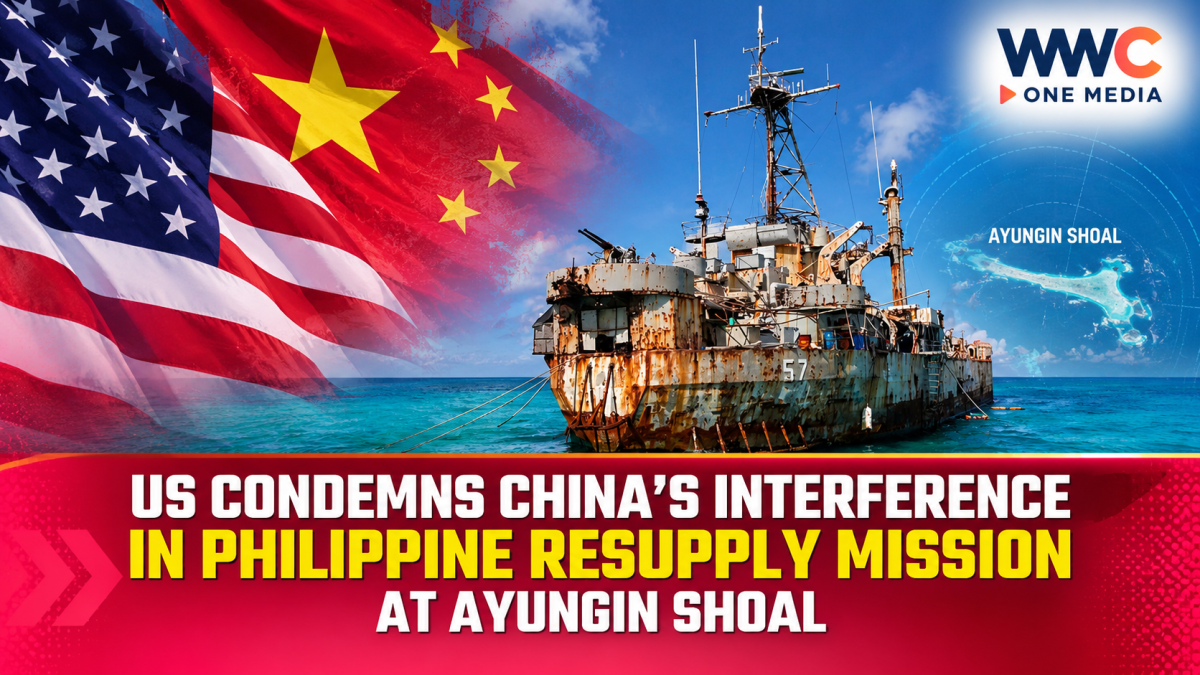
The United States has condemned what it described as dangerous Chinese maneuvers that disrupted a Philippine humanitarian rotation and resupply mission to Ayungin Shoal in the West Philippine Sea, after the Philippine military said eight Chinese warships and coast guard vessels interfered with the operation.
US Ambassador to the Philippines Lee Lipton said the United States stood with its Philippine ally and criticized the actions of the China Coast Guard and the People’s Liberation Army Navy during the mission. Washington called on Chinese forces to stop tactics that could endanger vessels and restrict freedom of navigation.
The incident occurred on Thursday night as a Philippine supply ship, the M/V Lapu-Lapu, accompanied by three Philippine Navy and Coast Guard support vessels, attempted to carry out a routine humanitarian rotation and resupply operation for personnel aboard the BRP Sierra Madre at Ayungin Shoal.
According to the Armed Forces of the Philippines, the Chinese vessels repeatedly monitored and contacted the Philippine ships by radio while moving close to the formation. The encounter lasted from about 8:35 p.m. until 11 p.m., with the Philippine vessels operating roughly 60 nautical miles from Ayungin Shoal.
The Philippine Coast Guard eventually called off the mission at about 11:08 p.m., citing the safety of personnel. The PCG’s BRP Malabrigo had also been deployed to provide security assistance during the operation.
The aborted mission is significant because the BRP Sierra Madre serves as the Philippine military outpost at Second Thomas Shoal, where Filipino personnel require regular deliveries of food, water, equipment and other supplies.
The latest confrontation also adds to a series of encounters between Philippine and Chinese vessels in the South China Sea. Manila has repeatedly described its resupply missions as routine and lawful activities, while Beijing maintains its own claims over much of the disputed waters.
The United States has increasingly emphasized its treaty relationship with the Philippines as maritime confrontations have continued. Washington has repeatedly stated that its alliance commitments cover armed attacks against Philippine armed forces, public vessels and aircraft, including Philippine Coast Guard vessels, in the South China Sea.
The 2016 South China Sea arbitral ruling remains another central point of disagreement. An international tribunal rejected the legal basis of China’s expansive nine-dash-line claim and clarified maritime entitlements under the United Nations Convention on the Law of the Sea. China has rejected the ruling, while the Philippines continues to regard the decision as final and binding.
The latest incident also comes as Philippine defense officials maintain that Chinese interference will not stop future resupply missions to Ayungin Shoal. The Department of National Defense said the Philippines would continue conducting its humanitarian rotation and resupply operations despite the recent disruption.
The confrontation therefore extends beyond a single interrupted mission. Regular access to the BRP Sierra Madre has become an important test of how the Philippines can maintain its presence at the shoal while avoiding an escalation with Chinese maritime forces.
For Washington, the incident provides another occasion to publicly reaffirm support for Manila and freedom of navigation in the region. For Beijing, however, activities around Ayungin remain connected to its broader claims in the South China Sea, which overlap with the Philippines’ maritime entitlements.
The presence of multiple Chinese vessels during the latest encounter also highlights the increasingly complex environment surrounding Philippine maritime operations. The AFP said the Chinese forces included both warships and coast guard vessels, while Philippine forces were conducting what Manila described as a routine support mission.
The immediate concern is the safety of personnel and vessels during future missions. Close encounters between military and coast guard ships can create the risk of collision or miscalculation, particularly when vessels maneuver in confined areas while attempting to influence one another’s movements.
The incident is also likely to keep the South China Sea high on the agenda of Philippine and US security discussions as both countries continue strengthening maritime cooperation.
For the Philippines, the challenge remains maintaining regular support for its personnel at the BRP Sierra Madre while managing encounters with Chinese forces. For the United States, the latest condemnation reinforces its stated alliance commitments and its position on freedom of navigation.
The bigger issue now is whether future Philippine resupply missions to Ayungin Shoal can proceed without another confrontation — or whether repeated encounters will create additional pressure on Manila, Beijing and Washington to manage the risks at sea.