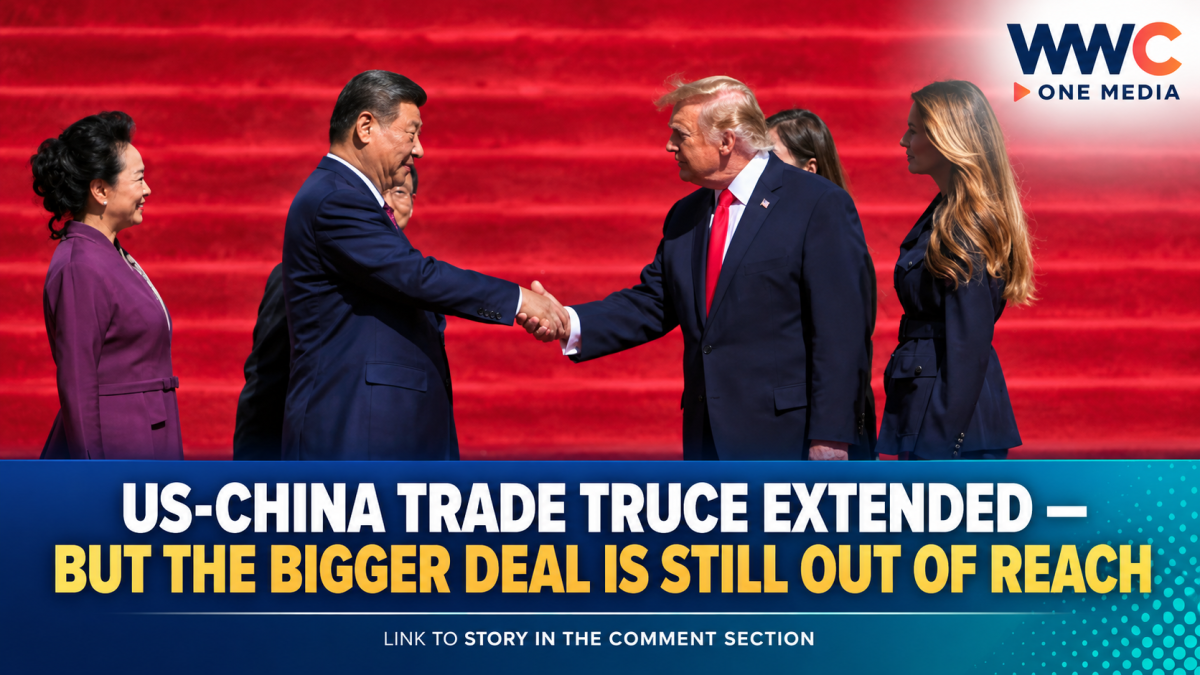
WASHINGTON/BEIJING — The United States and China have extended their fragile trade truce for another two months, giving President Donald Trump and Chinese President Xi Jinping more time to work toward a broader economic agreement while keeping tariffs and other trade disputes from escalating immediately.
The extension pushes the arrangement’s deadline from November 10, 2026, to January 10, 2027, according to U.S. Treasury Secretary Scott Bessent and subsequent Chinese government statements. The move came as Xi made a state visit to Washington from September 23 to 25 and held talks with Trump at the White House.
Rather than ending the trade conflict, the extension effectively creates another negotiating window for the world’s two largest economies.
$30 BILLION IN RECIPROCAL TARIFF REDUCTIONS
One of the most significant developments from the talks is an agreement covering approximately $30 billion worth of goods on each side.
China’s Ministry of Commerce said the two countries agreed to negotiate reciprocal tariff reductions covering about $30 billion in imports from each country. Around 90% of the products covered under the arrangement are expected to have tariffs reduced to most-favored-nation levels, subject to each country’s domestic procedures.
The White House also said the countries reached consensus on more favorable tariff treatment for $30 billion of non-sensitive goods in each direction.
The U.S. list includes Chinese consumer products such as small appliances, toys, holiday decorations and children’s car seats, while the Chinese side identified U.S. agricultural products, fish and seafood, wood products, cosmetics and medical devices among the goods covered by its arrangements.
TRADE TRUCE IS NOT A FINAL DEAL
The extension does not represent a permanent settlement of the broader U.S.-China trade dispute.
Reuters reported that the two-month extension gives both governments additional time to assess implementation of their existing arrangements and determine how to move negotiations forward. The remaining disputes include tariffs, agricultural purchases, rare-earth supplies and technology restrictions.
That means businesses and investors still face uncertainty beyond January unless Washington and Beijing reach another agreement.
NEW US-CHINA TRADE COUNCIL
The two countries also agreed to establish a U.S.-China Board of Trade, designed to provide a formal mechanism for continuing negotiations and addressing trade issues.
China’s Commerce Ministry said the body will initially work on the reciprocal tariff-reduction framework and will include an agricultural working group.
The White House separately said the two sides also operationalized a Board of Investment, intended to provide a channel for discussing investment opportunities and barriers affecting businesses in both countries.
AI TALKS ADDED TO THE AGENDA
Trade was not the only issue addressed during the Trump-Xi meeting.
The two governments agreed to establish a China-U.S. AI Dialogue to discuss the risks and benefits associated with artificial intelligence. The next exchange is scheduled for November 2026, while the countries also agreed to establish a bilateral communication channel for AI-related incidents.
The development comes as Washington and Beijing increasingly compete over advanced technology while also exploring ways to prevent AI-related disputes from escalating.
COOPERATION ON CRITICAL MINERALS CONTINUES
Rare earths and other critical minerals remain another major point of tension.
The White House said the two governments would continue working on supply-chain concerns involving rare earths and critical minerals, with the goal of restoring appropriate shipment levels.
These materials are important to industries ranging from electronics and electric vehicles to advanced manufacturing and defense.
MORE THAN TRADE
The September summit produced several other understandings.
According to China’s Foreign Ministry, Trump and Xi agreed to support each other’s hosting of the 2026 APEC Economic Leaders’ Meeting and the G20 Summit. They also agreed to continue cooperation between their law-enforcement agencies on narcotics and precursor chemicals.
The two militaries also agreed to work toward a memorandum of understanding covering crisis communication and prevention, while continuing cooperation to search for the remains of missing U.S. servicemembers in China.
THE NEXT DEADLINE IS NOW JANUARY 10
For now, the agreement gives Washington and Beijing additional time to negotiate without immediately returning to another escalation in tariffs.
But the January 10, 2027 deadline means the central trade disputes have not disappeared. Reuters reported that the two-month extension leaves questions over tariffs, Chinese purchases, rare-earth supplies and technology restrictions for further negotiations.
The latest agreement therefore represents another pause in the trade conflict rather than a final resolution.
What happens next will depend on whether the two governments can turn the new tariff arrangements, trade mechanisms and continuing negotiations into a broader and more durable agreement before the new deadline arrives.