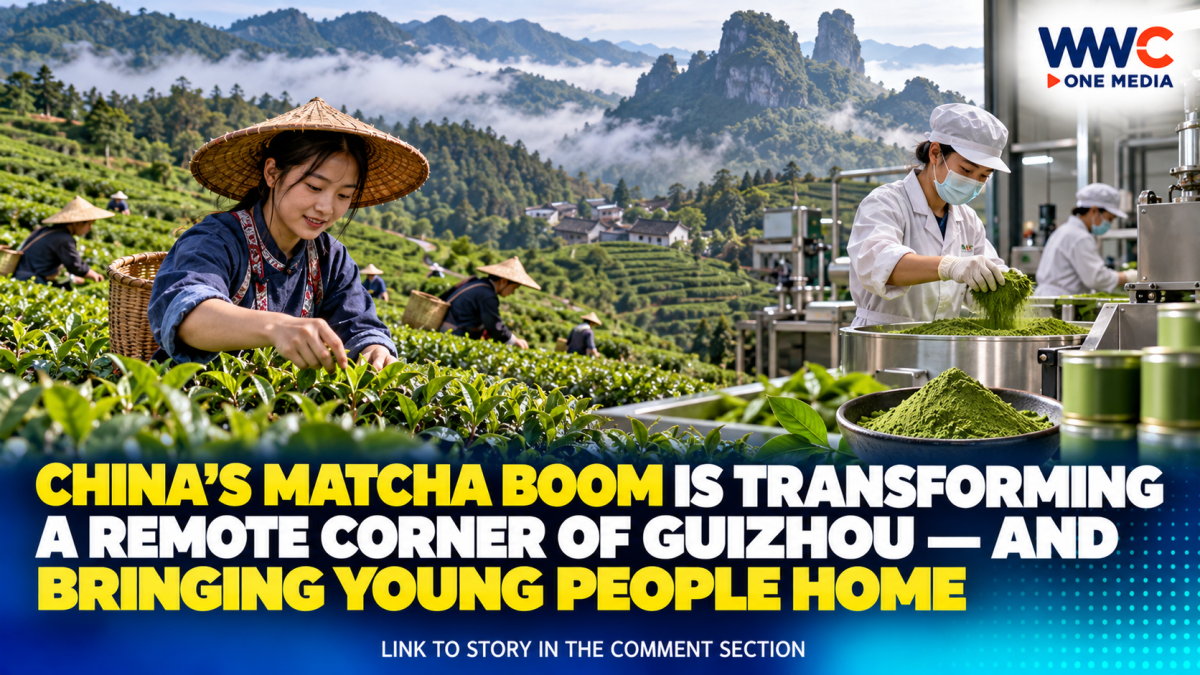
For years, young people from the mountainous areas of southwestern China often left their hometowns in search of better opportunities.
Now, an unexpected green industry is helping change that equation.
Matcha is turning Tongren in Guizhou province into one of China’s major matcha-producing hubs, creating jobs, attracting tourists and giving some local residents new reasons to build their futures closer to home.
Tongren, surrounded by the mountains of Guizhou and close to Mount Fanjing, has increasingly branded itself as China’s “matcha capital.” The region’s combination of high elevation, abundant rainfall, cloud cover and relatively limited sunlight provides conditions well suited to tea cultivation.
From Mountain Tea Fields to Global Matcha
China has rapidly expanded its matcha production as worldwide demand has surged.
The Straits Times reported that China became the world’s largest matcha producer by volume in 2025, surpassing Japan. Chinese producers have increasingly focused on large-scale cultivation and processing, while Japanese matcha continues to occupy a strong premium position in the international market.
Tongren has become a major part of that expansion.
According to recent reporting, the city’s matcha production increased more than sixfold over four years. In 2025, Tongren matcha was exported to 54 countries and regions, while local officials expect production to exceed 5,000 tonnes in 2026.
The industry’s growth has also been supported by investment in processing technology, cultivation techniques and international expertise.
Why Young People Are Coming Back
The matcha boom isn’t only about exports.
It is also changing the economic landscape for communities that have historically faced limited employment opportunities.
CNA reported that more than 100,000 farmers in Guizhou now make a living from the matcha industry. The expansion has created work across cultivation, processing, tourism, food production and related businesses.
That broader ecosystem matters for younger residents.
Instead of leaving the region permanently, some young people can find work connected to tea production, hospitality, food and beverage businesses and matcha tourism closer to their hometowns. The Straits Times reported that matcha-related tourism is helping bring young people back to Tongren.
Matcha Is Becoming a Tourism Attraction
The green tea powder is also becoming part of the region’s tourism identity.
Matcha-themed shops, desserts, drinks and cultural experiences have emerged alongside the tea plantations. Visitors can encounter matcha not only as a beverage but as an ingredient in foods and as part of tourism experiences built around the region’s tea culture.
That creates another layer of economic activity beyond farming.
Guizhou has also introduced new industry standards covering matcha and tencha production. The standards are intended to support quality control and the development of the region’s tea industry.
Japan Still Holds a Distinct Position
China’s growing production does not mean Japanese matcha has simply been displaced.
Japan remains strongly associated with matcha’s modern cultural identity and premium market. Japanese producers also face challenges including an aging workforce and supply constraints as global demand rises.
China’s advantage is increasingly tied to scale, processing capacity and expanding international supply.
The result is a rapidly evolving global matcha market in which Guizhou is becoming increasingly visible.
A Green Powder With a Bigger Story
What began as an effort to develop a high-value agricultural industry in a mountainous region has grown into something much larger.
For Tongren, matcha now connects farmers, factories, exporters, restaurants, tourism businesses and younger workers to a global consumer trend.
And as matcha continues appearing in lattes, desserts and other products around the world, one of China’s lesser-known tea regions is finding itself at the center of a booming international industry.
The next question is no longer whether Guizhou can produce matcha at scale — but how far its green tea ambitions can reach.
WWC ONE MEDIA G,A