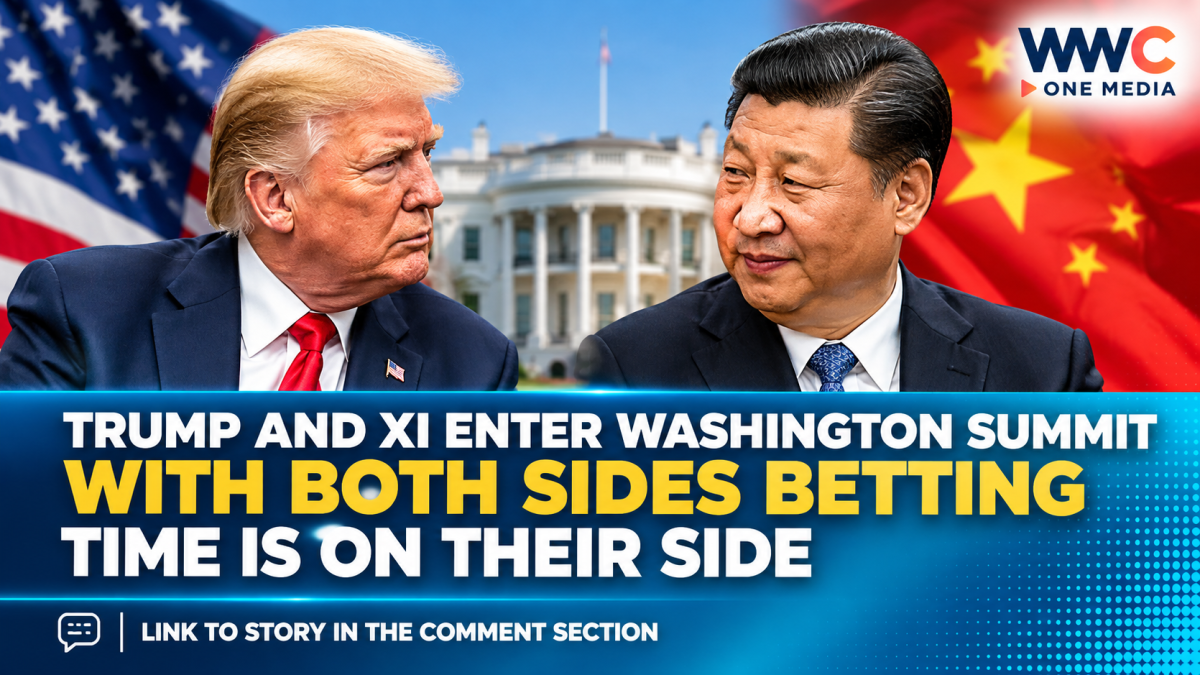
US President Donald Trump and Chinese President Xi Jinping entered their Washington summit facing a long list of disputes, but both sides also had reasons to avoid a major breakdown in relations between the world’s two largest economies.
The Sept. 24 White House meeting came as Washington and Beijing continued negotiating over trade, artificial intelligence, advanced technology, Taiwan, critical minerals and the war in Iran. The two countries had also agreed to extend their existing trade truce by two months, giving negotiators more time to work toward a longer-term arrangement.
The short extension, however, leaves many of the underlying economic disputes unresolved. Issues including tariffs, Chinese rare-earth supplies, US technology restrictions and Chinese purchases of American goods remain part of the broader negotiations.
Before the meeting, officials and analysts described both leaders as believing that time could strengthen their respective positions.
For Trump, the calculation was linked to expectations that the US economy could continue expanding while American advances in artificial intelligence and technology, along with efforts to develop alternative sources of critical minerals and rare earths, could reduce US dependence on China.
Xi, meanwhile, has been operating from a different assessment of the balance between the two countries. Analysts cited by the Associated Press said the Chinese leadership views the United States as facing longer-term economic and strategic challenges while China continues to strengthen its position in high-tech exports and other industries.
The summit nevertheless produced a highly public display of diplomacy. Trump personally welcomed Xi and his wife, Peng Liyuan, during their arrival in Washington, while the White House prepared an elaborate state visit for the Chinese leader.
The symbolism was significant because US-China relations have gone through periods of intense confrontation, including a major tariff dispute. Both governments now appear interested in maintaining communication even as strategic competition continues.
Trade was one area where the two sides showed limited movement. Treasury Secretary Scott Bessent said the existing truce could be extended for another two months, potentially allowing the countries to negotiate a broader agreement by January or consider another extension.
That arrangement provides temporary stability but does not settle the fundamental disagreements that triggered the trade confrontation in the first place.
Artificial intelligence is another increasingly important battleground. The US and China are competing over advanced AI development, computing power and semiconductor technology, while Washington has imposed restrictions on some advanced technologies exported to China.
Bessent had indicated that the two governments could discuss a possible notification mechanism for AI-related incidents that could have national-security implications. The issue reflects how technological competition is becoming increasingly intertwined with national security.
Taiwan remains another major point of disagreement. Beijing has continued pressing Washington to stop arms sales to Taiwan, while US policy has historically included providing Taiwan with defensive equipment.
Trump had previously described a planned US$14 billion arms package for Taiwan as a negotiating tool and postponed final approval following his earlier meeting with Xi. Beijing continues to regard Taiwan as a core issue in its relationship with Washington.
The war in Iran has added another layer to the summit. Washington has urged Beijing to use its economic relationship with Tehran to help pressure Iran, while China has opposed US and Israeli military action and has been reluctant to become directly involved in Washington’s strategy.
Xi also raised the broader need to prevent competition between the United States and China from developing into direct confrontation. During the White House meeting, he called for communication and cooperation to avoid what he described as the “Thucydides Trap,” referring to the risk of conflict between an established power and a rising one.
Despite the high-profile setting, the summit did not immediately resolve the major disagreements between Washington and Beijing. Reuters reported that there were no clear breakthroughs on several of the most difficult issues, including AI, trade, Taiwan and Iran.
Instead, the meeting highlighted an emerging pattern in US-China relations: both governments appear willing to keep negotiating while protecting their positions on issues they consider strategically important.
The bigger question now is whether the temporary trade truce and renewed leader-level dialogue can create enough stability for Washington and Beijing to tackle their deeper disputes — or simply provide more time before the next confrontation.