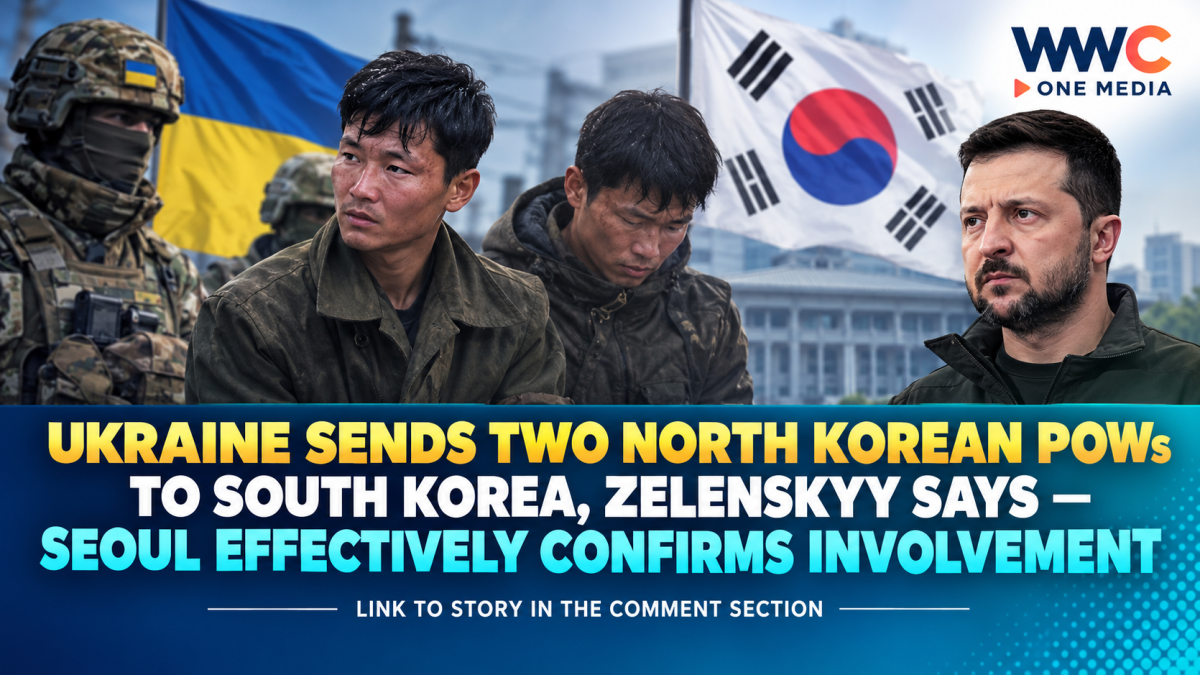
SEOUL — Two North Korean soldiers captured while fighting alongside Russian forces have reportedly been transferred from Ukraine to South Korea, marking a significant development in the unusual case of North Korean prisoners captured during the Russia-Ukraine war.
Ukrainian President Volodymyr Zelenskyy announced the transfer during his address to the United Nations General Assembly on September 23, saying Ukraine had recently sent the two North Korean prisoners of war to the Republic of Korea.
South Korea’s Foreign Ministry stopped short of explicitly confirming the transfer, but its response indicated that Seoul had been actively involved in discussions with Ukraine and other relevant countries and organizations.
A ministry official said the government has consistently maintained that the issue should be resolved according to the prisoners’ free will, international law and humanitarian principles. Seoul declined to disclose whether custody had formally been transferred, as well as the timing, route or details of the consultations.
Two Soldiers Were Captured in Russia’s Kursk Region
The two North Korean soldiers were captured by Ukrainian forces in Russia’s Kursk region in January 2025, after North Korea deployed troops to support Russia’s war against Ukraine.
They subsequently expressed a desire to go to South Korea, including through media interviews and handwritten letters conveyed through North Korean defector organizations.
Their case became particularly sensitive because of questions over what would happen to them if they were returned to North Korea.
South Korea has maintained that North Korean POWs who request entry should be accepted and provided protection and support under relevant laws. Seoul’s position is rooted partly in its constitutional framework, which treats the Korean Peninsula as the territory of the Republic of Korea.
Seoul Had Already Been Working With Kyiv
The reported transfer did not come out of nowhere.
South Korean and Ukrainian officials had been discussing the fate of the two soldiers for months.
In June, South Korean Foreign Minister Cho Hyun and Ukrainian Foreign Minister Andrii Sybiha agreed that the POW issue should be addressed in accordance with international law and humanitarian principles. Seoul said at the time that the soldiers’ wish to come to South Korea remained unchanged.
South Korea had also stated that it was prepared to accept North Korean POWs captured while fighting for Russia if they wished to relocate to South Korea, while opposing their return to Russia or North Korea against their wishes.
The issue was also discussed by South Korean President Lee Jae-myung and Zelenskyy during their July summit, according to Yonhap. The two leaders agreed that the matter should be handled with respect for the individuals’ free will and international and humanitarian principles.
Why Seoul Is Keeping Details Secret
The South Korean government has deliberately avoided confirming operational details surrounding the reported transfer.
The Foreign Ministry cited the personal safety of the soldiers and their families when declining to discuss whether custody had changed hands, when the transfer occurred or what route was used.
That means Zelenskyy’s announcement provides the public account that the soldiers were sent to South Korea, while Seoul’s official response confirms that relevant communications and consultations took place without publicly detailing the transfer itself.
Yonhap described the government’s response as effectively acknowledging Zelenskyy’s disclosure while maintaining confidentiality around the individuals.
North Korea’s Role in Russia’s War
The two POWs are part of a much larger North Korean military involvement in Russia’s war against Ukraine.
South Korean and Ukrainian assessments have put the number of North Korean troops deployed to support Russia since 2024 at roughly 14,000 to 15,000. Most have been associated with fighting in and around Russia’s Kursk region.
North Korea has also provided Russia with military equipment and ammunition, according to Ukrainian and independent assessments.
The deployment has deepened military cooperation between Moscow and Pyongyang and has made the capture of North Korean personnel an important diplomatic and humanitarian issue.
A Rare Path From the Battlefield to South Korea
The reported transfer is especially notable because the two men were among the first North Korean soldiers captured alive by Ukrainian forces after North Korea became directly involved in Russia’s war.
Their stated preference to go to South Korea created a complicated diplomatic question involving Ukraine, Russia, North Korea and Seoul.
Earlier in the war, Zelenskyy had said Ukraine could potentially return the soldiers to North Korea in exchange for Ukrainians held by Russia. Human-rights advocates instead called for them to be allowed to seek safety in South Korea.
The latest development indicates that the case has now moved toward the outcome the soldiers reportedly requested.
What Happens Next?
For now, many details remain undisclosed.
South Korea has not publicly provided the exact date, route or mechanism of the transfer, and officials have emphasized that the matter involves sensitive personal-security considerations.
What is publicly established is that Zelenskyy announced the transfer, Seoul acknowledged having conducted necessary consultations with Ukraine and other parties, and the two soldiers had previously expressed a desire to come to South Korea.
The case could become an important precedent for how South Korea, Ukraine and other governments handle North Korean personnel captured while serving alongside Russian forces.
For the two soldiers at the center of the story, however, the immediate significance is more personal: after being captured thousands of kilometers from the Korean Peninsula, they have reportedly been transferred to the country they had asked to reach.
WWC ONE MEDIA G,A