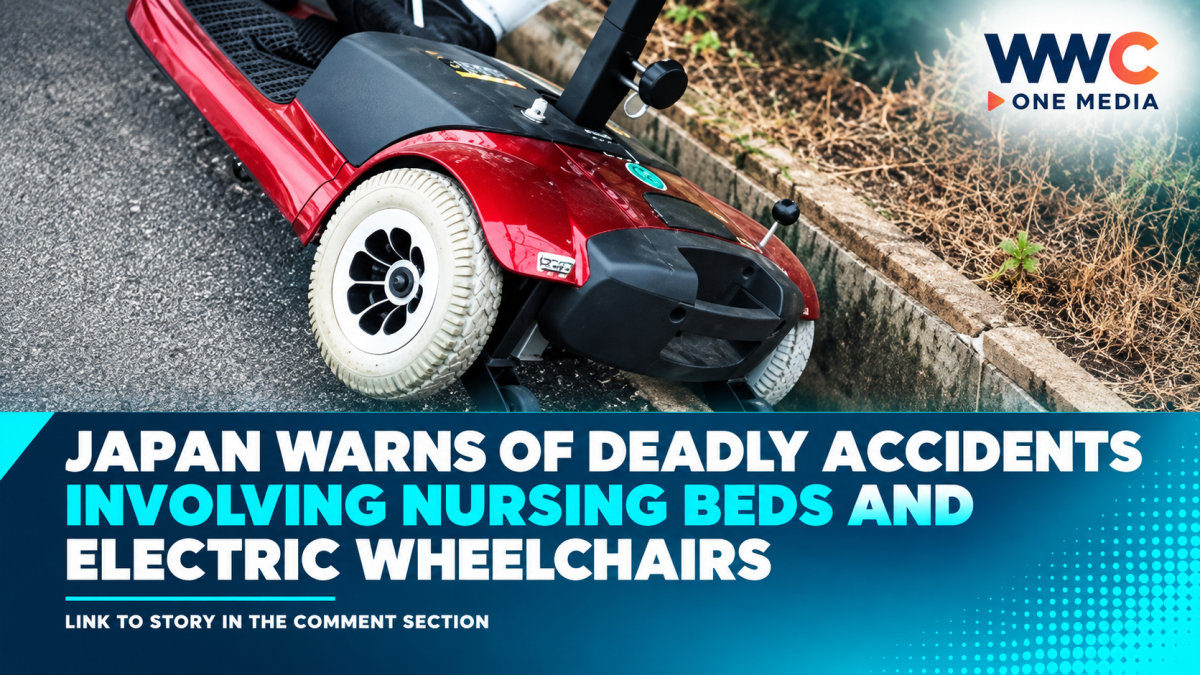
Japan is warning older people, families and caregivers about potentially fatal accidents involving nursing beds and electric wheelchairs, with authorities urging users to review safety procedures and equipment ahead of Respect for the Aged Day.
The National Institute of Technology and Evaluation, or NITE, said 43 accidents involving nursing beds and 59 involving electric wheelchairs were reported over the 10 years from 2016 through 2025. Many resulted in deaths, highlighting risks that can arise even when the products themselves are not defective.
Of the 43 nursing-bed incidents, 23 involved elderly users becoming trapped in gaps around bed rails or other parts of the equipment. NITE recorded 23 fatalities. In one case in Shizuoka Prefecture in June 2022, a woman in her 80s died after her neck became trapped between a bed rail and mattress.
Safety standards for nursing beds were revised in 2009 to reduce dangerous gaps around handrails. NITE is urging families and caregivers to check whether beds meet appropriate safety standards and to use protective covers or spacers where necessary to reduce the possibility of someone becoming trapped.
Electric wheelchairs present a different set of dangers. NITE recorded 59 accidents during the same period, including 26 cases in which users fell into roadside drainage channels, waterways or similar hazards. There were 34 deaths, including an incident in Ehime Prefecture in April 2024 in which a man in his 80s fell into a waterway.
NITE said roughly half of the nursing-bed accidents and about 80% of the electric-wheelchair accidents were not caused by product defects. That means proper preparation, inspections, supervision and awareness of the surrounding environment could help prevent some incidents.
For electric wheelchair users, the agency recommends checking the planned route with family members or caregivers, particularly where there may be ditches, steep slopes, railway crossings or other hazards. Users should also inspect battery conditions and confirm that safety devices, including anti-tip mechanisms where fitted, are working properly.
The warning comes as Japan continues to face a rapidly aging population. Government figures released for Respect for the Aged Day showed that about 36.24 million people in Japan were aged 65 or older, representing 29.6% of the population.
The latest warning therefore goes beyond the elderly themselves. NITE is calling on families, caregivers and other people assisting older adults to regularly check equipment, identify environmental hazards and make sure safety measures are in place before accidents happen.
As Japan’s elderly population continues to grow, preventing everyday accidents involving mobility and caregiving equipment is becoming an increasingly important part of keeping older people safe and independent.