Bhutan is turning increasingly toward solar power to strengthen its electricity supply as rising demand, seasonal drops in hydropower generation and climate-related risks put pressure on a system long dominated by mountain rivers.
The Himalayan kingdom has built its economy and electricity exports around hydropower, but river flows fall sharply during the winter months. Bhutan’s hydropower capacity of around 3,700 megawatts can drop by about 80% during the dry season, according to the country’s power-generation utility. At the same time, winter electricity demand has climbed to roughly 1,500 MW, compared with about 400 MW several years ago.
That seasonal mismatch has forced Bhutan to import electricity from neighboring India during periods when its rivers produce less power. The problem is becoming more important as the country faces growing demand from households, businesses and new development projects.
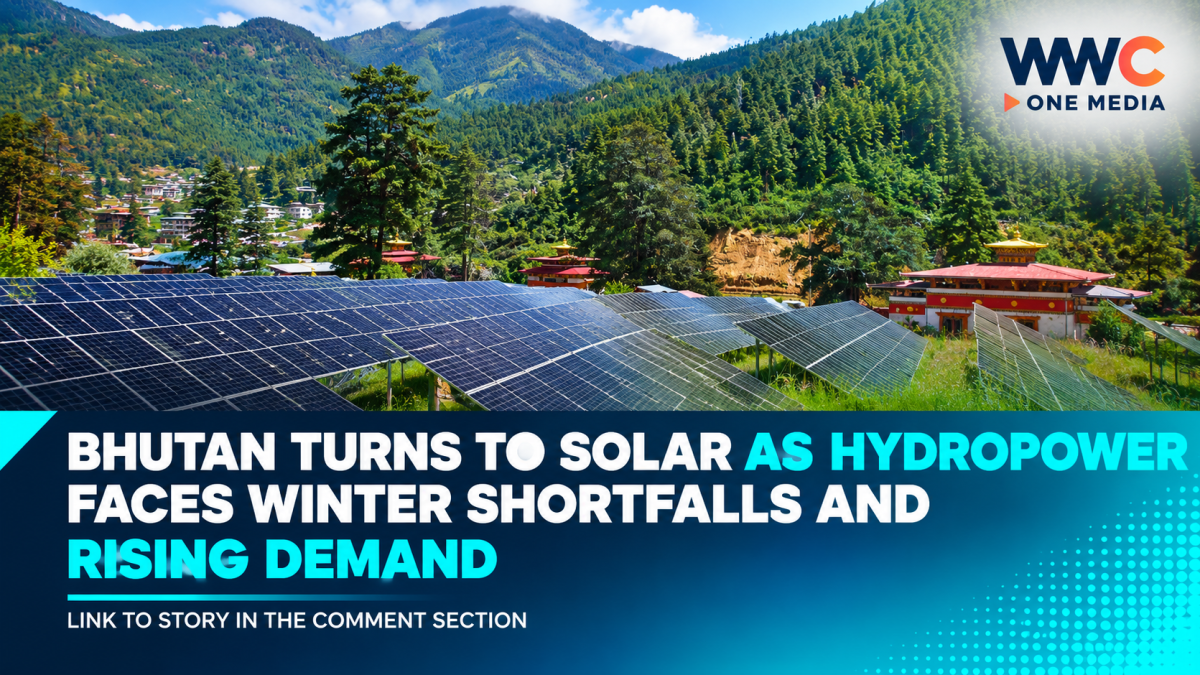
Solar is emerging as a way to supplement hydropower when water resources are at their weakest. In Thimphu, the Dechencholing solar farm, built on a former military shooting range, has an installed capacity of 4.45 MW. Another project at Sephu has more than 22 MW, marking a significant step for a country where solar generation remains small compared with hydropower.
Bhutan’s long-term ambitions are considerably larger. Druk Green Power Corp. says it plans to develop around 5,000 MW of solar capacity, while the country’s broader energy strategy calls for substantially increasing renewable generation to meet future demand and reduce seasonal shortages.
The shift is not an abandonment of hydropower. Instead, solar is being considered as a complement to Bhutan’s existing system, producing electricity during daylight hours while hydropower can provide flexibility when solar generation falls.
Climate change is adding another reason for diversification. Bhutan’s hydropower system depends heavily on rivers fed by snow and glaciers, while changing temperatures and weather patterns are creating uncertainty around future water availability. The country is also vulnerable to climate-related hazards affecting its mountainous infrastructure.
Finding suitable land, however, is a challenge. Bhutan’s mountainous terrain limits the availability of large areas for conventional solar farms, encouraging developers to consider rooftops and other available sites. High installation costs and relatively cheap electricity have also limited the financial incentives for some consumers to install solar systems.
Bhutan is simultaneously expanding its hydropower capacity. In May, the World Bank and Bhutan signed financing agreements totaling $515 million for the 1,125 MW Dorjilung Hydroelectric Power Project. The project is designed in part to help close the country’s seasonal energy gap and provide additional electricity for export to India.
Energy cooperation with India remains central to Bhutan’s plans. The two countries have developed several major hydropower projects together, and in September they welcomed a 4,000-crore Indian rupee concessional line of credit for energy projects in Bhutan, alongside continued cooperation on hydropower and renewable energy.
Hydropower exports remain economically important, accounting for as much as 15% of Bhutan’s gross domestic product, according to World Bank figures cited in the report. That makes improving the reliability of electricity generation important not only for households but also for government revenues and the broader economy.
Bhutan’s emerging energy strategy therefore combines two approaches: continue expanding its hydropower advantage while adding solar capacity to reduce seasonal vulnerability. As electricity demand rises and climate pressures grow, the country’s next challenge will be turning that diversification into a reliable system capable of meeting domestic needs while maintaining its role as a clean-energy exporter.