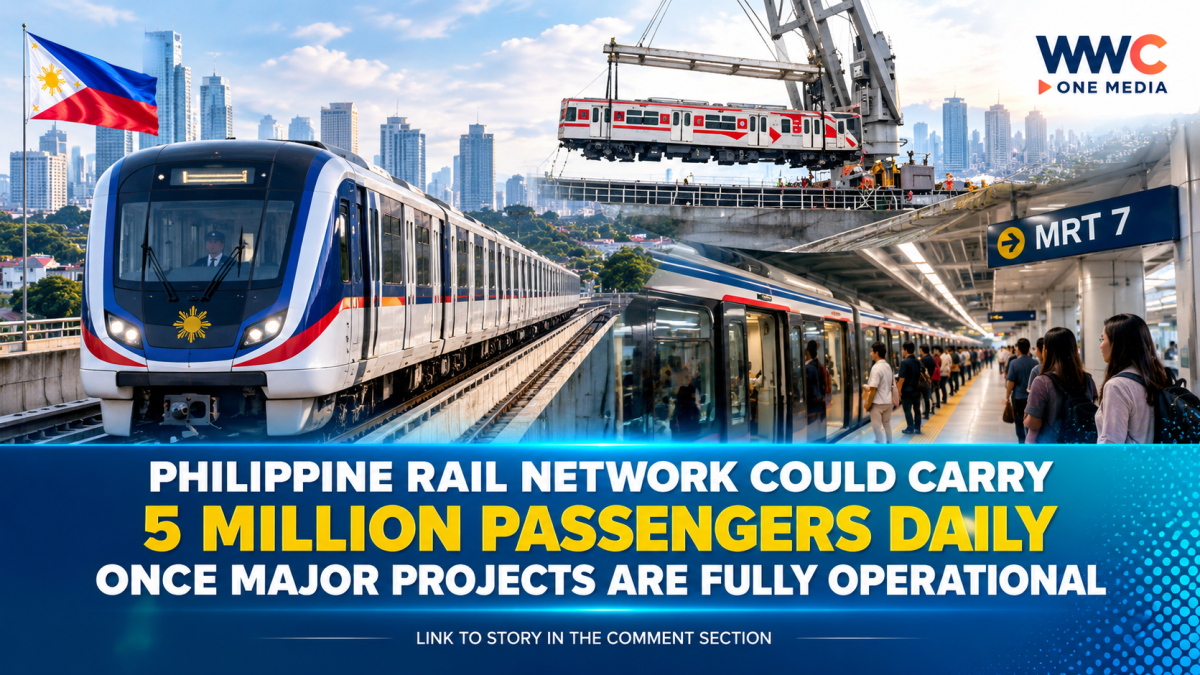
MANILA — The Philippines is targeting a major expansion of its rail network that could eventually allow trains across the country to serve up to 5 million passenger trips every day, according to the Department of Transportation (DOTr).
The figure is a future projection, not current ridership. Transportation officials say the capacity could be reached once major railway projects now under construction or development are completed and operating as an integrated network.
The expansion is expected to strengthen connections across Metro Manila and nearby provinces while providing commuters with more alternatives to road-based transportation.
5 Million Daily Passenger Trips Is the Long-Term Target
Transportation Undersecretary TJ Batan said the completed rail network could eventually handle around 5 million passengers daily.
Transportation Secretary Giovanni Lopez described the goal as providing Filipinos with more predictable and affordable transportation while reducing the amount of time people spend commuting.
The projection depends on the completion and operation of several major railway projects, meaning the full 5-million figure will not be reached immediately.
North-South Commuter Railway Is a Major Piece of the Expansion
One of the most important projects is the 147-kilometer North-South Commuter Railway (NSCR), designed to connect Clark in Pampanga with Calamba in Laguna.
The government has said the first NSCR trains between Valenzuela and Malolos are targeted to begin operations in December 2027.
The railway is expected to eventually provide a north-south alternative to road travel through Metro Manila and surrounding areas.
The NSCR is also being built largely as an elevated railway, with officials saying the design is intended to improve resilience against flooding and other disruptions.
Metro Manila Subway Is Another Key Project
The Metro Manila Subway is another major component of the country’s planned rail expansion.
The subway is intended to provide a high-capacity underground connection through key parts of Metro Manila and reduce dependence on congested roads.
Government officials previously said the project is expected to provide additional rail capacity as construction progresses.
Together with existing MRT and LRT systems, the subway and commuter rail projects are expected to create a much more extensive rail network than the Philippines currently has.
Why the Rail Expansion Matters for Commuters
Metro Manila and surrounding provinces face persistent traffic congestion, with millions of daily trips taking place across the metropolitan area.
A larger rail network could give commuters more options for moving between residential areas, business districts and major transport hubs.
The potential benefit is not simply the number of trains or stations.
A connected system can allow passengers to transfer between different railway lines, potentially reducing the need for long road journeys and improving connections between Metro Manila and nearby provinces.
The Projects Are Still Being Built
Despite the ambitious 5-million-passenger projection, much of the network remains under construction.
That distinction is important.
The Philippines does not currently have a rail system carrying 5 million passengers every day. The number represents the transportation capacity officials expect from the broader network once major projects become operational.
The timeline also depends on construction progress, procurement, testing, integration and eventual commercial operations.
The NSCR’s initial Valenzuela–Malolos service, for example, is currently targeted for December 2027 rather than immediate operation.
Bigger Stations Could Bring More Than Trains
Officials have also highlighted the potential for railway stations to become hubs for wider development.
NSCR stations are being planned with significant land areas that can support transit-oriented development, while improved connections could help strengthen last-mile links between stations and surrounding communities.
That could eventually mean more than simply getting passengers from one station to another.
Better-integrated rail stations can become centers for businesses, services and other transportation connections.
A Major Shift Away From Road Dependence
For decades, Philippine commuters have relied heavily on buses, jeepneys, cars and other road-based transportation.
The government’s current infrastructure program seeks to change that balance by expanding rail capacity in Luzon and developing major systems in other parts of the country.
The long-term goal is a transportation network where rail becomes a larger part of everyday commuting rather than a limited alternative available only along certain corridors.
The Real Test Will Come After Construction
The 5-million daily passenger projection represents a significant ambition for the country’s transportation system.
But reaching that number will depend on more than finishing individual railway projects.
The lines must operate reliably, connect efficiently, provide convenient transfers and integrate with buses, jeepneys and other modes of public transportation.
For commuters, the real measure will ultimately be whether the expanding network translates into shorter and more predictable journeys.
For now, the Philippines is still in the construction phase of that transformation.
But as the NSCR, Metro Manila Subway and other major rail projects move toward completion, the country is laying the groundwork for a railway network designed to carry millions of passenger trips every day.