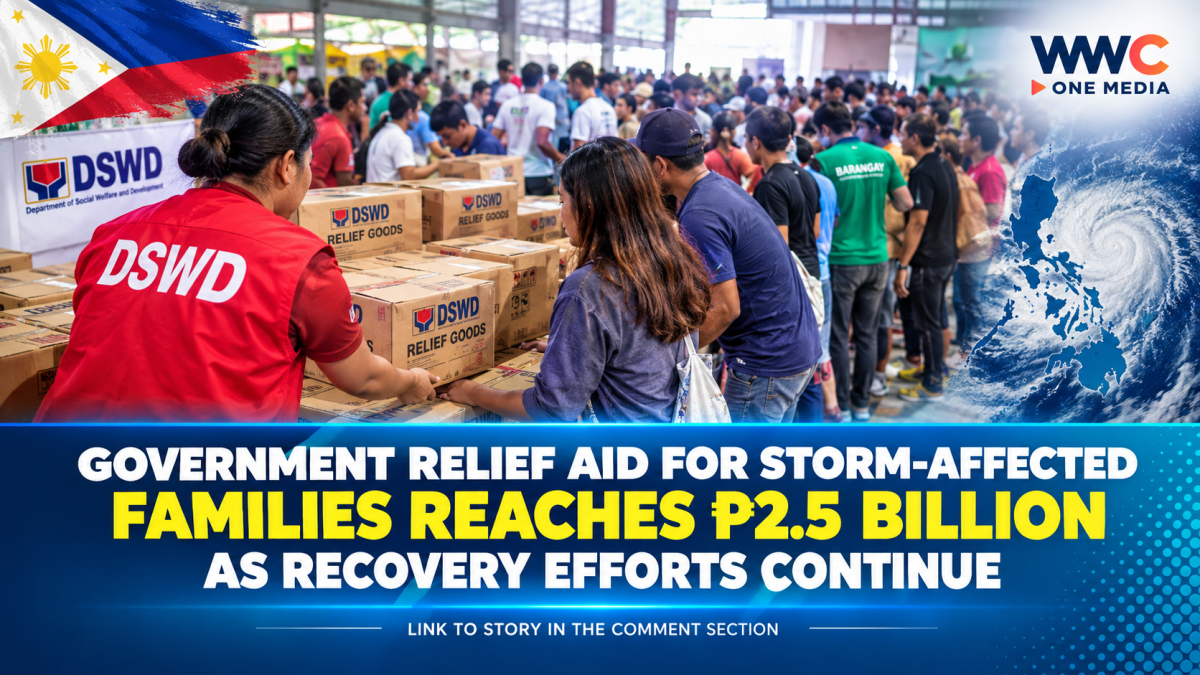
MANILA — Government assistance to families affected by recent tropical cyclones and the southwest monsoon has climbed to around ₱2.5 billion, according to the National Disaster Risk Reduction and Management Council (NDRRMC).
The latest figure highlights the scale of the ongoing disaster-response operation as authorities continue delivering food, emergency supplies and other forms of assistance to communities affected by severe weather.
The ₱2.5-billion figure represents relief assistance already provided, not the estimated total cost of damage caused by the storms.
Relief Assistance Continues to Reach Affected Communities
The assistance has included essential relief supplies such as family food packs, ready-to-eat meals, hygiene kits, sleeping kits and kitchen kits, based on previous NDRRMC updates.
On September 10, the NDRRMC reported that assistance had already reached approximately ₱2.3 billion, with nearly 1.57 million families receiving aid across several regions.
The latest increase to ₱2.5 billion indicates that relief operations have continued as authorities respond to communities still dealing with the effects of flooding, storms and the enhanced southwest monsoon.
Millions Have Been Affected by the Severe Weather
The disaster response involves a much larger population than the number of families that have directly received relief packages.
An earlier Office of Civil Defense update cited by PNA reported that around 10.4 million people, equivalent to roughly 2.97 million families, had been affected by inclement weather across thousands of villages in nine regions.
At that stage, hundreds of evacuation centers were also sheltering tens of thousands of displaced residents.
These figures help explain why relief operations require continued coordination among national agencies, local governments and other response organizations.
Food Packs Remain a Major Part of the Response
The Department of Social Welfare and Development has been one of the main agencies involved in distributing emergency assistance.
Government reporting earlier in the disaster response said millions of family food packs had been distributed to supplement the efforts of local government units.
The assistance is intended to provide immediate support while affected communities work toward restoring normal activities and recovering damaged homes and livelihoods.
Relief Aid Is Different From Disaster Damage
The amount of assistance should not be confused with the overall economic damage caused by the weather disturbances.
An earlier NDRRMC update put combined agriculture and infrastructure damage at about ₱12.4 billion. That figure measures reported losses and damage, while the ₱2.5 billion figure refers to assistance extended to affected families.
The distinction is important because government relief spending and disaster losses measure two very different aspects of the crisis.
Recovery Goes Beyond Immediate Relief
For communities hit by repeated flooding and storms, the challenges can continue long after emergency food and supplies arrive.
Families may also need to repair damaged homes, replace belongings, restore livelihoods and regain access to schools, transportation and other essential services.
Government agencies and local authorities therefore face the longer-term task of moving from emergency response toward rehabilitation and recovery.
The scale of the reported assistance also underscores the importance of coordination between national agencies and LGUs, particularly when multiple regions are affected simultaneously.
Weather Risks Remain a Concern
The Philippines remains highly exposed to tropical cyclones and monsoon-related flooding, making disaster preparedness and rapid response crucial.
The current relief operation follows a period in which several tropical weather systems combined with the southwest monsoon to produce widespread impacts.
Government agencies have continued monitoring affected areas while providing assistance based on reported needs.
For families still recovering, the immediate priority remains access to food, shelter and essential services while longer-term recovery efforts move forward.
₱2.5 Billion and Counting
The latest NDRRMC figure shows that the government’s emergency response has already reached a substantial scale.
But the ₱2.5 billion in assistance is only one part of the broader recovery effort.
With millions of people affected and billions of pesos in reported agricultural and infrastructure damage, the next challenge will be helping communities move from relief to recovery.
For families whose homes, livelihoods and communities were disrupted, that transition could determine how quickly they are able to rebuild.