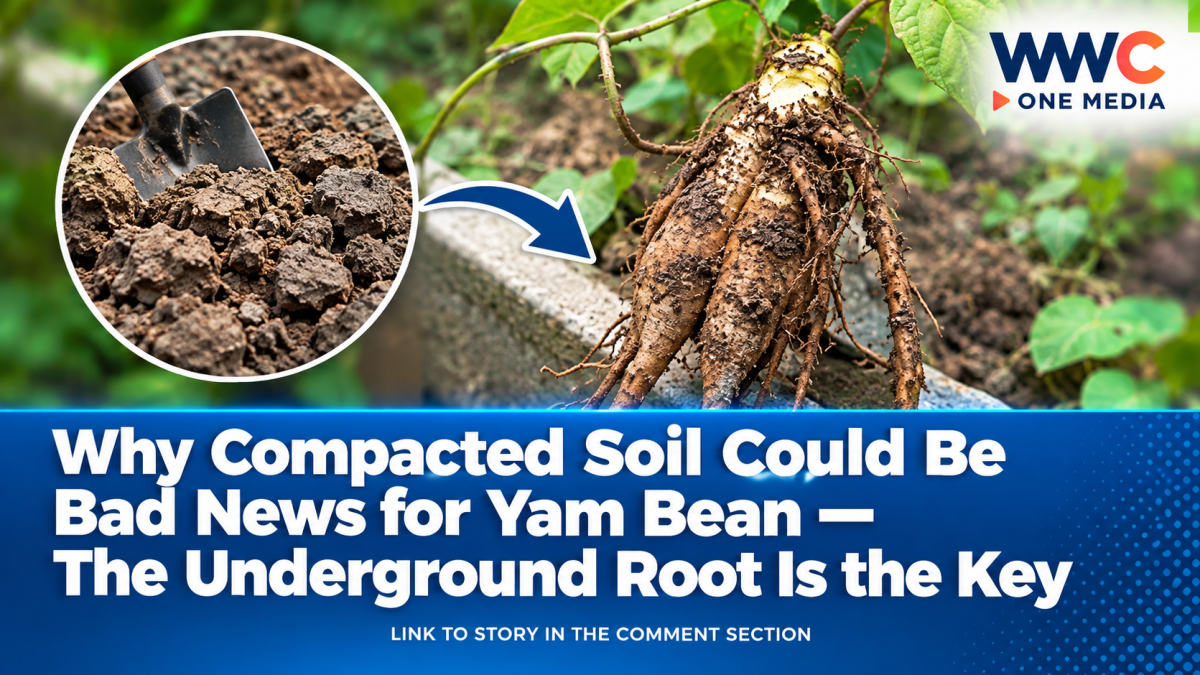
SINGAPORE — A seemingly ordinary gardening problem could have a major impact on one of Southeast Asia’s familiar root vegetables: yam bean, also known as jicama, bangkuang or sengkuang.
The crop produces its edible portion underground, meaning the condition of the soil can directly affect how successfully its storage root develops. Agricultural guidance recommends fertile, well-drained soil for yam bean, while excessive water and poor soil conditions can interfere with tuber formation.
That makes soil compaction an important issue for anyone trying to grow the crop.
Yam Bean Is More Than Just Another Bean
Despite its name, yam bean belongs to the legume family and grows as a climbing vine. Its large underground storage root is the part commonly eaten.
Singapore’s National Parks Board lists yam bean, or bangkuang, as an edible crop that can be grown as a climber. The plant is also known locally as jicama, Mexican turnip and sengkuang.
The crop generally needs considerable time to develop a sizeable tuber. NParks notes that plants grown from seed require at least 150 days to produce sizeable tubers measuring roughly 5 to 16 centimetres in diameter.
Why Soil Compaction Matters
Compacted soil has fewer usable spaces between soil particles, making it harder for roots to penetrate and for water and air to move through the soil.
That can be particularly significant for yam bean because its harvested product is a storage root that needs room to expand underground.
Agricultural guidance identifies fertile, well-drained sandy loam as particularly suitable for yam bean. The crop can also grow in loamy and clay-loam soils when drainage and organic matter are adequate. Waterlogging, however, is considered harmful to cultivation.
More broadly, soil-science guidance explains that compaction can reduce drainage and restrict the depth through which roots can grow, while reducing the air available in soil pores.
In other words, the problem is not simply whether a seed can germinate. The underground tuber needs a suitable soil environment to develop properly.
The Soil Needs to Balance Moisture and Drainage
Yam bean requires moisture, but that does not mean constantly wet soil is beneficial.
NParks recommends planting bangkuang in moist, well-draining soil and says the crop thrives in full sun.
Agricultural research similarly identifies good drainage as a key requirement and warns that waterlogging can damage yam bean cultivation. A soil pH around 6.0 to 7.0 is also cited as suitable in technical cultivation guidance.
This balance is important in tropical environments, where heavy rainfall can quickly expose weaknesses in drainage.
What Makes the Yam Bean Root Special?
Jicama is a warm-season legume cultivated primarily for its swollen storage root.
The University of California’s Postharvest Research and Extension Center describes jicama as a warm-season root crop whose mature roots can range from roughly 250 grams to 1.5 kilograms, depending on growing conditions and harvest stage.
Research literature also describes yam bean as a tropical and subtropical crop with significant potential for producing large storage roots.
That underground growth habit explains why soil quality matters so much: the part farmers ultimately harvest must develop within the soil rather than above it.
A Familiar Ingredient Across Southeast Asia
Yam bean is already deeply connected with regional food culture.
In Singapore, bangkuang is commonly associated with dishes such as rojak and popiah, according to NParks. The crisp, starchy root can also be eaten raw or cooked.
Its versatility has helped make it a familiar ingredient across tropical Asia and other parts of the world where the crop is cultivated.
But producing a good root begins long before harvest—with the conditions beneath the surface.
The Bigger Lesson: Healthy Soil Is Part of the Harvest
The yam bean story illustrates a broader agricultural principle: what happens beneath the ground can determine what eventually appears above it—or what farmers can harvest from below.
Poorly structured or compacted soil can restrict root development and interfere with water movement. By contrast, soil with suitable structure, moisture and drainage provides a better environment for underground crops.
For yam bean, that distinction is particularly important because its most valuable edible portion is hidden beneath the soil.
So while the plant may appear to be a simple climbing vine above ground, the real crop is developing underneath—and the soil has a major role in determining how well it grows.